France has two great salt coasts, one on the Atlantic and one on the Mediterranean. Here is what I know about each, and how I would use the salt in a kitchen.
Guérande, in Brittany
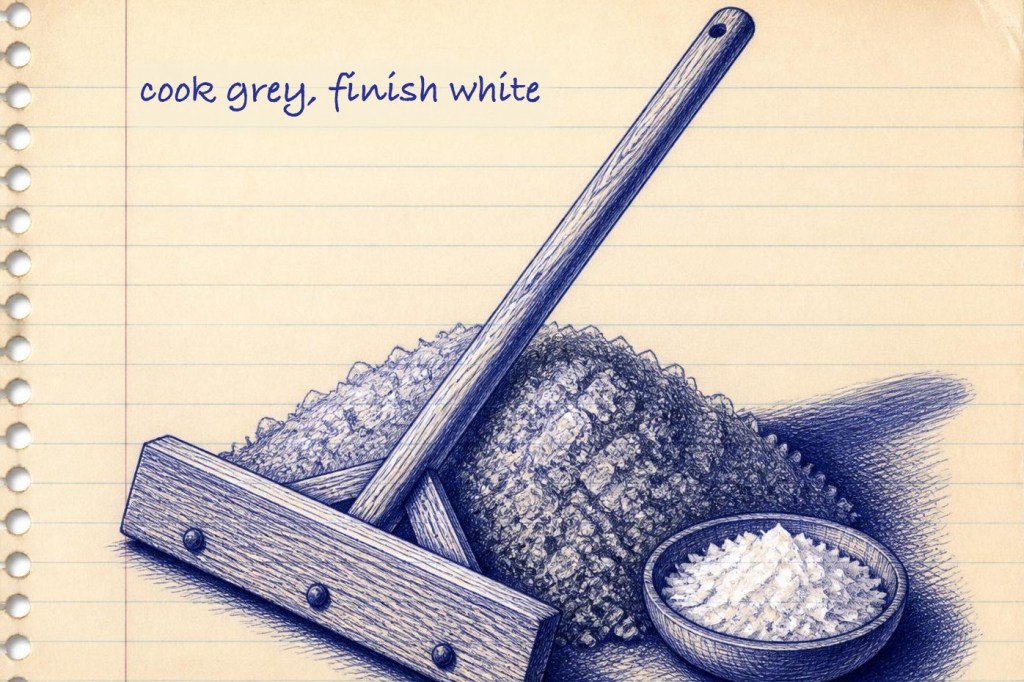
Guérande sits on the Atlantic coast of Brittany. Seawater is let into shallow clay basins and left to the sun and the wind, and the salt is gathered by hand by the paludiers, the salt workers. For the grey salt they use a long wooden rake called a lousse. Nothing is refined, nothing is washed after harvest, and nothing is added.
Two kinds come out of the same marsh:
- Gros sel gris (grey sea salt), for cooking. It forms on the bottom of the basin, in contact with the clay, and that is where its grey color comes from. It’s coarse and slightly damp, with a rounder, more mineral flavor than white salt. This is the salt for the pasta water, the braise, the stock, the roast chicken and the salt crust. Pinch it with your fingers and you quickly learn how much you are using.
- Fleur de sel (“flower of salt”), for finishing. On hot, dry, windy days, a thin, delicate crust of white crystals forms on the surface of the water, and the paludier skims it off by hand with a finer tool, careful never to touch the clay below. It’s light, crunchy and fragile, and it dissolves slowly on the tongue. Never cook with it. Use it at the very end, on a tomato, a boiled egg, a steak, buttered bread or a chocolate dessert, so the crystals are still there when you bite.
Both cost more than ordinary salt, and fleur de sel especially, because far less of it is harvested and it depends on the weather. But you use little, and a box lasts a long time. Look for Sel de Guérande or Fleur de sel de Guérande with the IGP seal, a European protected designation of origin that Guérande salt received in 2012. Some grey salt also carries the Label Rouge.
The Camargue, on the Mediterranean
The other great French salt coast is the Camargue, around Aigues-Mortes, between Marseille and Montpellier. The setting is very different: huge flat salt pans under a hot sun and a strong wind, with salt works that go back many centuries. Some of the ponds turn pink in the heat, colored by a tiny algae and by the brine shrimp that feed on it. The flamingos that come to eat the shrimp give the landscape its famous color.
The Camargue also produces fleur de sel. It is harvested by hand in the hottest part of the summer, before rain or humidity can damage the fragile crystals. I use it the same way as the Guérande one: at the end, on the plate, never to salt water and never in the pot.
How I would use them
- Cooking: a grey salt, from Guérande or similar, in the pot and the pan, and a pinch at a time so your hand learns it.
- Finishing: a little fleur de sel, from Guérande or the Camargue, on the finished dish.
- Don’t waste it: fleur de sel dissolved in a boiling pot is money down the drain.
If you can’t find French salt, use kosher salt for cooking and any flaky sea salt to finish. Brands differ a lot in how salty a spoonful is, so pick one and stay with it.
I wrote about salting itself, when and how much, in The Kilo of Salt I Lost on My First Day.

Leave a Reply