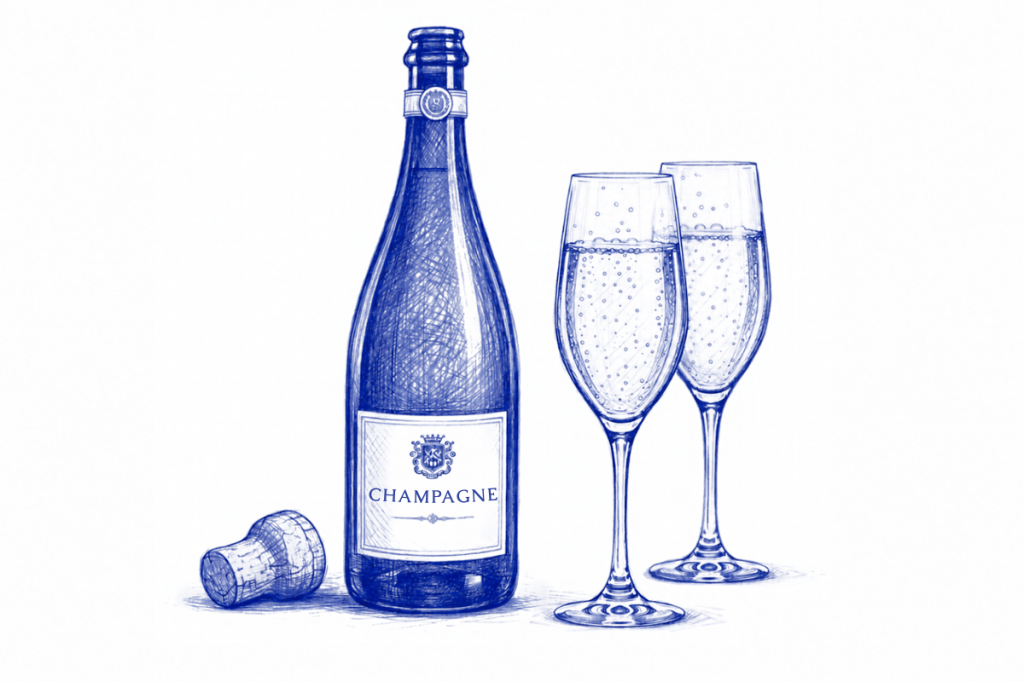
A bottle of sparkling wine is the one item on the table that can go wrong in front of everyone. It can foam over, pop like a firecracker, or arrive warm and flat. None of that takes talent to avoid. It takes a few habits that every professional dining room teaches on the first week, and they cost nothing. Here is how to chill, open and pour sparkling wine so the first glass is a good one.
Start with temperature
Sparkling wine is best cold, but not freezing. A common target is roughly 6 to 8°C (43 to 47°F) for most non-vintage bottles, and a little warmer for richer, more complex bottles, where too much cold hides the aroma. Cold also keeps the carbon dioxide dissolved, which makes the bottle safer and calmer to open.
- In the refrigerator: at least 3 to 4 hours, or overnight, laid on its side or standing.
- In an ice bucket: fill it with half ice and half cold water, add a handful of salt if you have it, and leave the bottle for 20 to 30 minutes. Ice alone chills far more slowly than ice with water.
- The freezer: only as an emergency, for 15 to 20 minutes at most, and set a timer. A forgotten bottle can freeze and push out the cork.
Avoid shaking the bottle on the way to the table. Even a carried bottle needs a few minutes standing still before you open it.
Why the bottle is under pressure
A bottle of Champagne holds about six atmospheres of pressure, roughly what you find in a truck tire. That is the reason for the thick glass, the wire cage and the care. It also means the rule is simple: the cork must never be pointed at a person, a window or a light fixture, and you control the cork the entire time.
How to open it, step by step
- Dry the bottle. A wet, cold bottle slips. Wrap it in a clean napkin.
- Remove the foil from the top, all the way down to the wire.
- Loosen the cage. Untwist the wire loop about six half turns. Keep your thumb over the cork from this moment on. Leave the cage on the cork; it gives you a better grip.
- Tilt the bottle to about 45 degrees, pointed away from everyone.
- Turn the bottle, not the cork. Hold the cork and cage firmly in one hand and rotate the base slowly with the other. Turning the bottle gives you much more control.
- Ease it out. As you feel the cork push up, resist it with your hand. The goal is a soft sigh, not a bang. A loud pop wastes carbonation and, in a dining room, is not considered good service.
- Hold the angle for a few seconds after the cork is out, then set the bottle upright.
If the cork will not move, do not force it with a knife or your teeth. Run a little cool water over the neck, dry it, and try again with the napkin for extra grip. If the cork breaks, use a corkscrew carefully, again at an angle, with the bottle pointed away from you.
Pouring without a foam disaster
- Use a clean, dry glass. Detergent residue and lint flatten bubbles. Rinse glasses well and dry them.
- Pour in two stages. A small amount first, let the foam settle, then fill to about two thirds.
- Tilt the glass slightly and let the wine run down the side, like pouring a beer.
- Hold the bottle by the base or by the punt, the dent underneath, if you want to look polished. A napkin in the other hand catches drips.
- Never fill to the brim. The bubbles and aromas need space.
Which glass
The old wide coupe looks festive but lets the bubbles and the aroma disappear quickly. A narrow flute keeps the bubbles lively but can feel closed in. Many professionals now prefer a tulip glass or an all-purpose white wine glass, which gives the aroma room while still holding the sparkle. If all you have is flutes, use them. A clean glass of any shape beats a fancy glass that is dusty from the cupboard.
Serving at a table
- Pour for the guest of honor or the eldest first, then go around, finishing with the host.
- Wrap the bottle in a napkin and keep it cold between pours: an ice bucket on the table works well.
- Open sparkling wine at the table only if you are comfortable; otherwise open it in the kitchen and bring it out.
Storing leftover sparkling wine
Once opened, sparkling wine loses its bubbles quickly. A proper sparkling-wine stopper that clamps onto the bottle neck can keep a bottle reasonably lively in the refrigerator for a day or so. The old trick of a spoon in the neck does not work. For a festive table, the better plan is to open the amount you will finish.
The short version
- Chill it well, 3 to 4 hours in the refrigerator or 20 to 30 minutes in ice and water.
- Keep your thumb on the cork once the wire is loosened.
- Turn the bottle, not the cork, and aim for a sigh instead of a pop.
- Pour in two stages into a clean glass, tilted.
- Always point the bottle away from people.
For a menu that sparkling wine fits naturally, see my holiday menu in A French Chef’s Thanksgiving. Serving temperatures and pressure figures here are standard industry guidance; bottles and rooms vary, so trust your hands and your senses.

Leave a Reply