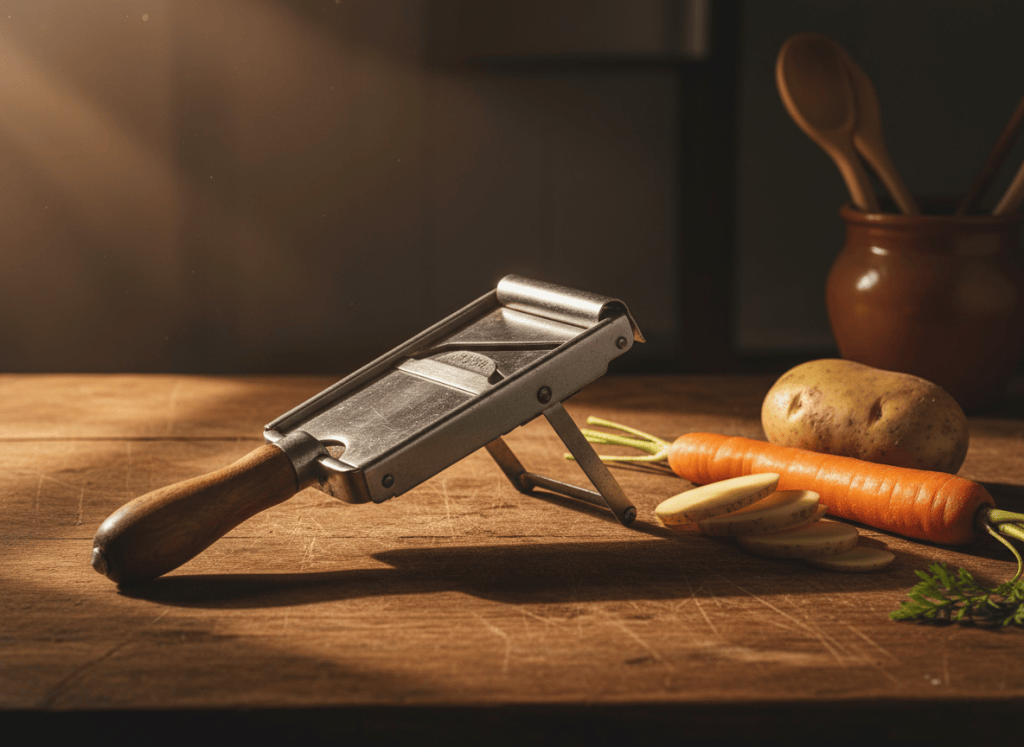
Mandolines and vegetable slicers exist for one reason: consistency. A professional cook can produce paper-thin, perfectly even slices with a knife alone, but it takes years to get there. These tools compress that skill gap — scalloped potatoes, coleslaw, garnishes, spiralized vegetables, all with a precision that’s hard to match by hand, regardless of experience.
They’re not all the same tool, though. Depending on the cut you’re after, you want a genuinely different piece of equipment. Here’s how the three main categories break down.
Mandoline Slicers: For Even, Adjustable Slices
A true mandoline slicer duplicates knife skills that take professional cooks years to master. De Buyer’s Kobra Slicer is a good example of the category done right: a V-shaped micro-serrated blade that cuts vegetables, fruits, and soft foods — cooked beets, ripe tomatoes, ripe pears — with equal efficiency, something a straight blade struggles with. It slices from paper-thin up to 3/16″ thick, adjustable via an in-handle thumb wheel, with an ergonomic pusher that keeps your fingers well clear of the blade.
This is the tool for scalloped potatoes, gratins, uniform salad and slaw prep, or any dish where even thickness actually matters to the final texture.
Spiral Slicers: For Long, Continuous Strands
A different job entirely: turning a vegetable into long, spaghetti-like strands or delicate thin curls for garnish or vegetable-noodle preparations. These tools use rotating stainless steel blades — typically a set of interchangeable blades at a few different thicknesses — mounted in a sturdy frame, with the vegetable spun against the blade by hand crank.
Good for zucchini noodles, carrot and daikon garnishes, or decorative vegetable nests — not a mandoline replacement, a completely different cut entirely.
Turning Slicers: The Real Japanese Technique
This is the category most home cooks have never encountered. A tabletop turning slicer — the kind used to produce true continuous sheets, fish-net cuts, and long julienne strips — is a genuinely specialized machine, hand-operated, that rotates a whole vegetable against a fixed blade to peel it into one unbroken ribbon. Done well, it can produce vegetable lasagna sheets, fried vegetable nests, or decorative fish-net garnishes that are simply not achievable by hand, mandoline, or spiralizer.
It’s a genuine specialty tool — not something every home kitchen needs, but if you’ve ever wondered how a restaurant produces a perfect continuous vegetable ribbon or a decorative lattice garnish, this is the machine behind it.
Which One Do You Actually Need?
- Scalloped potatoes, gratins, even slaw: a mandoline slicer
- Vegetable noodles, garnish curls, spiralized strands: a spiral slicer
- Continuous sheets, fish-net cuts, restaurant-style garnish work: a turning slicer
Most home cooks only need the first — a mandoline covers the overwhelming majority of real kitchen use. The other two are worth it once you know exactly why you want them, not before.
A Word on Safety
Every mandoline and slicer on this list is genuinely sharp, and the injuries that come from them are some of the most common in both home and professional kitchens — always because someone got impatient near the end of the vegetable and skipped the guard. Use the pusher every time, all the way through, no exceptions, no matter how experienced you are.
For more on keeping your primary knife skills sharp alongside these tools, see the chef’s knife guide.
As an Amazon Associate, I earn from qualifying purchases.
 The Seasoned Bench
Leave a comment