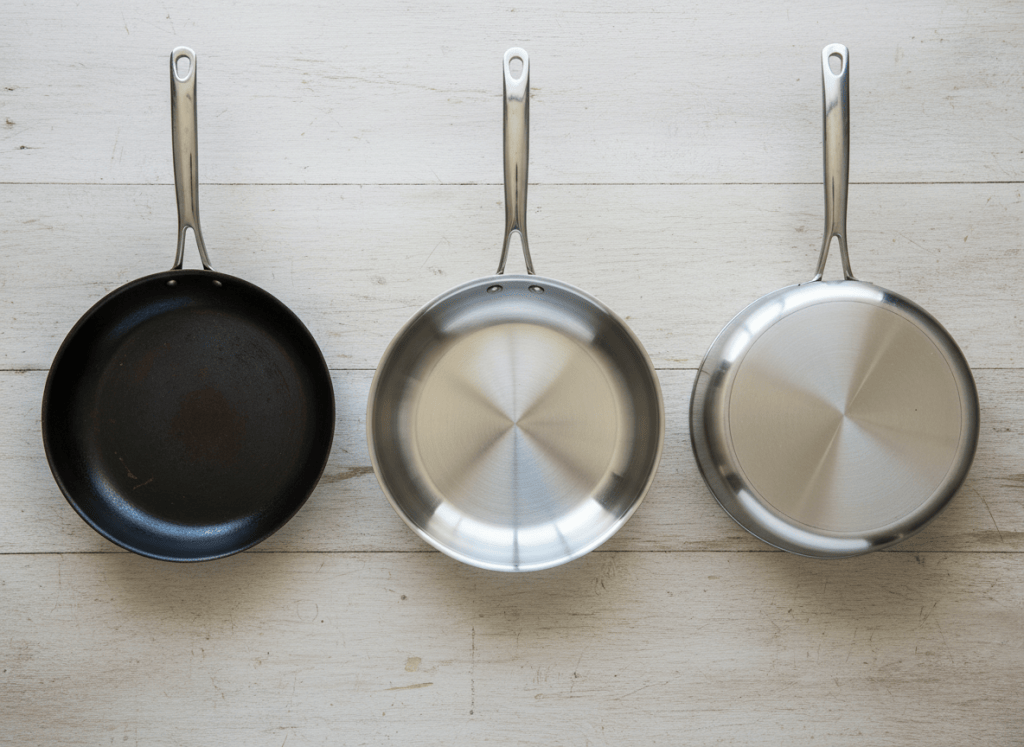
Ask five cooks what the best sauté pan is and you’ll get five different answers, because the honest truth is that “best” depends entirely on what philosophy of cooking you’re buying into. De Buyer, All-Clad, and Hestan ProBond aren’t really competing on quality — they’re built on three different ideas about what a pan should be.
I’ve cooked on all three for years, professionally and at home. Here’s how they actually differ, and which one I’d put in your hands depending on how you cook.
The Quick Answer
| If you want… | Buy this |
|---|---|
| A pan that sears like nothing else and gets better with age | De Buyer Mineral B |
| A no-maintenance workhorse that goes straight in the dishwasher | All-Clad D3 |
| All-Clad’s performance with a more refined finish | Hestan ProBond |
Comparison Table
| Feature | De Buyer Mineral B | All-Clad D3 | Hestan ProBond |
|---|---|---|---|
| Material | 100% carbon steel (mineral iron) | 3-ply: aluminum core, stainless exterior | 3-ply: aluminum core, stainless exterior |
| Surface | Bare metal, beeswax-treated, develops seasoning | 18/10 stainless, no seasoning | Stainless, brushed finish with polished band |
| Oven-safe | 400°F, 10 min (epoxy handle limit) | 500°F | 500°F |
| Dishwasher-safe | No — hand wash, dry, oil | Yes | Yes |
| Maintenance | Regular seasoning required | None | None |
| Weight (comparable size) | ~6 lbs | Moderate | Moderate |
| Induction compatible | Yes | Yes | Yes |
De Buyer Mineral B: A Pan Close to My Heart
Carbon steel is the closest thing to cast iron that still feels nimble in the hand. De Buyer’s Mineral B line is bare mineral iron finished with a beeswax coating — no non-stick coating, no gimmicks. It sears meat and vegetables better than either stainless option here, full stop, because bare metal at high heat simply browns food more aggressively.
These pans hold a special place in my kitchen, and honestly, in my heart. When I helped build the culinary sciences program in Macau, De Buyer sponsored the kitchens we trained in — every station outfitted with their pans. Hundreds of students learned to cook on that same Mineral B carbon steel, many of them touching a raw metal pan for the first time in their lives. I’ve kept one from those years, and every time I reach for it at home, I think about that classroom.
The tradeoff is real maintenance: hand wash only, dry it immediately, and give it a light coat of oil after each use. Skip that routine and it will rust. The handle is also epoxy-coated, which caps oven use at 400°F for just 10 minutes — a real limitation if you’re finishing dishes under a broiler or in a hot oven.
This is the pan for someone who wants the best possible sear and doesn’t mind treating a pan like a living object that needs care.
All-Clad D3: The Workhorse
All-Clad’s D3 line is the standard against which most tri-ply stainless cookware gets measured. Three bonded layers — stainless, aluminum, stainless — give you fast, even heat without any of the maintenance carbon steel demands. Dishwasher-safe, oven-safe to 500°F, no seasoning, no babying.
What you give up compared to carbon steel is that extra edge of searing performance — stainless simply doesn’t get quite as hot at the surface, and food is more prone to sticking until you’ve built real technique with fat and heat control. But for anyone who wants excellent, reliable performance without a maintenance routine, this is the safer everyday choice.
Hestan ProBond: The Refined Alternative
Hestan ProBond uses the same 3-ply construction as All-Clad D3 — aluminum core, bonded stainless exterior — so functionally, expect near-identical cooking performance. Where it distinguishes itself is finish and feel: a brushed stainless body with a polished band near the rim, giving it a slightly more refined look on the stovetop.
If the two pans cook essentially the same, the decision comes down to what you’re willing to pay for the finish and brand positioning. I wouldn’t buy ProBond over D3 purely for performance reasons — but if you’re building a kitchen where the cookware is also on display, it’s a legitimate reason to prefer it.
My Honest Verdict
If I could only keep one, it would be the All-Clad D3 — it’s the most versatile, forgiving choice for the widest range of home cooks, and the lack of maintenance means it actually gets used instead of babied. But the De Buyer earns a permanent spot in my kitchen for one job specifically: searing. Nothing else in this comparison browns a steak or a piece of fish quite the same way.
The Hestan ProBond is a fine pan, but in this specific comparison, it’s really a question of whether the finish is worth the premium to you — not a meaningful performance gap.
FAQ
Is carbon steel better than stainless steel for searing?
Generally yes — bare carbon steel gets hotter at the surface and browns food more aggressively than stainless, which is why professional kitchens lean on it for high-heat searing work.
Can I put De Buyer carbon steel in the dishwasher?
No. Hand wash, dry immediately, and apply a light coat of oil to prevent rust. This is the main tradeoff for the searing performance carbon steel offers.
What’s the real difference between All-Clad D3 and Hestan ProBond?
Both use the same 3-ply aluminum-core stainless construction and perform similarly. The meaningful difference is finish and price positioning, not cooking performance.
Related Guides
As an Amazon Associate, I earn from qualifying purchases.
 The Seasoned Bench
Leave a comment