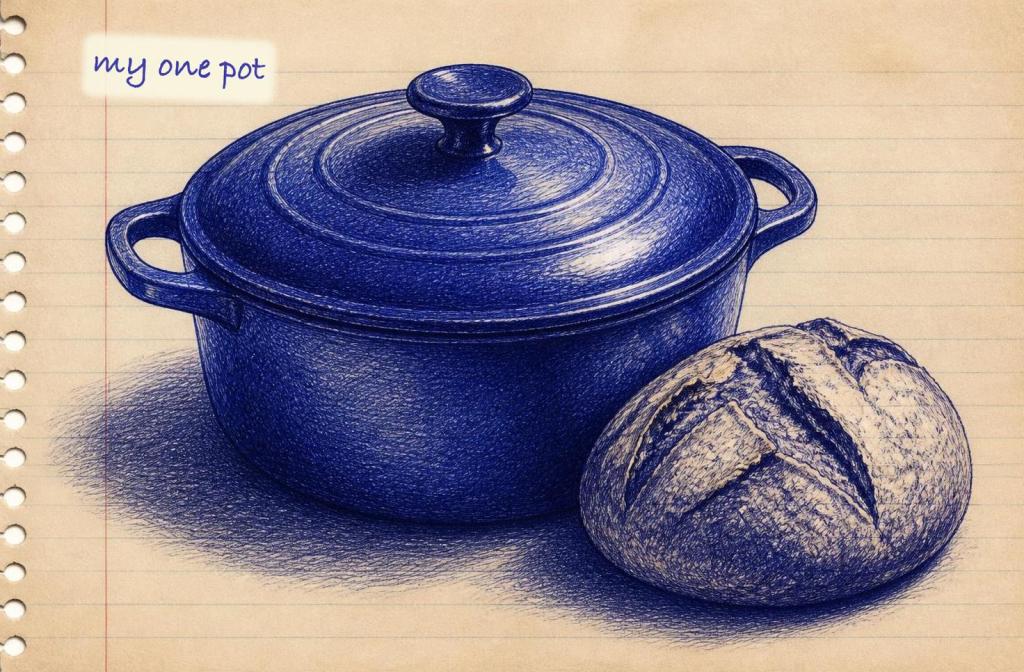
If a kitchen fire ever forced me to grab exactly one piece of cookware on my way out, it wouldn’t be a knife, and it wouldn’t be a sauté pan. It would be my Dutch oven — a heavy, enameled cast iron cocotte that’s done more work in my kitchens over the years than almost anything else I own.
People tend to think of a Dutch oven as a single-purpose pot — something you pull out twice a year for a stew. That’s a mistake. It’s closer to seven tools in one.
What it actually replaces
- Braising — short ribs, pork shoulder, lamb shanks, anything that needs low and slow until it falls apart
- Stewing and soups — deep enough for stock, chili, broth, anything that needs real volume
- Roasting — goes straight from stovetop to oven, which makes a whole chicken or a pot roast almost foolproof
- Bread — the no-knead artisan method depends entirely on a heavy lidded pot trapping steam for that crackling crust
- Frying — the thick walls hold oil temperature steady in a way a thin pan never will
- Searing and sautéing — wide bottom, even heat, no hot spots
- Slow simmering — cast iron holds heat for hours, which is exactly what a good ragù, curry, or tagine wants
That’s most of a kitchen’s workload, in one pot.
Why the material matters
Enameled cast iron isn’t a style choice — it’s a functional one. The cast iron core holds and distributes heat evenly, so you don’t get the scorched spots you’d see in a thin stainless pot. The enamel coating means you’re not seasoning it like a bare cast iron skillet, and it won’t react with acidic things like tomato sauce or wine, which a lot of home cooks don’t realize is actually a problem with raw cast iron.
The one I use
Staub’s 7-quart Round Cocotte is the size that makes sense for most kitchens — big enough for a whole braise or a full pot of soup for a family, not so big it’s awkward to lift and clean. Staub is French-made, and it shows in the fit and finish — the lid seals tightly enough to actually trap steam properly, which matters more than people expect until they try baking bread in a cheaper knockoff and the crust doesn’t come out right.
It’s not cheap. But this is exactly the kind of purchase where cheap costs you twice — a poorly made version chips, warps, or just doesn’t hold heat the way it should, and you end up buying the good one eventually anyway.
If you’re trying to decide between Staub and its biggest rival, I put both through 40 years of use — full verdict in Le Creuset vs Staub: A 40-Year Chef’s Honest Verdict.
The whole reason a Dutch oven gets this kind of devotion from me — why the tool matters more than the recipe — is worth reading if this is your first visit here.
This post contains an affiliate link. If you buy through it, I earn a small commission at no extra cost to you.

Leave a Reply