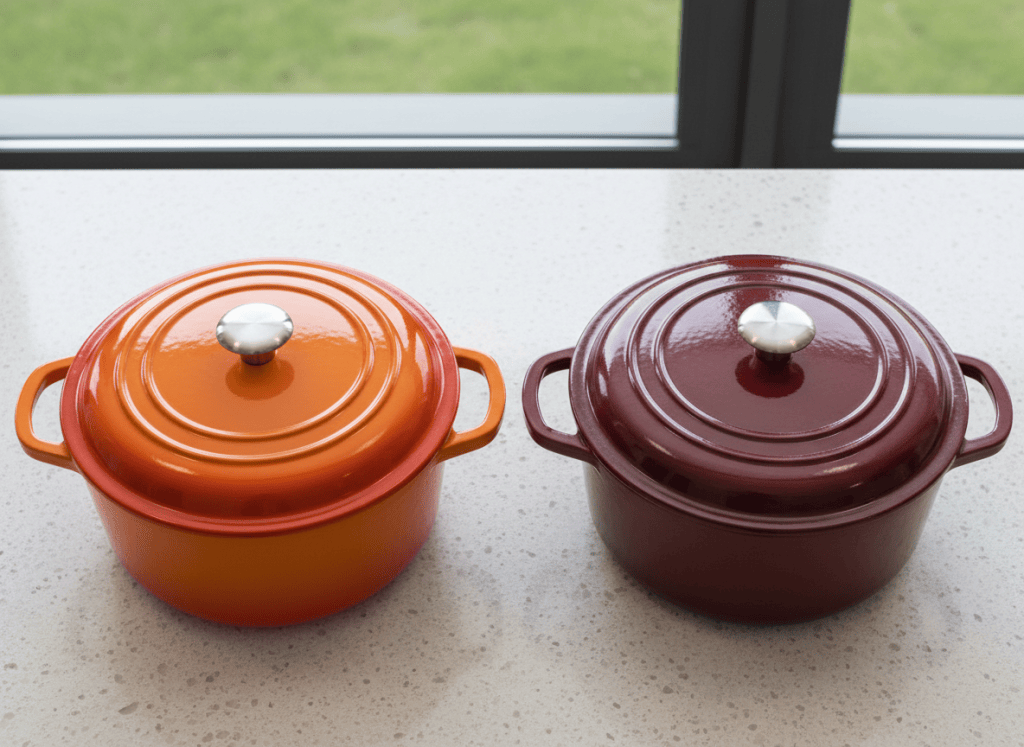
Here’s the question I get more than any other about cookware: “Jean, I’m ready to buy a real Dutch oven. Le Creuset or Staub?”
The person asking has usually already done their research. They know both are French. They know both are enameled cast iron. They know both cost roughly the same — somewhere between $300 and $450 depending on size and color. And they’re stuck.
So let me un-stick you. After four decades of cooking professionally — with both of these pots in my kitchens and my home — here’s my honest, detailed breakdown of Le Creuset vs Staub. I’ll tell you where each one wins, where each one loses, and exactly which one I’d put in your kitchen depending on how you cook.
The Quick Answer
| If you want… | Buy this |
|---|---|
| The lighter, easier-to-handle pot that’s easier to monitor while cooking | Le Creuset |
| The heavier pot with better browning and a truly self-basting lid | Staub |
| The one I reach for most at home | Staub — by a nose |
Now let’s dig into why.
Quick Comparison Table
| Feature | Le Creuset | Staub |
|---|---|---|
| Founded | 1925, Fresnoy-le-Grand, France | 1974, Alsace, France |
| Interior | Smooth, light cream enamel | Textured, matte black enamel |
| Lid | Flat interior, phenolic (plastic) knob | Spiked “self-basting” interior, brass or nickel knob |
| Weight (5.5 qt) | ~11.5 lb with lid | ~13 lb with lid |
| Exterior finish | High-gloss enamel | Matte or semi-matte enamel |
| Color range | 20+ colors, seasonal releases | ~10-16 colors, darker earthy palette |
| Oven-safe | 500°F (knob limit) | 500°F+ (metal knob) |
| Handles | Wide, looped — easy to grip | Smaller, more compact |
| Price (5.5 qt round) | ~$370–450 | ~$350–420 |
| Warranty | Lifetime | Lifetime |
| Made in | France | France |
Prices are approximate and fluctuate with sales — both brands run 30–40% off during Prime Day and seasonal events.
The Two Houses of French Cast Iron
Le Creuset: The Icon (Since 1925)
Le Creuset is the elder statesman. Founded in 1925 in Fresnoy-le-Grand in northern France, the company practically invented colorful enameled cast iron. Their signature Volcanique (orange) flame color has been in continuous production since the beginning — it’s one of the most recognizable pots in the world.
Le Creuset parlayed that icon status into a full kitchenware empire: bakeware, stoneware, utensils, kettles, even pet bowls. But the Dutch oven remains the heart of the brand.
Staub: The Challenger (Since 1974)
Staub was founded in 1974 in Alsace — the other end of France, and historically the other end of French cooking culture. Alsace is baeckeoffe and choucroute country: slow, hearty, wine-braised peasant food. (My own favorite dish, baeckeoffe, is Alsatian — you can see where my affection for this region began.)
Staub stayed focused where Le Creuset expanded. The collection is more curated, the aesthetic is darker and moodier, and the design philosophy is unapologetically about performance: the black matte interior, the self-basting lid, the heavier build.
Head-to-Head: The Differences That Actually Matter
1. The Interior: Light vs Dark
This is the biggest functional difference between the two pots. Le Creuset uses a smooth, light cream-colored enamel interior. Staub uses a textured, matte black enamel interior.
| Le Creuset (light) | Staub (black) | |
|---|---|---|
| Monitoring your cook | You can see fond development and browning clearly | Dark interior hides the fond |
| Hiding wear | Stains, crazing, and scratches show over time | Scuffs and discoloration nearly invisible |
| Browning performance | Good | Slightly better — the textured surface and dark finish excel at developing crust |
| Cleaning | Smooth surface scrubs clean easily | Rougher texture takes a bit more scrubbing |
My take as a chef: The light interior of the Le Creuset is genuinely useful when you’re learning. Seeing the fond — those browned bits that form on the bottom of the pot — is how you know when to deglaze. In the Staub, you’re cooking partly by sound and smell.
But the Staub’s black interior is more forgiving over a lifetime. Twenty years of cooking leaves marks on a Le Creuset’s interior. A Staub looks nearly the same at year twenty as it did at week one.
2. The Lid: Staub’s Secret Weapon
This is where Staub earns its reputation. Staub’s lid has spikes on the underside — small projections that catch rising steam, condense it, and drip it evenly back down over the food. It’s a genuine self-basting system.
Le Creuset’s lid is smooth on the underside. Steam condenses on it and drips from wherever it happens to pool — mostly the edges.
Does it matter? In my own kitchen testing, braises come out marginally more moist and evenly glazed in the Staub. It’s not a night-and-day difference. But it’s real, and it’s the feature Staub owners always mention first.
3. Weight: Le Creuset Is Noticeably Lighter
A Staub weighs about a pound to a pound and a half more than the equivalent Le Creuset. That doesn’t sound like much until you’re pulling a full pot — seven quarts of short ribs plus the pot itself — out of a 350-degree oven. Then it’s the difference between confident and careful.
If strength or wrist issues are a factor, this alone justifies the Le Creuset — it’s noticeably easier to lift in and out of the oven.
4. The Knob: A Small Detail With Real Consequences
Le Creuset’s standard knob is phenolic resin — essentially a heat-resistant plastic. It limits the pot to 500°F in the oven. (You can swap in a stainless knob, sold separately.)
Staub’s standard knob is brass or nickel — solid metal. No heat limitation beyond the enamel itself.
For bread bakers who push 500°F+, this matters. For everyone else, it’s a footnote.
5. Durability: The Staub Is the Tougher Pot
Both carry lifetime warranties and both are made in their own French factories with a strong reputation for quality control — you’re not getting a lemon from either.
But in my experience, the Staub handles metal utensils, high heat, and aggressive cleaning better over the long run. The black matte enamel is simply harder to damage visibly — and when it does mark, you can’t see it.
The Le Creuset’s light interior will develop staining and fine crazing over years of use. It’s cosmetic, not functional — but if a pristine pot matters to you, know this going in. (Le Creuset sells a cleaner that removes most of it.)
6. Aesthetics: Two Different French Personalities
Neither is “better looking” — they’re different characters.
| Le Creuset | Staub | |
|---|---|---|
| Style | French country — polished, glossy, bright | French bistro — heavier, matte, moody |
| Colors | 20+ including seasonal and limited editions | ~10-16, focused on earthy tones (grenadine, graphite, forest green, basil) |
| On your stove | A statement piece | A quiet workhorse |
I’ve always thought of it this way: Le Creuset is French country, Staub is French bistro. They look like they’re from the same family — cousins, not twins.
7. Price: Staub Is Slightly Cheaper
Comparing the same size, Staub typically runs $20–50 less than Le Creuset. Both go on deep sale — Amazon Prime Day, Black Friday, and seasonal sales knock 30–40% off both brands regularly. Never pay full price for either.
How I Tested (And How I’ve Cooked With Both for Decades)
This isn’t a lab test. It’s 40 years of professional use, distilled. I’ve run both pots through the same dishes hundreds of times: baeckeoffe, beef bourguignon, coq au vin, no-knead bread, weeknight braises, Sunday ragùs. Here’s my scoring across the criteria that matter:
| Criterion | Winner | Margin |
|---|---|---|
| Browning & searing | Staub | Small but consistent |
| Moisture retention (braises) | Staub | Small — the spiked lid works |
| Heat retention | Staub | Noticeable |
| Handling & weight | Le Creuset | Clear win |
| Visibility while cooking | Le Creuset | Clear win |
| Ease of cleaning | Le Creuset | Modest win |
| Long-term wear tolerance | Staub | Clear win |
| Oven temp flexibility | Staub | Metal knob |
| Color & finish options | Le Creuset | Clear win |
| Price | Staub | Modest win |
That’s 5–5 on paper — which is exactly why this debate never dies. The tiebreaker is how you cook, not which pot is “best.”
The Verdict: Which One Should You Buy?
Buy the Le Creuset if:
- You’re newer to braising — the light interior lets you see what’s happening
- Weight matters — bad wrists, smaller build, or you just don’t want 13 pounds
- You want the color — 20+ options, and yes, the Volcanique orange is iconic for a reason
- You’re building a matching kitchen collection — Le Creuset’s ecosystem (skillets, braisers, saucepans, stoneware) is unmatched
- Easy cleaning matters to you — the smooth interior wipes clean
Check Le Creuset price on Amazon →
Buy the Staub if:
- Browning and braising are your religion — the black interior sears better and the self-basting lid keeps braises moister
- You cook bread — metal knob, no 500°F ceiling, and the spikes protect the crust from condensation drips
- You cook dark, hearty dishes — beef stew, coq au vin, baeckeoffe, chili — the black interior shows no wear
- You’re rough on your cookware — metal utensils, high heat, aggressive scrubbing — the Staub shrugs it off
- You want maximum performance per dollar — slightly cheaper, slightly tougher
What I Own Personally
Both. Of course both — I’m a chef, and rationalizing cookware purchases is part of the job description.
But if you held a gun to my head and made me keep one? The Staub. The browning advantage and the self-basting lid are performance features, and after 40 years, I choose performance. My Staub has made more baeckeoffe than I can count — there’s a certain rightness to an Alsatian pot cooking an Alsatian dish.
The Le Creuset is the one I hand to guests who want to help in my kitchen. It’s friendlier. The Staub is the one I reach for when it matters.
FAQ
Is Staub better quality than Le Creuset?
Both are exceptional, made in France, with lifetime warranties. Staub’s black matte enamel is more durable and damage-tolerant; Le Creuset’s light enamel is more informative and easier to clean. Most independent reviewers rate them nearly equal, giving Staub a slight performance edge.
Why is Staub cheaper than Le Creuset?
Brand positioning, mostly. Le Creuset’s iconic status and color range command a premium. Staub prices aggressively to win converts. The quality gap doesn’t explain the price gap — there isn’t one.
Can Le Creuset go in the oven at 500 degrees?
Yes, but the standard phenolic (plastic) knob is rated to 500°F — that’s the limiting factor, not the pot. If you bake bread at higher temps, swap in Le Creuset’s stainless steel knob (sold separately, ~$10–15) or choose the Staub, whose brass or nickel knob has no such limit.
Does the Staub self-basting lid really work?
Yes, modestly. The spikes on the lid’s underside condense steam and drip it evenly back over the food instead of pooling at the edges. In side-by-side braises, results in the Staub come out slightly more moist and evenly glazed. It’s a genuine advantage, not just marketing — but it won’t rescue a bad braise.
Which Dutch oven is best for bread baking?
Staub. The metal knob removes the temperature ceiling, the dark interior absorbs heat for a better oven spring, and the spiked lid distributes condensation away from the developing crust.
Can I use metal utensils on Le Creuset or Staub?
Staub: yes, the black matte interior tolerates metal utensils well. Le Creuset: avoid metal on the light enamel — use wood or silicone. Both brands recommend silicone or wood for longest life.
What size Dutch oven should I buy?
For most home cooks: 5.5 to 6.5 quarts. That handles a whole chicken, a braise for 4–6 people, or a no-knead loaf. For couples: 4–5 quarts. For families and entertaining: 7–8 quarts.
Related Guides
- Best Chef’s Knife for Home Cooks — the other tool worth spending real money on
- Baeckeoffe: The Alsatian Stew Baked in a Baker’s Oven — the recipe that explains why I love Staub
Disclosure: This post contains affiliate links. If you purchase through these links, I may earn a small commission at no additional cost to you. I own and use both of these pots — my opinions are not for sale.
 The Seasoned Bench
Leave a comment