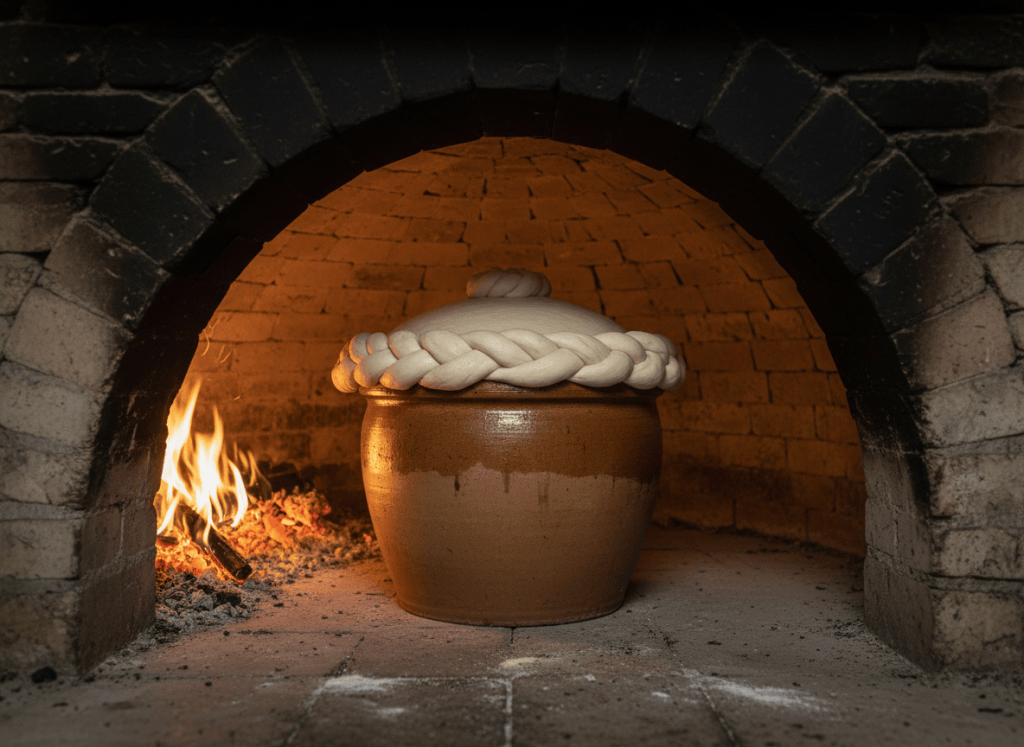
An Alsatian classic — three meats, potatoes, and white wine, slow-baked under a pastry seal.
The Story
Baeckeoffe is, far and away, my favorite traditional Alsatian dish. In the local dialect, baeckeoffe means “baker’s oven” — and that name tells the whole story of this oven-baked meat and potato stew that Alsatians have served for Monday lunch for centuries.
The ritual went like this: on Sunday, the women of the house would prepare the stew in a special earthenware crock. On Monday morning, on their way down to the river to wash the family’s clothes, they would drop the crock off with the village baker. The baker would seal the crock with leftover bread dough and set it in his wood-burning oven to slowly cook in the residual heat as it cooled after the morning’s bread baking. Hours later, on their way home with the clean wash, the women would collect their crocks — along with a fresh loaf of bread to serve alongside.
The result is a dish of remarkable depth: three meats braised until spoon-tender in Riesling, layered with potatoes that melt into the cooking liquid. It is peasant cooking at its absolute finest.
These days I make it in the pot I wrote about in The One Pot I’d Keep If I Could Only Keep One — a Staub 7-quart Round Cocotte. No earthenware tureen or village baker required, though I like to think the dish doesn’t mind the substitution.
Ingredients (Serves 8–10)
Marinade
| Quantity | Ingredient |
|---|---|
| 2 | onions, minced |
| 2 small | leeks, white and tender green parts, julienned |
| 1 | carrot, cut into ⅛-inch thick slices |
| 2–3 | cloves garlic, finely minced |
| 2 | bay leaves |
| 1 teaspoon | juniper berries |
| 1 | sprig fresh thyme |
| 3 tablespoons | fresh parsley, finely minced |
| 3 cups | dry white wine (Alsatian Riesling) |
| — | salt and pepper to taste |
Meats
| Quantity | Ingredient |
|---|---|
| 1 pound | beef chuck roast, cut into 1¼-inch cubes |
| 1 pound | boneless pork butt, trimmed, cut into 1¼-inch cubes |
| 1 pound | boneless lamb shoulder, trimmed, cut into 1¼-inch cubes |
| 1 pound | pig’s feet (optional) |
| 3 pounds | Yukon Gold or other yellow potatoes, peeled, cut into ⅛-inch thick slices |
| — | salt and pepper to taste |
Pastry Seal
| Quantity | Ingredient |
|---|---|
| ¾ cup | flour |
| 5 tablespoons | water |
| 1 tablespoon | canola oil |
Method
1. Marinate (the day before)
Place all the marinade ingredients in a non-reactive bowl. Add the meats and toss gently to combine. Cover and refrigerate overnight.
2. Preheat
Preheat the oven to 350°F.
3. Layer the tureen
Season the potato slices with salt and pepper. Lightly oil a large earthenware tureen or ovenproof casserole.
Build the layers in this order:
- Bottom: half the potato slices
- Middle: the mixed meats
- Over the meats: the marinated vegetables
- Top: the remaining potato slices
Pour the reserved marinade over the top. Add enough additional white wine or water to just cover the potatoes.
4. Seal with pastry
Mix the flour, water, and canola oil into a smooth dough. Roll it into a rope long enough to wrap around the rim of the tureen. Press the dough onto the rim, set the lid on top, and press firmly to seal completely — this seal is what prevents the cooking liquid from evaporating.
5. Bake
Bake for about 3½ hours.
Bring the tureen to the table whole. Break the pastry seal by cutting under the lid, remove the lid, and serve the baeckeoffe directly from the tureen onto warm plates.
Chef’s Notes
- Plan ahead: Allow at least 12 hours — preferably overnight — for marinating, plus about 30 minutes of active preparation.
- The vessel matters: The tureen or casserole should be large and wide, and it must have a small hole or vent in the lid so steam can escape.
- Flexible on meats: You can substitute one type of meat by doubling up on another.
- On the pig’s feet: They’re optional, but they give the stew a suitably gelatinous, silky consistency. I recommend including them.
- To serve: A frisée salad and fresh rustic bread — Black Olive Bread or San Francisco Sourdough — are the traditional accompaniments.
Recommended Wine
An Alsatian Riesling — the same wine you cook with. Its bright acidity cuts through the richness of the three meats, and its minerality echoes the slow-braised vegetables.
 The Seasoned Bench
Leave a comment