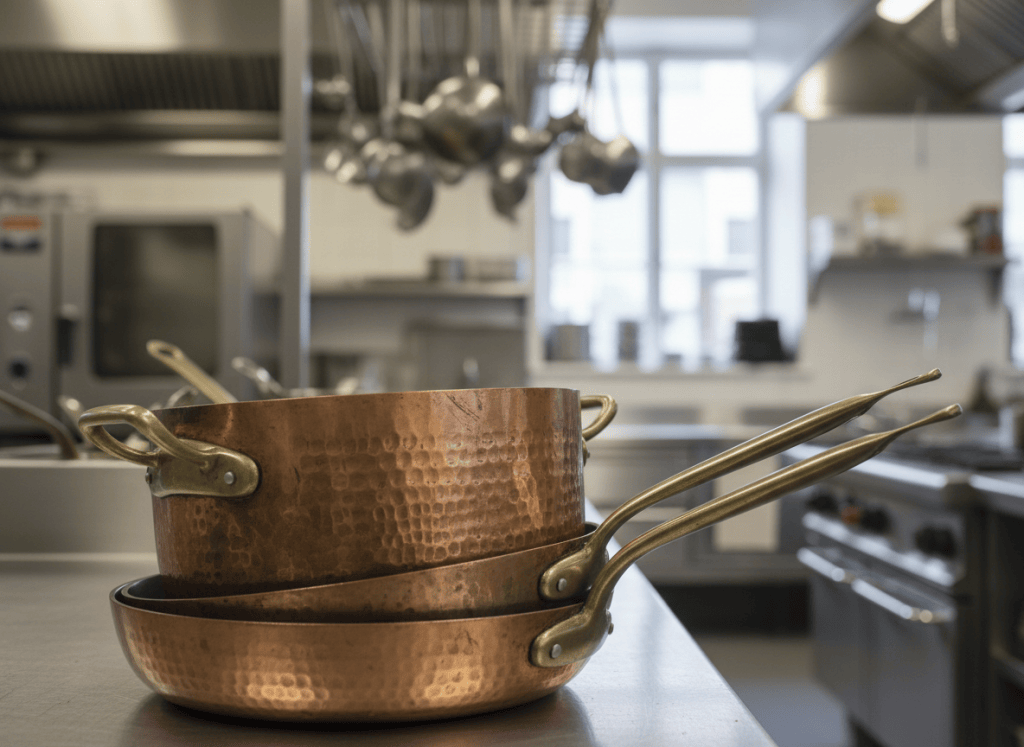
When I started my apprenticeship at the École Hôtelière de Murbach, in Alsace, every pot in that kitchen was copper. Not some of them. Not the good ones reserved for special work. All of them. Sauté pans, saucepans, the big pots for stock — copper, every single piece, and most of them older than I was.
They were heavy in a way that’s hard to explain to someone who’s only ever cooked with stainless steel or aluminum. Not heavy like a dumbbell — heavy like a tool that had been used by hands before yours, for years before you arrived, and would keep being used long after you left. Some of those pans had gone thin and shiny in the middle from decades of whisking, scraping, and stirring. You could see, in the wear pattern, every cook who’d stood at that stove before you.
At sixteen, lifting a full copper stockpot for the first time, I didn’t think about any of that. I just thought: this is absurd, why does this have to weigh so much. Pot and contents together could reach 20 kilos — over 40 pounds — and the chef wouldn’t let me near the stove with one until he’d shown me how to carry it properly. He taught me to slide the long handle under my forearm, bracing it there, and hold the body of the pot with both hands. Not swing it by the handle alone, the way you’d carry something light. Brace it, control it, walk slowly. It took years before I understood that the weight wasn’t an accident, and it wasn’t a flaw. It was the entire point.
Why the Weight Matters
Copper conducts heat faster and more evenly than almost any other metal you’ll cook with. That’s not marketing language — it’s just physics, and it’s the reason professional kitchens have relied on it for centuries. Where a cheap aluminum pan develops hot spots that scorch a sauce in one corner while leaving the rest lukewarm, a good copper pan responds to heat almost instantly, and evenly, across the entire surface.
That responsiveness is exactly why it’s unforgiving. You can’t walk away from a copper pan the way you might get away with on a heavy stainless pot. Turn the heat up, and it reacts immediately — for better or worse. A sugar syrup, a delicate sauce, a reduction that needs constant attention: copper punishes inattention faster than almost anything else in the kitchen. It doesn’t hide your mistakes. It shows you exactly when you’ve made one, in real time, while there’s still a chance to fix it.
I didn’t understand any of this as a teenager. I just knew that the chef could tell, without looking, the moment I let something go too far — because the pan would already be telling on me before he did.
What the Weight Was Actually Teaching
Looking back, I think the physical weight of those old copper pots was doing something beyond conducting heat well. It was teaching attention. You don’t lift a heavy copper pot carelessly, and you don’t walk away from a pan that responds that fast to a flame. Everything about cooking in copper demands that you stay present at the stove — not glance over occasionally, not multitask, but actually watch what’s happening in front of you.
That’s a lesson that outlasted the apprenticeship by decades. Every kitchen I’ve run since — in Paris, London, Los Angeles, Shanghai, here in the Bay Area — the cooks who paid the closest attention to their pans were always the ones who turned out the best food, regardless of what the pan was actually made of. Copper just made that lesson impossible to avoid. The pan wouldn’t let you get away with not paying attention.
The Case for Cooking in Something That Fights Back a Little
I’m not going to pretend every home kitchen needs a full set of copper — it’s expensive, it needs regular re-tinning or a lined interior to stay food-safe, and it’s genuinely more maintenance than most people want to take on for everyday cooking. But there’s something worth taking from those years of copper pots beyond the pots themselves: good equipment shouldn’t be something you can ignore.
The best tools in a kitchen — a well-balanced knife, a pan with real heat responsiveness, a pot heavy enough that you notice when you’re carrying it — keep you honest. They ask something of you. And in exchange, they give you back a level of control that cheaper, more forgiving equipment simply can’t.
Every time I pick up something with real heft in my hands now — a good chef’s knife, a cast iron pot, an old copper sauté pan that’s survived longer than most of the cooks who’ve used it — I think about that first stockpot at sixteen, and how long it took me to understand that the weight wasn’t the problem. It was the teacher.
 The Seasoned Bench
Leave a comment