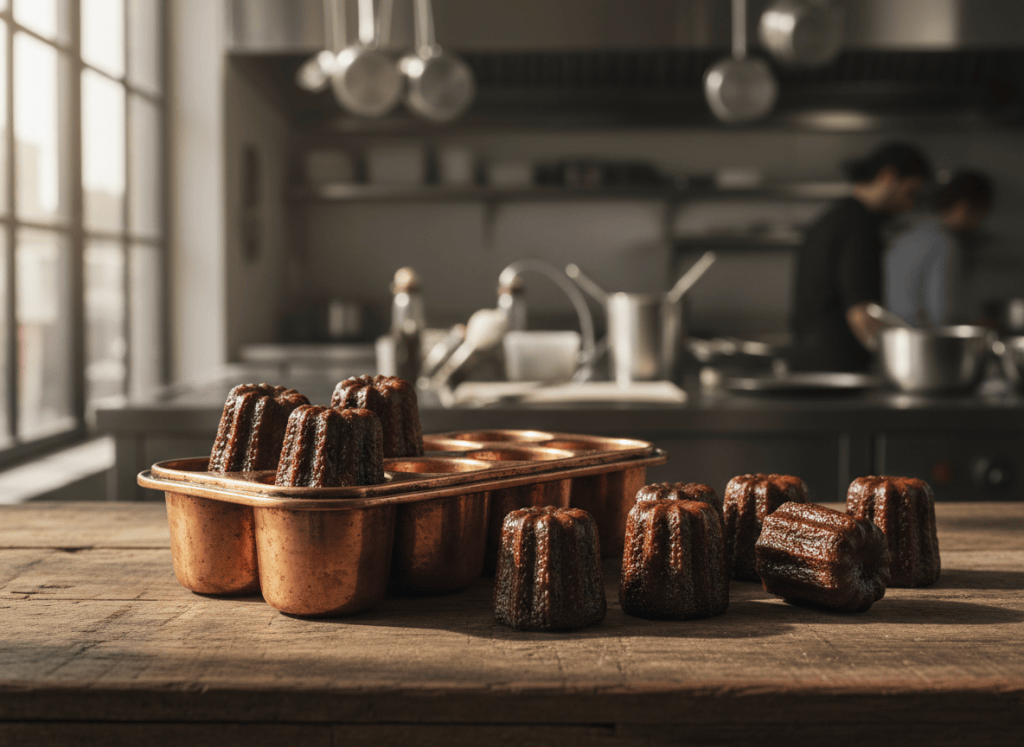
After forty years on the line — three continents, restaurants I opened from scratch, pastry stations I rebuilt more than once — my mold drawer tells the truth about what works. I own copper molds that are older than some of the cooks who have worked for me. I also own silicone molds I reach for without shame.
This is not a post about what looks beautiful hanging in a French kitchen shop. It is about what each material does to your pastry, because the mold is not passive — it is part of the recipe.
The Short Answer
- Copper for canelés, tarte Tatin, and madeleines — nothing else caramelizes like it.
- Black steel for muffins, financiers, and everyday workhorses — the best value in bakeware, period.
- Silicone for storage, mousses, entremets, and anything you need to release cleanly — practical, not magical.
Now the details.
Copper: The Caramelization Machine
Copper conducts heat roughly twice as well as aluminum and about five times better than black steel (stainless is worse still). In a mold, that means heat hits the batter instantly and evenly, and the sugar in your batter reacts fast. That reaction — caramelization and the Maillard browning that follows — is the entire point of certain pastries.
I learned exactly how much a copper mold collection is worth the night someone else decided to find out. Early in my career I worked at Le Gavroche in London, under Albert Roux, with his brother Michel running pastry. Michel had built a copper mold collection over years — canelés, tartlet rings, the works — the kind of collection you don’t replace, you inherit or you earn. One night the restaurant was burglarized. The thieves took a few bottles of wine, which you’d expect. But they also took Michel’s entire copper collection, and a set of ornate silver-plated skewers with little animal figurines on the handles — pieces that were already priceless forty years ago. Wine is wine. Someone who steals a pastry chef’s copper molds and antique silver skewers knows exactly what they’re stealing, and exactly what it’s worth.
You cannot beat the caramelization of a canelé or a Tatin prepared in a copper mold. I will say that plainly, because it is true, and because most of what you read online waters it down.
Canelé de Bordeaux. A proper canelé has a dark, almost burnt-looking crust that gives to a custard-soft center. That crust is the pastry. In a copper mold, the batter against the wall caramelizes before the center sets — you get the contrast. In silicone, you get a pale, gummy-edged cake that a Bordelais would refuse. This is the single clearest case for copper in the entire pastry world.
Tarte Tatin. The caramel happens in the mold itself — the apples cook in sugar and butter before the dough ever sees the pan. Copper’s responsiveness means the caramel moves when you move it: turn the heat down and the pan follows. In a heavy steel or (disaster) silicone vessel, you’re cooking on delay, and delayed caramel is burnt caramel.
Check the Mauviel M’Passion copper Tarte Tatin mold on Amazon →
Madeleines. The bump — la bosse — comes from a thermal shock to the batter. Copper delivers that shock. Black steel gets you most of the way there; silicone does not.
The honest downsides:
- Price. Real copper molds are so expensive that, realistically, almost no home cook can justify a full set. A single quality copper canelé mold costs what an entire black steel bakeware set costs. I know this. My copper was bought one piece at a time over decades, some of it inherited from kitchens I worked in.
- Care. Unlined copper reacts with acidic doughs, so most quality molds are lined with tin or stainless. Tin lining wears and eventually needs re-tinning. Copper also tarnishes; some cooks love the patina, others polish religiously.
- Weight and handling. A tray of copper canelé molds is heavy and awkward. In service, that matters.
Verdict: Buy copper for the two or three pastries where caramelization is the pastry — canelés first, Tatin second, madeleines if you’re committed. One at a time, over years, the way professionals do. Do not buy a copper set for looks.
Check the Matfer Bourgeat tin-lined copper canelé mold on Amazon →
Black Steel: The Workhorse Nobody Regrets
Black steel (also called carbon steel) is what you’ll find under half the pastry work in real restaurant kitchens. It heats fast — not copper-fast, but far faster than stainless or aluminum-coated nonstick — it browns beautifully, it seasons with use like a cast iron pan, and it costs a fraction of copper.
For muffins, I still use black steel, always have. A black steel muffin pan gives you the crusted, slightly fried edge that makes the top of a muffin worth eating — the part everyone tears off first. Silicone muffin pans steam the batter instead of searing it, and the difference is obvious on the plate.
Same story for financiers: those little almond cakes want a dark, buttery crust, and black steel delivers it.
The honest downsides:
- It rusts if you leave it wet. Dry it immediately, lightly oil it now and then, and it will outlive you.
- It needs seasoning to become truly nonstick. The first few bakes may stick; by bake ten, released like a dream.
- Not dishwasher-safe, ever.
Verdict: If you are building a bakeware collection on a normal budget, start here. Black steel gets you 85% of copper’s performance at 10% of the price. It is the best value in bakeware, full stop.
Check the Gobel tinned black steel madeleine pan on Amazon →
Silicone: Practical, Not Magical
Silicone has one genuinely great property: nothing sticks to it, and it bends so anything frozen or delicate pops out clean. That makes it the right tool for:
- Mousses, entremets, and frozen desserts — the shapes you cannot turn out of a rigid mold
- Storage — it stacks, it doesn’t dent, it doesn’t rust, it survives decades of abuse
- Portioning and freezing — flexible molds are brilliant for holding and turning out pre-portioned bases
But silicone is an insulator, not a conductor. It shields your batter from the oven’s heat instead of transferring it. The result is pale edges, weak crusts, and longer bake times. For anything where caramelization matters, it is the wrong tool.
Verdict: Own silicone for what it’s good at — flexibility, release, freezing, storage. Never reach for it when the recipe depends on a crust.
Check the Silikomart silicone entremet mold on Amazon →
Head-to-Head Comparison
| Copper | Black Steel | Silicone | |
|---|---|---|---|
| Heat conductivity | Excellent | Good | Poor (insulator) |
| Caramelization / crust | Unmatched | Very good | Weak |
| Release (unseasoned) | Good (if lined) | Needs seasoning | Excellent |
| Durability | Decades, with re-tinning | Decades, with care | Decades, nearly indestructible |
| Care level | High | Medium | Low |
| Price | Very expensive | Inexpensive | Inexpensive |
| Best for | Canelé, Tatin, madeleine | Muffins, financiers, tart rings | Mousse, entremet, freezing, storage |
What’s Actually in a Pro Pastry Station
Walk into a serious pastry kitchen and count: you will find black steel and stainless everywhere, a small shrine of copper for the signature items that demand it, and silicone in the freezer section — not the oven.
That is not tradition or romance. It is economics plus physics. Copper where the caramel justifies the cost, steel for everything else, silicone where nothing goes into a hot oven at all.
My Recommendations by Pastry
- Canelé: Copper. Non-negotiable if you’re serious. (A tin-lined copper mold, brushed with butter and beeswax, is the classic method.)
- Tarte Tatin: Copper or heavy black steel.
- Madeleines: Black steel or copper — you need the thermal shock for the bump.
- Muffins: Black steel.
- Financiers: Black steel.
- Tart rings and tartlets: Stainless rings, baked on a silicone mat.
- Mousses and entremets: Silicone.
- Anything frozen: Silicone.
FAQ
Are copper molds worth the money?
For canelés, Tatin, and madeleines — yes, because the caramelized crust is the entire point of those pastries and copper is the only material that produces it reliably. For everything else, no. Buy one copper mold for the pastry you make most, and use black steel for the rest.
Do copper molds need to be lined?
Quality ones come tin- or stainless-lined, because raw copper reacts with acidic doughs and batters. Tin linings wear over years of use and can be re-tinned by specialists.
Why are my canelés pale in silicone?
Silicone insulates the batter from the oven’s heat, so the crust never caramelizes before the center sets. This is a material problem, not a technique problem. Rest the batter properly, use copper, brush with beeswax and butter — the old way exists for a reason.
Can I put silicone molds in the oven?
Yes — silicone is oven-safe typically to around 430–480°F depending on the brand. The issue is not safety, it’s performance: weak browning and no crust.
How do I care for black steel molds?
Wash quickly, dry immediately, rub lightly with oil now and then. Never the dishwasher. They darken and become naturally nonstick with use — that’s the seasoning working, same as a carbon steel pan.
Related Guides
- Le Creuset vs Staub: A 40-Year Chef’s Honest Verdict — the same premium-material question, applied to cast iron
- De Buyer vs All-Clad vs Hestan ProBond — more on carbon steel seasoning and care
Disclosure: This post contains affiliate links. If you purchase through these links, I may earn a small commission at no additional cost to you. I only recommend equipment I have used in professional kitchens.
 The Seasoned Bench
Leave a comment