I have a confession that would have gotten me laughed out of the kitchen forty years ago: there is a plug-in pot on my counter at home, and I use it.
I spent my career cooking for Presidents, running kitchens on three continents, opening restaurants in San Francisco. I own knives older than most of my line cooks. I have seen every kitchen gadget fad come and go — the fondue sets, the spiralizers, the air fryer that ended up in a garage.
So when I tell you the Instant Pot earned its counter space in my house — a chef’s house, where the standards are unforgiving — I want you to understand what that means. It is not a gimmick. It is a technique tool that happens to have a plug. And for busy families, it may be the single most useful appliance in the kitchen.
Here is my honest, professional take on the Instant Pot: what it does brilliantly, what it absolutely cannot do, and how to get restaurant-quality results from a machine that costs less than a decent sauté pan.
What an Instant Pot Actually Is
Strip away the marketing and the Instant Pot is an electric pressure cooker that also sears, slow cooks, and steams. That’s it. But understand what a pressure cooker means to a cook: it is the oldest speed trick in the book.
Pressure raises the boiling point of water from 212°F to about 250°F. At that temperature, the tough collagen in cheap cuts of meat — the stuff that takes four hours of braising to melt into gelatin — breaks down in forty-five minutes. Every restaurant kitchen I ever ran used stovetop pressure cookers for stocks and braises. The Instant Pot is the same technique, made safe enough and simple enough for a Tuesday night with kids underfoot.
Your favorite kitchen time-saver is nearly 350 years old. In 1679, French physicist Denis Papin built the first pressure cooker — the “Steam Digester” — to cook food fast under steam pressure. Early versions were dangerous enough that Papin’s own fix, the safety valve, is the direct ancestor of the mechanism that keeps your Instant Pot’s lid locked until the pressure is fully released.
The mistake people make is thinking of it as a gadget. Think of it as a technique you now own.
7 Real Instant Pot Benefits for Busy Households
1. Weekend braises on a weeknight
This is the headline. Pot roast, short ribs, braised chicken thighs — dishes that normally demand a lazy Sunday take 35–45 minutes under pressure. A beef stew that would simmer for three hours is on the table with rice in under an hour, most of it completely hands-off. On a night when homework, laundry, and a work call are all happening at once, “hands-off” is the entire point.
2. Dried beans with zero planning
Every chef will tell you: dried beans taste better than canned, and cost a third as much. The problem was always soaking them overnight. Under pressure, dried chickpeas or black beans go from bag to tender in 30–40 minutes, no soaking, no watching. This alone changes your grocery bill and your Tuesday dinners.
3. You can actually walk away
The stovetop pressure cookers I grew up with demanded respect — a jiggling weight, a hissing valve, and your full attention. The Instant Pot is a different animal. It comes to pressure, cooks, and shuts itself off, then keeps food warm. You can pick up a kid from practice while dinner cooks. For a busy parent, that safety and autonomy is worth more than any single feature.
4. One pot, less cleanup
Sear, deglaze, pressure, serve — all in the same vessel. On a weeknight, the difference between two pots and one pot is the difference between a kitchen that recovers and one that doesn’t. The stainless inner pot also goes in the dishwasher.
5. Freezer-to-dinner rescue
Forgot to plan dinner? Frozen chicken breasts, a jar of salsa, pressure for 12 minutes — shred it, and you have taco filling that tastes intentional. This is the real-world use that saves weeknight takeout money, week after week.
6. The small daily wins add up
Rice, every single time, without watching a pot. Chicken stock from yesterday’s carcass in 45 minutes — better and vastly cheaper than anything in a carton. None of these is life-changing alone. Together, they quietly return twenty minutes to your evening, every evening.
7. Cheap cuts become dinner-party food
This is the chef’s secret weapon. Chuck roast, pork shoulder, lamb necks, chicken thighs — the cuts that cost a fraction of the fancy ones are exactly the cuts pressure cooking was invented for. The Instant Pot pays for itself at the butcher counter, over and over.
What the Instant Pot Can’t Do — Read This Part
I promised you honesty, so here it is. Any review that only lists benefits is a sales pitch, not a review.
It cannot brown properly. The sauté function is serviceable, but that thin heating element will never build the deep, crusty maillard sear you get from a ripping-hot pan — the kind of crust that makes a short rib unforgettable. The workaround: sear hard in a cast iron pan first, deglaze with wine, pour it all into the pot. Five extra minutes, and it transforms the result.
It cannot roast. Chicken skin from a pressure cooker is pale and flabby. No crispy edges, no caramelized vegetables, no gratin. If your dish’s magic happens in a dry oven, no amount of pressure will fake it.
It is not faster for everything. Eight minutes of pressure time means ten minutes to come to pressure and ten to release. For quick-cooking foods — pasta, delicate fish, green vegetables — a pan on the stove beats it every time.
Knowing what a tool can’t do is the difference between a cook and a person who owns equipment. Buy the Instant Pot for braises, beans, stocks, and grains — and let your oven do what only your oven can do.
A Chef’s Four Tips for Instant Pot Success
- Use less liquid than feels right. Almost nothing evaporates under pressure. Half a cup where a stovetop braise would use three. You can always reduce after; you cannot un-water-down a sauce.
- Always deglaze. After sautéing, scrape every browned bit off the bottom with wine or stock. That fond is pure flavor — and it keeps the burner from scorching and throwing a burn warning.
- Finish in a pan. When pressure cooking ends, my restaurant habit takes over: reduce the liquid in a skillet, mount it with a knob of butter, adjust salt and acid. Two minutes that make it taste like a kitchen cooked it.
- Resist overfilling. Two-thirds max, half for beans and grains, which foam and expand. Your ceiling — and your Tuesday — will thank you.
Start Here: Weeknight Beef Bourguignon
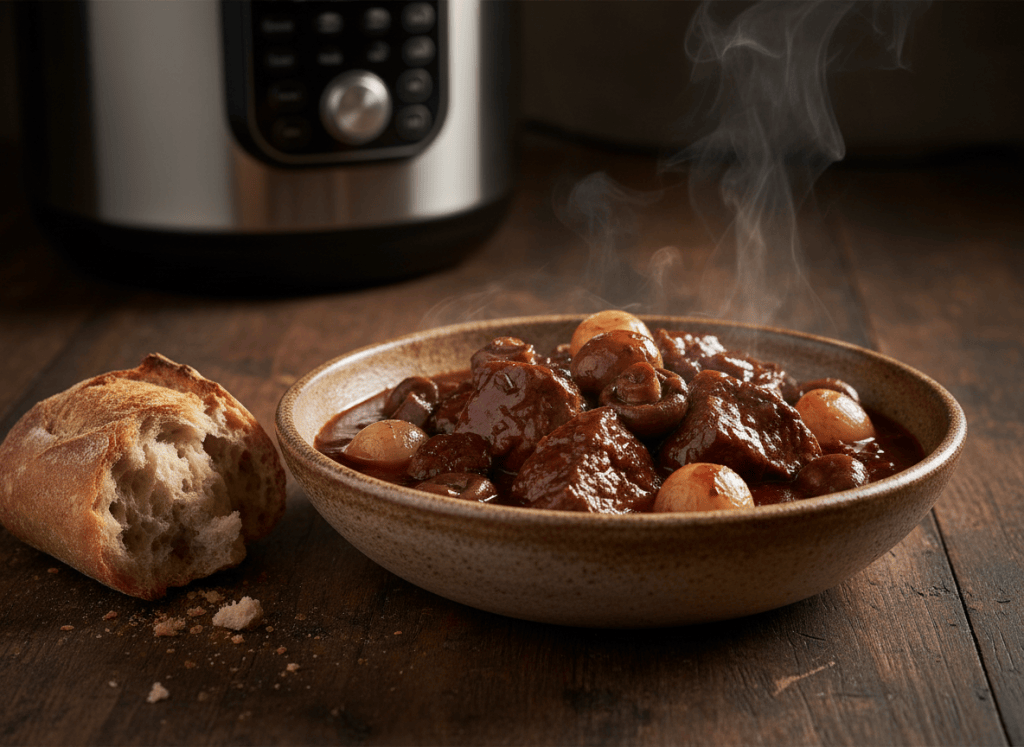
If you buy one, this is the recipe that will make you a believer. A proper beef bourguignon — braised beef, red wine, bacon lardons, pearl onions, mushrooms — traditionally means a 3-hour oven braise. This gets you there honestly in about a third of the time. It’s the weeknight version of the French braises I cooked for years — pot roast, coq au vin, all the same logic under pressure.
Serves 6 · Pressure time: 40 minutes · Total: about 1 hour 30 minutes
Ingredients
- 2 lbs beef chuck, cut in 1½-inch cubes
- 6 oz bacon or pancetta, diced
- 1 onion, diced
- 2 carrots, sliced into rounds
- 3 garlic cloves, minced
- 2 tbsp tomato paste
- 2 cups full-bodied red wine (Burgundy or Pinot Noir)
- 1½ cups beef stock
- 1 bay leaf, 3 sprigs thyme, a few parsley stems (tied into a bouquet garni)
- 10 oz pearl onions, peeled
- 8 oz cremini mushrooms, quartered
- 2 tbsp butter
- Salt, pepper
Method
- On Sauté, cook the bacon until crisp, about 5 minutes. Remove with a slotted spoon; leave the fat in the pot.
- Season the beef with salt and pepper. Brown in the bacon fat in batches, 2–3 minutes per side — do not crowd it. Remove.
- Add onion and carrot to the pot, cook 5 minutes until softened. Add garlic and tomato paste, cook 1 minute until it darkens.
- Pour in the wine and scrape the bottom clean — every browned bit.
- Return the beef and bacon to the pot. Add the stock and bouquet garni. Lock the lid.
- Pressure cook on High, 40 minutes. Natural release 15 minutes, then quick release.
- While it cooks, in a skillet, sauté the pearl onions and mushrooms in the butter over medium-high heat until browned, about 10 minutes. Set aside.
- Remove and discard the bouquet garni. Stir the pearl onions and mushrooms into the pot. If the sauce is thin, reduce on Sauté for a few minutes until it coats the back of a spoon.
- Taste, adjust salt and pepper. Serve with egg noodles, mashed potatoes, or crusty bread.
That is a proper bourguignon, achieved on a Tuesday.
Which Instant Pot Should You Buy?
(Affiliate links below — I only recommend equipment I’d put in my own kitchen.)
- Instant Pot Duo (6 quart) — the one most households need. Pressure cook, sauté, slow cook, rice. If you’re feeding 3–5 people, start here.
- Instant Pot Duo Plus — the nicer display and a few extra programs. Worth it if it’s on sale.
- Instant Pot Pro (8 quart) — for bigger families or batch cooking. The better inner pot is what earns the upgrade.
Skip the air-fryer-lid bundles unless you truly lack an oven — a good sheet pan and a hot oven beat a small basket every time.
Instant Pot FAQ
Is the Instant Pot worth it?
If you cook dinner on weeknights and own a freezer — yes. It converts cheap ingredients and zero planning into real meals. If you mostly cook delicate, quick foods, spend the money on a great pan instead.
Is pressure cooking safe?
Modern electric cookers are interlocked and self-regulating; the lid will not open under pressure. They are dramatically safer than the stovetop models your grandmother used.
Instant Pot or slow cooker?
The Instant Pot slow-cooks, so it replaces one. But its superpower is speed — a slow cooker plans ahead, a pressure cooker rescues. Most busy households need the rescue.
Does pressure cooking destroy nutrients?
No — shorter cook times and less water actually retain more nutrients than long boiling. Restaurant kitchens have known this for a century.
What size should I buy?
6 quarts for most families, 8 if you cook for six or want leftovers on purpose.
Cooked properly, an Instant Pot meal tastes like someone cared — because you did, for about twenty minutes of actual hands-on work. That’s a fair trade for a Tuesday.
— Jean, The Seasoned Bench
FTC disclosure: This post contains affiliate links. If you buy through them, I earn a small commission at no cost to you. I only recommend tools that have earned their place on my own bench.
 The Seasoned Bench
Leave a comment