The Interview Question That Almost Caught Me
A few years after I arrived in America, I was interviewed for the position of Executive Chef at the Tower restaurant, at the top of the Transamerica building on Olive Street in Los Angeles — the building you’d know today as the USC Tower. A serious job. The Tower was busy in the way that matters: the Hearst Corporation was the building’s main tenant, and their executives came for lunch every day, City Hall politicians used the restaurant as their refuge, and Mayor Bradley was a regular among other celebrities whose names I learned to keep to myself.
During the interview, the General Manager leaned back and asked me one final question: “Do you know how to make popovers?”
I said yes.
Here is the truth: I had never heard of a popover in my life. We do not make them in France. Nothing in my French training — not the lyonnais mother sauces, not the pastry apprenticeships, nothing — had ever mentioned this bread. I was completely clueless, and I had just staked an executive chef position on a bluff.
In any case, I was rapidly confronted with the test.
The tradition at the Tower was to welcome every table — every politician, every executive, every celebrity — with a warm plate of popovers, straight from the oven, before anyone had even ordered. That warm popover was the restaurant’s handshake. And now it was mine to make.
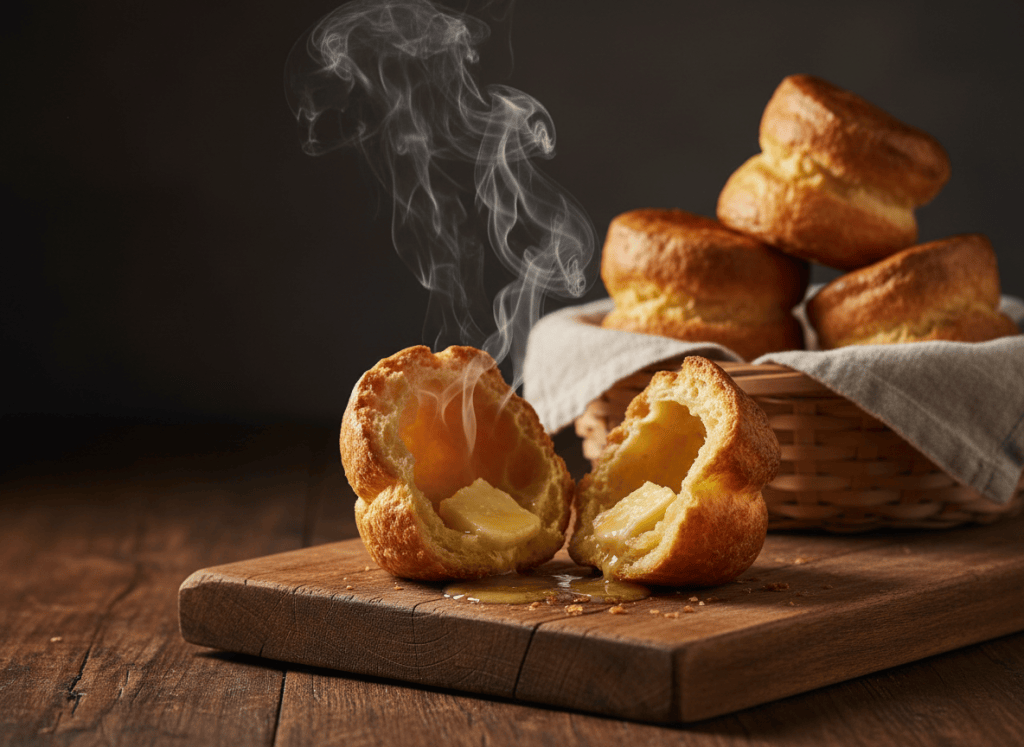
I want to tell you that I panicked. I didn’t have time. I found the old recipe card in the pastry station, I studied it like an exam, and by service that night, every table got their warm plate — golden, tall, and trembling with steam. I have made popovers a thousand times since, in restaurants and in my own kitchen, and I have never once served one without remembering that interview.
So this is the recipe that got an entire career started in America — and it is the one I’ll give you now, along with the why behind every step, because once you understand what makes a popover rise, you’ll never need a recipe again.
What Is a Popover, Exactly?
A popover is an egg-and-milk batter — essentially a pancake batter — baked in a very hot, well-greased tin until the water in the batter flashes to steam and blows the batter upward into a hollow, golden tower. The name is American: the first printed recipe appears in an 1876 American cookbook, and the story goes that the batter “pops over” the top of the tin as it bakes. That is why a French chef could spend years in French kitchens and never meet one.
It is a cousin of the English Yorkshire pudding — same batter idea, different attitude. Yorkshire pudding is baked in beef drippings and served alongside a Sunday roast; the popover is baked in butter, taller and crisper, equally at home with jam at breakfast or with prime rib at dinner. Learn one, and you own both.
The Science of the Rise (This Is the Whole Recipe)
Every instruction below follows from one fact: a popover rises because water turns to steam, and the batter must trap it. A popover won’t forgive you the way my Instant Pot does — there’s no walking away here, no machine shutting itself off while you pick up a kid from practice. Understand these four principles and you cannot fail — even, as I proved, if you learned the recipe two hours before service:
- Steam is the engine. Eggs and milk are mostly water. In a 450°F oven, that water flashes to steam, and the rapidly setting eggs and flour trap the steam inside — like a balloon inflating from within.
- Fat is the release agent. A smoking-hot, heavily greased tin means the batter climbs the walls as it rises instead of sticking and being dragged down. The pan should sizzle when the batter goes in.
- Structure must set fast. Cold batter in a hot pan deflates before it sets. Room-temperature ingredients and a preheated pan mean the rise and the set happen in the right order.
- Never open the door. A popover depends on oven heat. One peek at minute 15 releases the steam that was doing the lifting. When a table of politicians is waiting, you watch through the glass. That’s what it’s for.
The Foolproof Popover Recipe
Makes 6 · Prep: 5 minutes (plus 30 min resting) · Bake: 20 minutes at 450°F, then 20 minutes at 350°F
Ingredients
Measure by weight if you can, it’s the pro move.
- 2 large eggs, room temperature
- 1 cup whole milk, room temperature
- 1 cup all-purpose flour (130 g)
- ½ teaspoon fine salt
- 1 teaspoon sugar (optional, for golden color)
- 3 tablespoons melted butter, for the pan (beef drippings if you’re serving prime rib — the Yorkshire way)
Method
- Rest the batter, always. Whisk the eggs, milk, flour, and salt until smooth — a blender or a good whisk, 30 seconds, no more. Then let the batter sit at room temperature for 30 minutes. This hydrates the flour and relaxes the gluten — the same instinct behind resting cookie dough overnight: flour needs time no matter what you’re baking. It’s the step everyone skips. Skip it and your popovers get tough.
- Preheat the pan with the oven. Put your popover pan (or a muffin tin — see below) in the oven and preheat to 450°F with the pan inside. It must be truly hot.
- Grease hot, fill fast. Pull the pan, drop a little butter into each cup — it should sizzle instantly — and divide the batter among the cups, filling about half to two-thirds.
- Bake 20 minutes at 450°F. Do not open the door. This is the blast that makes them explode upward.
- Drop to 350°F for 20 minutes. Without opening the door, reduce the heat and let them dry out and set. This second stage is what makes the outside shatter when you bite it instead of collapsing.
- Slit and serve immediately. The moment they’re out, pierce the side of each popover with a knife to let the steam out — this keeps them crisp. At the Tower, these went to the table the second they could be handled. Thirty seconds after the oven, they’re perfect. Ten minutes later, they’re leathery. Popovers wait for no one — not even Mayor Bradley.
Serve with butter and jam at breakfast, or with prime rib and a spoonful of pan gravy at dinner — the way the politicians of City Hall learned to expect them.
The 5 Mistakes That Flatten Popovers
I’ve seen every one of these — and made half of them myself, on a steep learning curve I hadn’t planned for.
- Cold batter into a cold pan. The single most common failure. Cold batter can’t generate steam fast enough to climb.
- Opening the oven door. You’ve just fired the engineer. Watch through the glass.
- Overmixing. Blend until smooth and stop. Whipped-in air is not what rises these — steam is — and overworked gluten toughens the walls.
- Skipping the fat. A dry or lightly-greased pan is a sticky pan, and sticky walls drag the rise down. Be generous; sizzle is the goal.
- Taking them out early. An under-set popover collapses in front of your guests — dramatic, but not in the way you wanted. They’re done when the sides are deep golden and firm to a gentle touch.
Do You Need a Popover Pan?
Honestly? It helps, but it isn’t mandatory.
A popover pan’s tall, steep cups straighten the climb, so the rise is more dramatic. A regular muffin tin bakes the same batter into something shorter and sturdier — closer to the Yorkshire pudding, and nothing wrong with that. At the Tower we ran proper popover tins because the rise was the welcome.
If you bake popovers more than twice a year, a proper popover pan is worth the shelf space — it’s on the short list in how I stock my kitchen, and unlike most single-use gear, it does one thing and does it perfectly.
(Affiliate links below — I only recommend tools I’d keep on my own bench.)
- NordicWare Popover Pan — the standard, nonstick, tall cups, lasts decades.
- Chicago Metallic Popover Pan — the restaurant choice: heavier steel, a bit less nonstick, a bit more browning.
- No popover pan? A standard 12-cup muffin tin works — reduce the bake at 450°F by 2–3 minutes and watch closely.
Popover FAQ
Why didn’t my popovers rise?
Almost always cold batter, a cold pan, or an opened oven door. Check all three and they’ll rise next time.
Can I make the batter ahead?
Yes — up to 24 hours in the fridge, covered. Bring it fully back to room temperature and re-whisk briefly before baking.
Can I make popovers without a popover pan?
Yes. A muffin tin gives you shorter, sturdier puddings; a cast iron pan gives you one giant popover to cut in wedges — the Dutch baby, a close relative.
Why are my popovers dense?
Usually under-rested batter or overmixing. Rest 30 minutes; blend only until smooth.
Are popovers French?
No — and trust me, I checked, urgently, once upon a time. They’re American, an adaptation of the English Yorkshire pudding that French kitchens never adopted. If a French chef tells you he grew up making them, ask him to say it again slowly.
Sweet or savory?
Both are traditional. A spoonful of sugar in the batter for breakfast popovers with jam; a handful of grated Gruyère and black pepper folded in at fill time for dinner. The technique never changes.
A popover is the rare dish where the drama is free: four ingredients, a hot pan, and the patience to leave the oven door shut. For me, it was also the beginning of everything I built in America — won with a bluff, kept with a recipe card, and served ten thousand times since.
— Chef Jean, The Seasoned Bench
FTC disclosure: This post contains affiliate links. If you buy through them, I earn a small commission at no cost to you.

Leave a comment