I was fortunate to be born in France, the land where good food matters — where spending three hours on a Sunday around a meal isn’t indulgence, it’s simply correct. But my family is from Sóller, a small village in Mallorca, and I spent most of my younger years in Spain. I love that country, and the easy, honest way of life that comes with it.
My earliest memory of cooking isn’t French at all. It’s my grandmother, leaving early for the farmers market, coming back with whatever was actually good that morning — vegetables, poultry, fish — and starting to cook the moment she walked back through the door. I was fascinated by her method. My mother, back in France, cooked in stainless steel, methodical and precise. My grandmother never used anything but a terra cotta cazuela.
It took me the better part of a career in professional kitchens — copper, cast iron, stainless, every serious tool a serious kitchen owns — to understand what she already knew standing over that clay pot every morning. Here’s what I’ve learned about why it works, how not to break one, and the dish that will make you understand the fuss.
What a Cazuela Actually Is
A cazuela is a shallow, round clay cooking vessel, traditionally glazed only on the interior, used across Spain for everything from garlic shrimp to rice dishes to slow-braised stews. Spain has entire towns built around this craft — La Bisbal d’Empordà, in Catalonia, has been a working pottery center since at least 1502, and its kilns are still where a lot of the traditional cookware sold today comes from.
The shape is the point: wide and shallow, so heat spreads evenly across a large surface, and the food goes straight from stovetop or oven to table in the same vessel it cooked in — which matters more than it sounds, because a cazuela keeps cooking long after you’ve turned off the heat.
Why Clay Cooks Differently
Metal responds to heat almost instantly — turn up the burner, the pan gets hot right away; turn it down, it cools just as fast. Clay is the opposite. It heats slowly, holds an enormous amount of thermal mass once it’s hot, and releases that heat gradually. That’s why a cazuela dish is still gently cooking, still bubbling, five minutes after it leaves the stove.
It also breathes. Unglazed clay is slightly porous, which means a small amount of moisture escapes through the walls during cooking — the same reason bread baked in a clay vessel gets a better crust than bread baked in metal. For a garlic shrimp dish swimming in olive oil, or a long-simmered bean stew, that slow, even, moisture-managing heat is the entire reason the dish tastes different than the same recipe in a stainless pan — the same reason I trust certain enameled cast iron for a braise but reach for clay when a dish wants that particular breathing heat.
Season It Before You Ever Cook in It
A new cazuela is not ready to use out of the box. Skip this step and you risk cracking it the first time it meets real heat.
- Soak it. Submerge the whole pot in water for at least two hours, ideally overnight. No soap — it can clog the clay’s pores.
- Boil it full. Fill the cazuela with water to about half an inch below the rim, set it over low heat on a flame-tamer or heat diffuser, and bring it to a slow boil. Traditionally, a few peeled garlic cloves go into the water — nobody can fully explain why, but the tradition holds, and I’m not the one who’s going to break it.
- Never boil it dry. Let the water reduce, but pull it before the pot runs empty — an empty hot cazuela on a flame is exactly the kind of stress that cracks one.
- Cool it slowly, then wash it. Let it come back to room temperature on its own before washing.
This hardens the clay and seasons it. Do it once, correctly, and the pot is good for years.
The One Rule That Prevents Cracked Cazuelas
Never shock it. That’s the whole rule, and almost every cracked cazuela story comes down to breaking it.
- Don’t pour cold liquid into a hot pot, or set a hot pot straight onto a cold counter or into cold water.
- Don’t put an empty cazuela over high heat — always have oil or liquid in it before it goes on the flame.
- On an electric coil stove, use a heat diffuser — direct contact with an electric element heats too unevenly for clay.
- Skip induction entirely, or use it only with a proper induction interface disk. A metal diffuser plate on an induction cooktop heats up instantly and focuses intense, localized heat on one spot of the clay, which is precisely the kind of uneven thermal stress that cracks a cazuela open. Gas is the most forgiving option, with a diffuser if your flame runs hot.
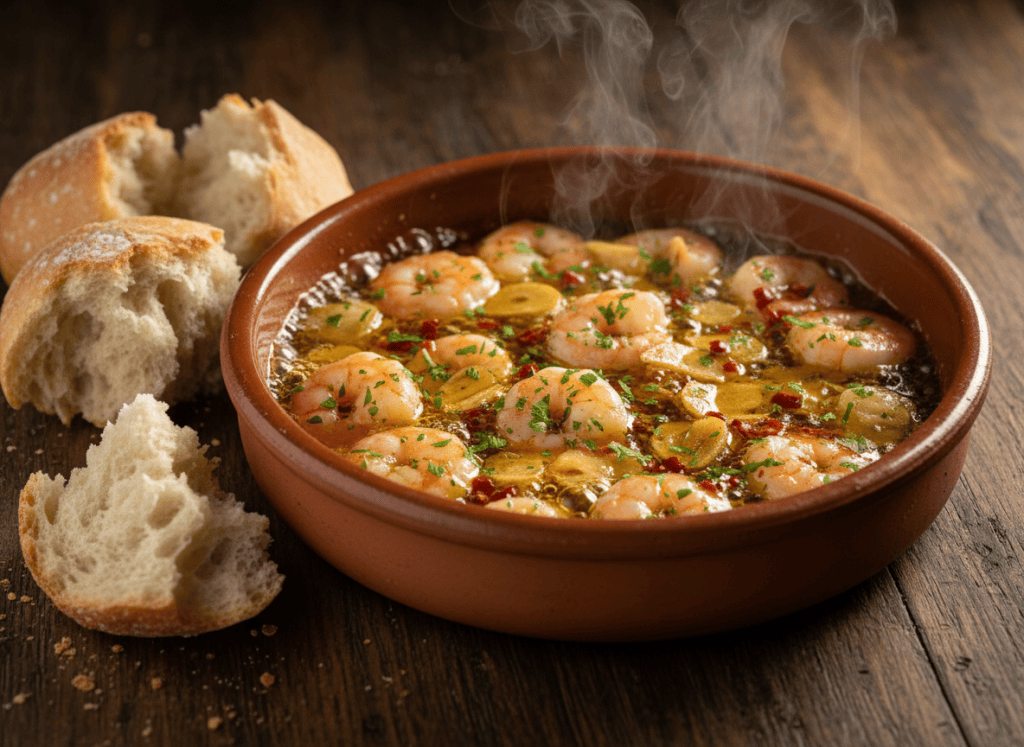
Gambas al Ajillo — Garlic Shrimp, the Dish That Sells the Pot
Serves 2 as a tapa · Prep: 10 minutes · Cook: 5 minutes
This is the dish that converts skeptics. It’s fast, it’s simple, and it only works properly in a cazuela — the oil needs to stay hot enough to keep sizzling at the table.
Ingredients
- 1 lb large shrimp, peeled and deveined, tails on
- ½ cup good olive oil
- 5 garlic cloves, thinly sliced
- 1 dried chile de árbol, crumbled (or ½ tsp red pepper flakes)
- 1 bay leaf
- 2 tbsp dry sherry (optional)
- Salt, to taste
- 2 tbsp parsley, chopped
- Crusty bread, for the oil
Method
- Set the cazuela over medium heat. Add the olive oil, garlic, chile, and bay leaf. Cook slowly until the garlic turns pale gold — not brown. Rushing this burns the garlic and turns the whole dish bitter.
- Raise the heat slightly and add the shrimp in a single layer. Cook about 1 minute per side, until just pink and barely cooked through — they’ll keep cooking in the residual heat once you pull the pot off the flame.
- Off heat, add the sherry if using, and season with salt.
- Scatter the parsley over the top and bring the cazuela straight to the table, still bubbling. Serve with bread for dipping the oil — that oil is half the reason people love this dish.
Which Cazuela Should You Buy?
Size and glaze matter more than brand here. A 9–10 inch cazuela is the right size for a dish like gambas al ajillo serving 2–4, and it’s on the same short list as the rest of the gear in how I stock my kitchen. Go larger for rice dishes or stews meant to feed a table. Always buy one glazed on the interior only — a fully glazed exterior defeats the breathing quality that makes clay worth using in the first place.
(Affiliate links below — I only recommend cookware I’d put in my own kitchen.)
- La Tienda Terra Cotta Cazuela, 9.5 inch — the right size for shrimp and small braises, glazed interior, made in Spain.
- Terra Cotta Cazuela, 15 inch — for rice dishes and stews serving a full table.
- SimmerMat Heat Diffuser — if you’re cooking on electric or induction, non-negotiable, not optional.
Cazuela FAQ
Can I use metal utensils in a cazuela?
Avoid them on the unglazed parts — wood or silicone is safer for the glaze and won’t scratch the surface you’re relying on to release food cleanly.
Why did my cazuela crack the first time I used it?
Almost always thermal shock — either it wasn’t cured first, or it met a sudden temperature change (cold liquid in a hot pot, a hot pot on a cold surface, or direct high heat on an electric coil).
Can I use a cazuela in the oven?
Yes — that’s actually where it shines for longer braises and rice dishes. Just bring it up to oven temperature gradually rather than starting it in a fully preheated oven from cold.
Is a cazuela the same as a Mexican olla de barro?
Related, not identical. Both are unglazed or partially glazed clay cookware with the same slow, even-heat principle, but the shapes and regional traditions differ — the cazuela is Spanish, wide and shallow; the olla is often deeper, used for beans and moles.
Do I need to season it again after the first cure?
No — one proper cure hardens the clay for the life of the pot. Just keep following the no-thermal-shock rule every time you cook.
A cazuela won’t do everything a good sauté pan does, and it shouldn’t try to. But for the dishes it’s built for — the ones that want to keep gently cooking after they leave the stove — nothing metal replicates it.
— Chef Jean, The Seasoned Bench
FTC disclosure: This post contains affiliate links. If you buy through them, I earn a small commission at no cost to you.

Leave a comment