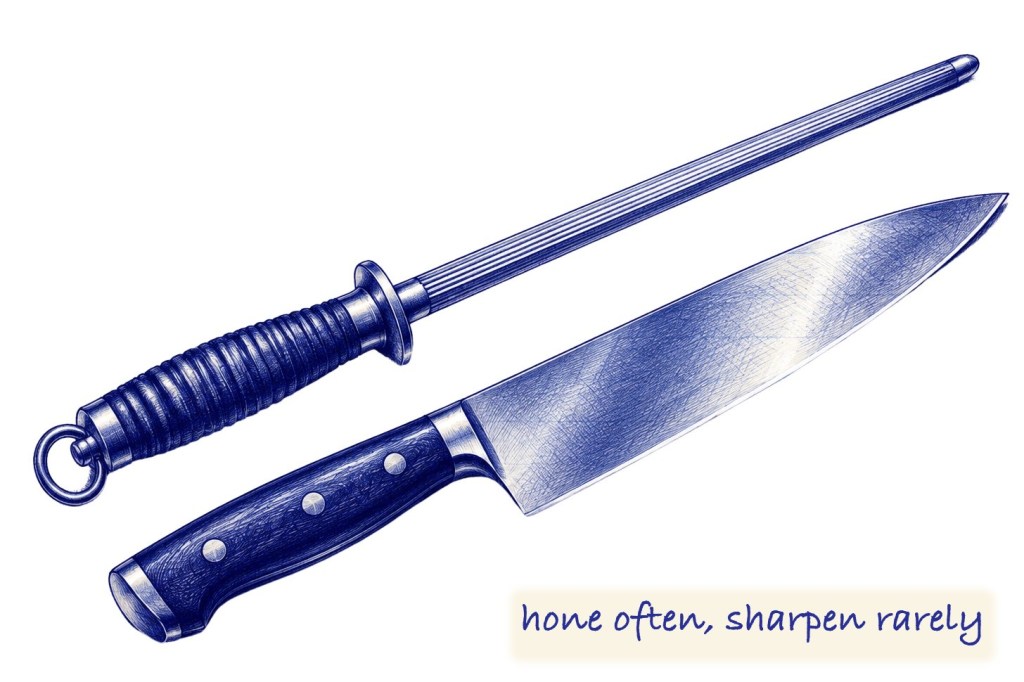
Walk into almost any professional kitchen and you will see a cook running a knife along a steel before a busy service. Walk into most home kitchens and the steel sits in the block, never touched, or gets used as if it were a sharpener. It is not one. Understanding what a honing steel really does, and what it cannot do, is the difference between a knife that stays pleasant to use and one that slowly turns into a butter spreader.
What an edge actually is
The cutting edge of a knife is a very thin line of steel, thinner than a hair. Every time you cut, that line takes tiny knocks. On a cutting board, the edge does not usually chip away. It bends, folding slightly to one side, like the bristles of a brush that has been pressed down. A knife with a bent edge feels dull even though most of the steel is still there.
What honing does
Honing pushes that bent edge back toward the center. A honing steel, also called a honing rod, realigns the edge and does not take off much metal. That is why a good cook hones often: it is a quick tune-up that keeps a sharp knife feeling sharp. Honing does not make a truly dull knife sharp. If the edge has worn away rather than bent, there is nothing left to straighten.
What sharpening does
Sharpening removes metal. A stone, a pull-through device or a grinding system takes steel off both sides of the blade until the two faces meet in a fresh, narrow edge. It is slower and it wears the knife down a little each time, so you want to do it only when you need to. Victorinox suggests sharpening only when honing no longer restores the edge, and puts typical sharpening at about once or twice a year for a home kitchen, depending on use. If you want to compare sharpening methods, I wrote up the options in Best Knife Sharpening Systems, Tested.
The simple test
- Hone first. If a few light passes on the steel bring the knife back, you only needed alignment.
- If the knife still crushes a ripe tomato or skates off the skin, honing will not fix it. It needs sharpening.
- Sharpen, then go back to honing to keep the new edge fresh.
Types of honing rods
Not every rod works the same way, and this is where the confusion starts.
- Smooth steel rods mostly realign the edge. They are the classic choice and work well on softer Western-style knives.
- Ribbed or grooved steel rods have a little more bite and can take off a trace of metal, so they sit between honing and sharpening.
- Ceramic rods are harder and slightly abrasive. They realign and also remove a small amount of steel.
- Diamond-coated rods are abrasive and act as a light sharpener. Use them sparingly.
A word of caution on harder knives. Many Japanese knives are made from harder steel at a thinner angle. A coarse steel rod can chip these edges, and a rod that is softer than the blade will not do much at all. Victorinox notes that harder forged blades do better with diamond, tungsten carbide or ceramic rods. If you own a hard Japanese knife, check the maker’s advice before reaching for the steel that came with your old block set.
How to hone, step by step
- Hold the rod firmly, tip down on a folded towel on the counter, or hold it out in front of you with a guard in place. A steady, stable rod is safer than waving one in the air.
- Place the heel of the blade against the top of the rod, at about 15 to 20 degrees. Musashi gives 15 to 20 degrees for Western knives and 10 to 15 for Japanese ones. If you cannot judge the angle, go a little shallower rather than steeper.
- Draw the knife down and across the rod in one smooth motion, heel to tip, keeping the same angle all the way through.
- Repeat on the other side. Alternate sides, three to five light passes each.
- Wipe the blade with a damp cloth before using it, so no fine metal dust ends up on your food.
Light pressure is enough. Pressing hard does not help, and it makes it easy to roll the edge the wrong way. The most common mistake is changing the angle partway through the stroke, which rounds the edge off and defeats the purpose.
How often to hone
There is no single rule. Musashi suggests that professional cooks hone before or after every use, and that home cooks hone at least two to three times a week. Victorinox puts it at every few uses. A reasonable habit for a home cook is a few passes before any serious cutting session. After 40 years in kitchens, the habit I trust most is simple: when you reach for the knife, take ten seconds with the steel first.
Care that keeps the edge longer
Honing and sharpening are only half of the picture. A cutting board of wood or soft plastic is kinder than glass, stone or ceramic. A dishwasher dulls and damages edges, so wash by hand and dry right away. Store the knife in a block, on a magnetic strip or in a sheath, never loose in a drawer. I covered the full routine in How to Care for Your Knives So They Last.
The short version
- Honing realigns a bent edge. It is quick, gentle and can be done often.
- Sharpening removes metal to create a new edge. It is slower and only needed now and then.
- Match the rod to your knife: smooth steel for softer Western blades, ceramic or diamond for harder ones.
- Keep the angle steady, use light pressure, and stop after a few passes.
I have not lab-tested any of the rods mentioned here. The advice above comes from long working experience and from published guidance by knife makers such as Victorinox and Musashi, so check your own knife maker’s instructions for your specific blades.

Leave a Reply