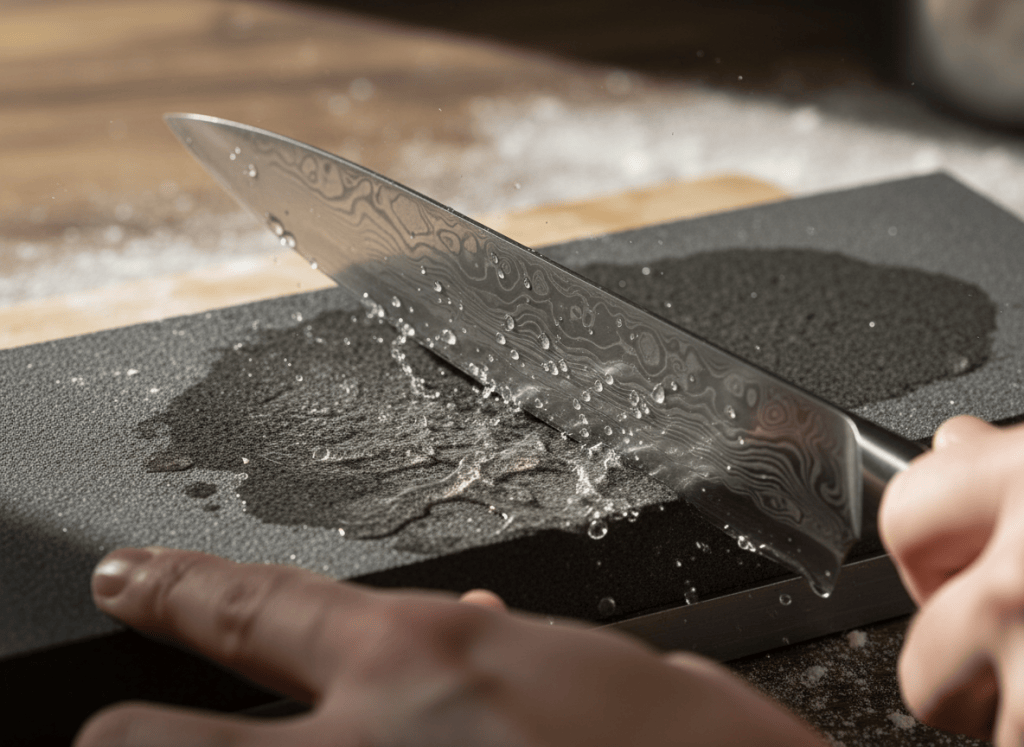
A dull knife is more dangerous than a sharp one, not less. It takes more force to cut through anything, which means more slipping, more pressure, and more chances for the blade to skate off whatever you’re cutting and onto your hand instead. Keeping your knives properly sharp isn’t just about performance in the kitchen — it’s a safety habit.
There are four main ways to keep an edge sharp, and each one suits a different kind of cook. Here’s how they compare, and what I’d actually recommend in each category.
Whetstones
This is what professional kitchens use, and for good reason — a whetstone gives you full control over the angle and amount of metal removed, and it produces the sharpest possible edge. The tradeoff is a real learning curve; it takes practice to hold a consistent angle, and a session takes longer than any of the other methods here.
Best for: serious home cooks willing to learn the technique and who want the best possible edge.
Top pick: King KDS 1000/6000 Combination Whetstone — a two-sided stone that covers both initial sharpening and fine polishing, and it’s the stone I’d point most people toward if they’re starting out.
Pull-Through Sharpeners
These are the fastest, simplest option — you draw the blade through a fixed slot a few times and you’re done. The downside is control: the angle is fixed by the tool, not by you, and cheap models can remove more metal than necessary, shortening your knife’s life if used too often.
Best for: beginners who want quick touch-ups without learning a technique.
Top pick: KitchenIQ 50009 Edge Grip 2-Stage Knife Sharpener — compact, inexpensive, and gentle enough not to over-remove metal with occasional use.
Electric Sharpeners
Electric sharpeners sit between the two above — faster and more consistent than a whetstone, with more genuine sharpening power than a pull-through. Good ones use multiple stages (coarse to fine) and guided slots that keep the angle accurate. They’re pricier, and like pull-throughs, they remove metal on a fixed schedule rather than to your exact specification.
Best for: home cooks who want near-professional results without the whetstone learning curve.
Top pick: Chef’sChoice 15 Trizor XV EdgeSelect — a three-stage system that can take a very dull knife to genuinely sharp, with enough control to work on most Western and hybrid blade styles.
Honing Rods
A honing rod doesn’t sharpen at all — it realigns the microscopic edge that bends out of true with normal use. Every kitchen should have one, but it’s a maintenance tool, not a substitute for any of the three above. (See our full breakdown of honing vs. sharpening for more on the difference.)
Best for: everyone, alongside whichever sharpening method you choose.
Top pick: Wusthof 10-Inch Sharpening Steel — matches the Classic line well, but works fine with any brand of knife.
How Often Should You Sharpen?
For most home cooks, every 2–4 months is enough — more often if you’re cooking daily, less if you’re an occasional cook. Honing, on the other hand, should happen every few uses. If you want the full maintenance schedule, including washing and storage, see our guide on how to care for your knives so they last.
And if you’re still deciding which knife to buy in the first place, start with our guide to the best chef’s knives for home cooks.
As an Amazon Associate, I earn from qualifying purchases.
 The Seasoned Bench
Leave a comment