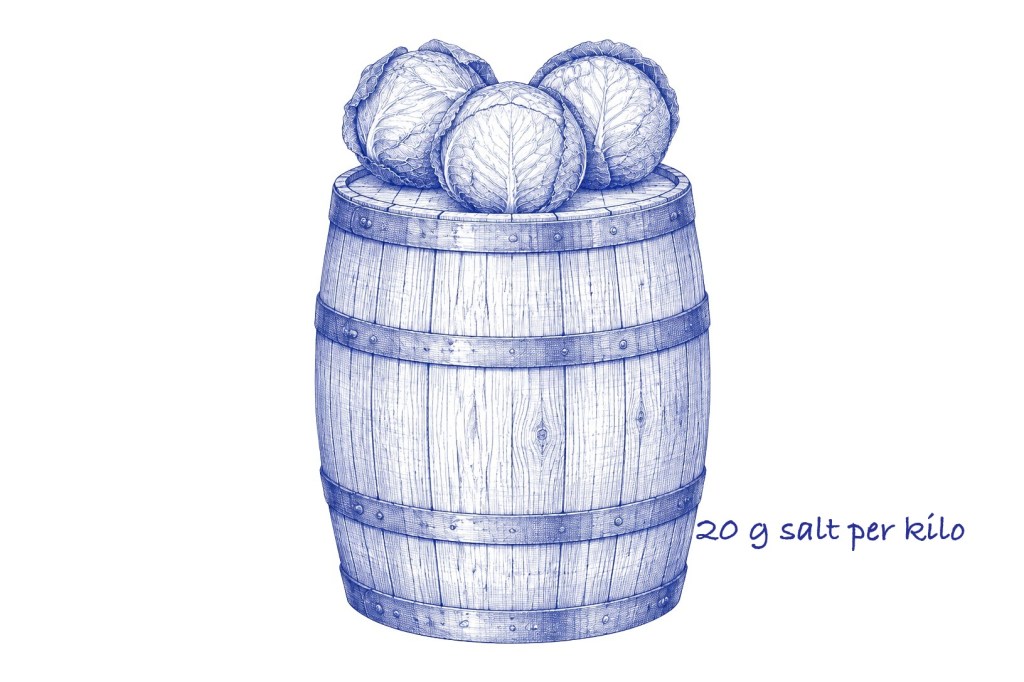
I grew up in Alsace, and in my youth I saw wooden barrels of sauerkraut everywhere. In the old days that is how it was made: cabbage shredded fine, salted, packed down hard into a big barrel, and left to ferment slowly until it turned sour and golden. Nobody called it a project. It was simply what you did with cabbage to get through the winter. I do not make it any more, but I remember the method very well, and it still works in a home kitchen with a crock.
What sauerkraut really is
Real sauerkraut has two ingredients: cabbage and salt. The salt pulls water out of the cabbage and makes a brine. Under that brine, with no air, natural lactic acid bacteria turn the sugar in the cabbage into acid. That acid is what gives sauerkraut its sour taste and keeps it from spoiling. There is no vinegar and no starter. Cabbage, salt, time.
The Alsatian ratio: 20 grams of salt per kilo
The rule I learned is 20 grams of salt for 1000 grams of cabbage. That is 2 percent by weight. It is also very close to the proportions in the recipe from the National Center for Home Food Preservation, which is reassuring: the traditional ratio and the tested one agree. Weigh both the cabbage and the salt. Measuring salt by the spoon is not reliable, because fine and coarse salts weigh very differently.
Use plain salt with no iodine or anti-caking agents, such as pickling salt or pure sea salt. Those additives can cloud the brine.
The little cloth purse
One detail I remember is that the spices did not go loose into the cabbage. We tied caraway seeds and juniper berries in a small piece of cloth, like a little purse, and buried it in the middle of the kraut. The flavor spreads through the brine, and at the end you lift the purse out and there are no seeds to pick from your plate. Juniper gives that piney, slightly peppery note you taste in a good choucroute.
Sauerkraut in a crock
I never use a barrel at home, and you do not need one. A ceramic crock or a wide glass jar works well. The recipe below is my adaptation of the old method, scaled for a home kitchen. This amount fills a 2-liter crock or jar.
- 1 kg (about 2 pounds) firm white cabbage, outer leaves and core removed
- 20 g plain salt, with no iodine or anti-caking agents
- 1 teaspoon caraway seeds
- 5 juniper berries, lightly crushed
- Wash everything: the crock, the weights and your hands. Keep the kitchen clean, but you do not need sterile conditions.
- Shred the cabbage as finely as you can with a sharp knife or a mandoline. Weigh it, and weigh out 2 percent of that in salt.
- In a large bowl, mix the cabbage with the salt and squeeze it firmly with your hands for 5 to 10 minutes. It will go limp and release a lot of liquid.
- Tie the caraway and juniper in a small square of clean cloth, like a purse.
- Pack the cabbage into the crock a handful at a time, pressing hard so the brine rises. Bury the spice purse in the middle.
- Press everything down so the brine covers the cabbage by at least a couple of centimeters. Set a plate, a weight or a water-filled bag on top to keep it under. Anything above the brine can spoil.
- Cover the crock with a clean cloth and leave it at room temperature.
Time and temperature
Sauerkraut ferments best at 70 to 75°F (21 to 24°C). At that temperature it takes about three to four weeks. In a cooler room, 60 to 65°F, plan on five to six weeks. Below 60°F it may not ferment properly, and in a warm kitchen above 75°F it can turn soft. Choose a spot out of direct sun.
You will see bubbles in the first days. After a week, start tasting it with a clean fork. When it is sour enough for you and the bubbling has stopped, it is done. When you like it, take out the spice purse, move the kraut with its brine into jars and keep it in the refrigerator, where it keeps for several months.
What to watch for
- Keep it under the brine. This is the one rule that matters most. If cabbage rises above the liquid, push it back down.
- A thin film on the surface can be skimmed off. Fuzzy mold, pink or black spots, or a rotten smell mean you should throw the batch away.
- Do not stir or open it often. Each time you uncover it, you let air and unwanted organisms in.
- Not enough brine: if the liquid does not cover the cabbage after a day, dissolve 1 teaspoon of salt in 250 ml of water and add it.
How to use it
Eat it cold, straight from the jar, as a side with sausages or roast pork. Rinse it briefly if it is too sour for you. In Alsace it becomes choucroute garnie, simmered slowly with white wine, pork and sausages. That dish deserves a post of its own, and I will write it later this winter.
My wife is from Shanghai, and she loves sauerkraut. She tells me it reminds her of her grandmother, who fermented vegetables in big jars to keep through the long winter. A continent apart, the idea was the same: salt, patience and a cool corner of the house.
The short version
- Weigh the cabbage and use 2 percent salt: 20 g per kilo.
- Squeeze it until it makes its own brine.
- Bury a small cloth purse of caraway and juniper in the middle.
- Keep everything under the brine, at 70 to 75°F for three to four weeks.
- Throw it out if you see fuzzy mold or smell anything rotten.

Leave a Reply