Truite au bleu is one of the simplest and most striking dishes in the French repertoire, and one of the easiest to get wrong. The trout is poached in an acidic broth and comes out with a pale blue sheen on its skin, curled slightly as if it were still swimming. There is no sauce to hide behind, no crust, no browning. It depends on one thing: a very fresh fish, handled as little as possible. It is a classic of Alsace, where trout come from the cold streams of the Vosges, and I will walk you through how it works and how to cook it at home.
Why the trout turns blue
The blue is not a dye and not a trick. A freshly killed trout is covered with a thin, slippery coating on its skin. When that coating meets acid and heat, it changes color and turns a soft, silvery blue. The more intact the coating, the better the effect.
That is why the rules are so strict. The fish must be extremely fresh, and for the most intense blue it should still be alive until the moment it is cleaned. It must not be scaled, scrubbed or rinsed under a hard stream of water, because rubbing removes the coating, and without it you get a plain poached trout with gray skin. A fish that has been sitting on ice for several days or has been frozen will not turn blue the same way. If you cannot find a very fresh fish, make something else. Poached trout is still good, but it is not truite au bleu.
How Alsace restaurants do it
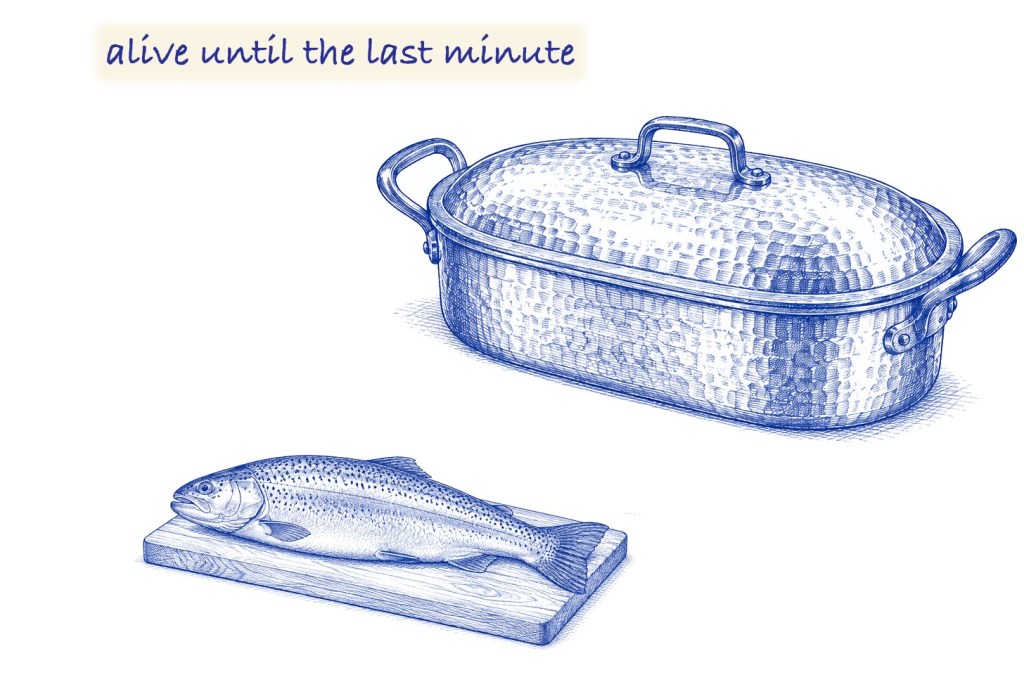
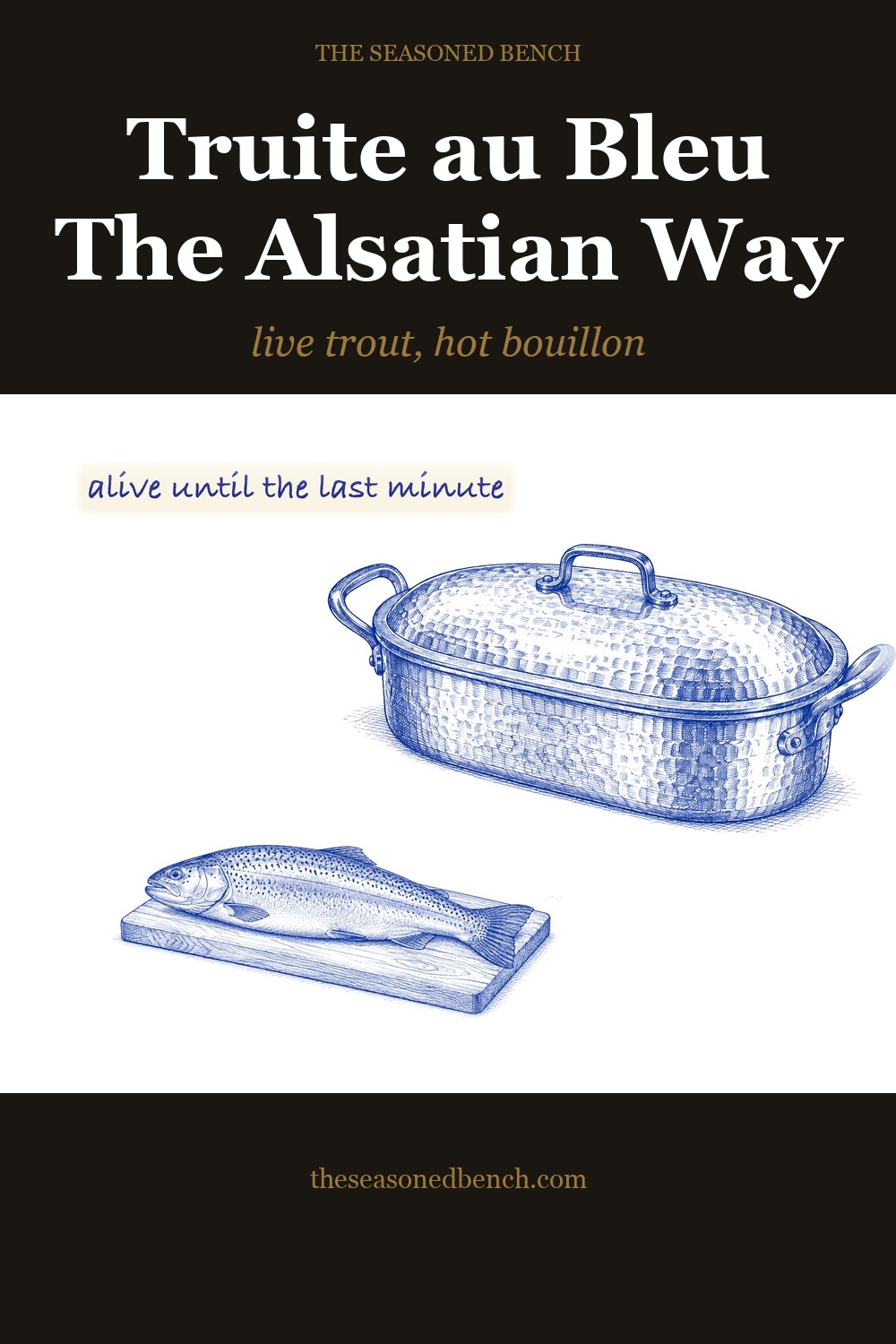
In the restaurants of Alsace, the trout is kept alive. Down in the basement there is a large tank, a vivier, with some fifty trout swimming in it. For every order, the youngest apprentice is sent down to fetch one. The apprentice runs back up to the kitchen, the fish is cleaned delicately, and it goes straight into the hot bouillon. A trout that is alive until the last minute gives the most intense blue, and that is exactly why the dish was done this way.
At home you will not have a vivier, so the goal is to get as close to that as you can. Buy from a trout farm or a fishmonger with a live tank, have the fish cleaned while you wait, and cook it within the hour. Handle it gently, and get it into the bouillon right away.
Choosing and preparing the fish
- Size: one trout per person, about 250 to 300 g (9 to 10 oz) each, cleaned. This size cooks evenly and fits on a plate.
- Source: ask a fishmonger who sells live or just-killed trout, or buy from a trout farm. Ask when it was killed.
- Cleaning: have the fish gutted through the belly, then rinse only the inside cavity with cold water. Leave the fins and tail. Do not scale it and do not wipe the skin.
- Handling: touch it as little as you can, and lift it by the head and tail, not with your fingers pressed on the sides.
The court-bouillon
Court-bouillon is simply a quickly simmered, seasoned liquid used for poaching. For truite au bleu it has to be clearly acidic, and in Alsace a dry white wine is the usual partner to the vinegar. For four trout:
- 2 liters (2 quarts) of water
- 250 ml (1 cup) dry Alsace white wine, such as Riesling
- 200 ml (3/4 cup) white wine vinegar
- 1 onion, sliced
- 1 carrot, sliced
- 1 stalk of celery, sliced
- 1 bay leaf, a few sprigs of thyme and parsley stems
- 8 black peppercorns
- 20 g (about 1 tablespoon) of salt
The traditional vessel for this dish is a truitière: a long, oblong copper pan with a domed lid and two handles, usually hammered copper with brass fittings, and often quite ornate. It is made for trout, long enough for the fish to lie flat, and handsome enough to come to the table. Some have a perforated insert that lets you lift the fish out in one move. If you do not have one, any long fish poacher or a wide, shallow oval pot will do. Put everything in the pot, bring it to a boil, then lower the heat and simmer gently for 20 minutes. Strain it if you like, and let it come back to a bare simmer before the fish goes in. The vinegar is what turns the skin blue, so do not cut it back.
How to poach the trout
- Keep the trout cold until the last minute. Bring the court-bouillon to a gentle simmer, about 90°C (195°F), with just a few bubbles breaking the surface. It must not boil hard.
- Lower the fish into the liquid carefully, one at a time, so they are fully covered. Some cooks pour a little hot vinegar over the fish just before, which gives a deeper blue.
- Poach for 6 to 8 minutes, depending on size. A 250 g trout needs about 6 minutes.
- Check that it is done: the dorsal fin should pull out easily, and the flesh at the thickest part near the head should be opaque and just flake when pressed.
- Lift the fish out with a slotted spoon or a spatula and drain for a few seconds on a clean cloth.
Boiling too hard breaks the skin and the blue will tear. A gentle simmer keeps it intact. Do not leave the trout in the liquid once it is cooked, or it will dry out.
What to serve with it
The classic accompaniments are small boiled potatoes with parsley and a sauce made from butter. Melted butter is the simplest; hollandaise is the richer version. A lemon wedge and a spoonful of grated fresh horseradish are also traditional in some regions. Keep the plate plain. In a dish like this, extra seasoning gets in the way of the fish.
- Boiled potatoes: peel them, cook in salted water until tender, and toss with chopped parsley.
- Melted butter: warm good butter gently and spoon it over the fish at the table.
- Wine: pour the same dry Alsace white that went into the court-bouillon, such as a Riesling or a Pinot Blanc.
Common mistakes
- Scrubbing or scaling the fish. The coating is what turns blue, so leave it alone.
- Not enough vinegar. Without acid the skin stays gray.
- Boiling instead of simmering. It tears the skin and overcooks the flesh.
- Using an old fish. It will not turn blue, and the flavor will be dull anyway.
The short version
- Buy very fresh trout, about 250 to 300 g each, and handle them as little as possible.
- Rinse only the inside, never scale or scrub the skin.
- Simmer a court-bouillon of water, white wine and vinegar, with vegetables and herbs, for 20 minutes.
- Poach the trout at a gentle simmer, about 90°C (195°F), for 6 to 8 minutes.
- Serve at once with parsley potatoes and melted butter.
If you like Alsace cooking, you may also enjoy my post on sauerkraut the Alsatian way.

Leave a Reply