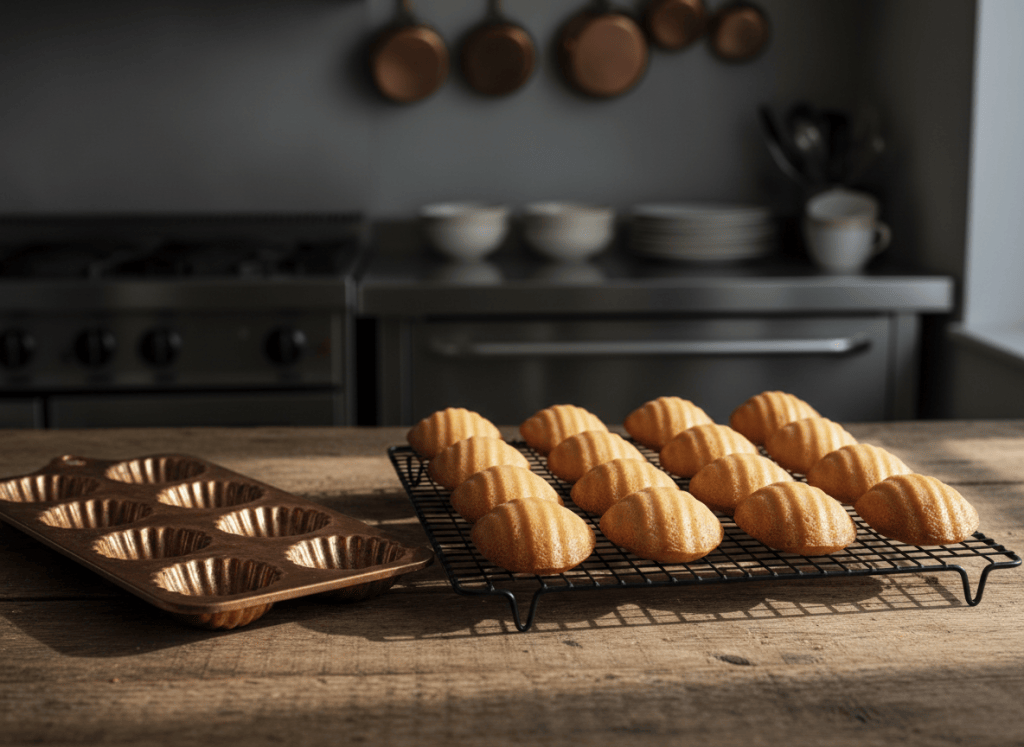
A madeleine is one of the simplest pastries in the French repertoire and one of the easiest to get wrong. Nine ingredients, no special skill — and yet most madeleines you meet are flat, pale, and dry. The difference between those and the real thing comes down to three things: brown butter, a cold overnight rest, and the right pan.
I learned this recipe the hard way, in a kitchen where a flat madeleine got sent back to the bench without a word — just a raised eyebrow that meant do it again. Forty years later, the method hasn’t changed.
Yield: 24 madeleines (2 standard pans)
The Three Rules
- Brown the butter. Nutty brown butter is half the flavor of a great madeleine. It takes four extra minutes. Do not skip it.
- Rest the batter overnight. The chill is not optional — it is the bump. Ice-cold batter hitting a hot oven and a hot pan creates the thermal shock that pushes the classic hump, la bosse. Warm batter bakes flat.
- Use a dark metal pan. Black steel or copper browns the shell and delivers the shock. A pale pan gives you blond, cakey shells. Silicone is worse still — I explain all of this in my mold guide: Copper vs. Silicone vs. Black Steel Molds.
Ingredients
- 150 g (10½ tbsp) unsalted butter, plus more for the molds
- 3 large eggs, at room temperature
- 130 g (⅔ cup, scant) granulated sugar
- 10 g (2 tsp) honey — the classic French touch, for moisture and color
- 1 tsp vanilla extract (or the seeds of half a vanilla bean)
- 150 g (1¼ cups) all-purpose flour
- 6 g (1¼ tsp) baking powder
- ¼ tsp fine sea salt
- Lemon zest from ½ lemon (optional, but classic — Proust would approve)
A note on flour: weigh it if you can. Madeleine batter is thin and sensitive to too much flour, and cups vary wildly.
Method
- Brown the butter (do this first, so it cools). Melt the butter in a light-colored saucepan over medium heat. Let it foam, then keep going, swirling, until the milk solids at the bottom turn golden brown and it smells like hazelnuts — 4 to 6 minutes total. Pour into a bowl, scraping the solids in, and set aside to cool to room temperature.
- Make the batter. Whisk the eggs, sugar, honey, and vanilla (and lemon zest, if using) vigorously for about a minute, until pale and slightly thickened — you don’t need a mixer, a good whisk arm is enough. Whisk in the salt. Sift the flour and baking powder directly over the bowl and fold in gently with a spatula until just combined — a few streaks of flour are fine at this stage. Stream in the cooled brown butter, including every browned bit from the bottom of the bowl, and fold until the batter is smooth and glossy. It should be a thick ribbon that slowly settles.
- Rest — overnight. Press plastic wrap directly onto the surface of the batter and refrigerate at least 4 hours, ideally 12 to 24. This rests the gluten, hydrates the flour, and — most importantly — makes the batter ice-cold for the oven shock.
- Prepare the pans. Brush the molds generously with softened butter, then dust with flour, tapping out the excess. If your pan is well-seasoned black steel, a light coat is still worth it for the edges. (The old-school method for copper molds is beeswax and butter — half and half, brushed warm. It gives canelé-grade edges. See my mold guide for details.)
- Bake. Preheat the oven to 400°F (200°C) — hot, on the strength of the shock. Spoon or pipe a rounded tablespoon of cold batter into the center of each mold — do not spread it; the oven does that. Do not fill to the edges; two-thirds is right. Bake 8 to 11 minutes, until the shells are deeply golden at the edges, lightly golden on the bump, and spring back when touched. A real madeleine is darker than most people expect — pale is underbaked. In my copper pan, this takes 8 minutes on the dot.
- Unmold immediately. Turn them out onto a rack the moment they leave the oven — a minute in the pan and the steam softens the crust you worked for. Eat as many as you reasonably can within the first 20 minutes.
Madeleines à la Minute (No Overnight Rest)
Some nights someone wants madeleines and there’s no batter resting anywhere. This is the version for that night — and the one I actually learned first, at Le Gavroche.
Madeleines there were never made ahead. The chef wanted them à la minute, and that job fell to whoever was youngest in the kitchen that service — usually me. At the end of the night, with the last covers still going out, I’d be at the bench portioning batter onto a tray, firing a few dozen to go out warm with the mignardises. The game — and every kitchen has one — was stealing them. The second a tray came out of the oven, hands would find a reason to walk past it before I could get them to the pass. The chef would yell about it, every time, and every time it was theater. He did the exact same thing the moment he thought no one was looking. They were irresistible hot, and everyone in that kitchen knew it, including him.
The trick is thermal shock without the wait: you can’t chill the batter overnight, so you chill it fast and make the pan work harder to close the gap.
Method:
- Make the batter as above, but use the eggs cold from the fridge rather than room temperature — you’re fighting for every degree.
- Portion the batter directly onto a tray — a rounded tablespoon per mound, spaced apart — and freeze for 10 minutes. This is your overnight rest, compressed.
- While it chills, preheat the oven to 425°F (220°C) with the madeleine pan already inside, empty. A cold pan won’t shock the batter the way a hot one will — this is exactly where black steel or copper earns its price. (See Copper vs. Silicone vs. Black Steel Molds.)
- Butter and flour the hot pan quickly, drop a frozen portion of batter into each mold, and get it back in the oven immediately.
- Bake 7 to 9 minutes. Don’t walk away — this version moves fast, and the gap between right and too dark is short.
Be honest about the trade. The bump is a little more rustic than a proper overnight batter gives you, and the crumb a touch less delicate. What you get instead is a madeleine that didn’t exist an hour ago, still hot in your hand. Most nights, that’s the better trade.
Running this for a few people, split the tray before it freezes — one plain, one lemon, one orange blossom. That’s exactly how it’s played at service: a few variations off the same batter, ready to fire the moment someone asks.
When to Eat Them
A madeleine has a lifespan of hours, not days. This is not a flaw; it is the entire point. The contrast — crisp shell, warm custard center — exists for roughly the length of an afternoon coffee. Day-old madeleines are a different, lesser pastry. If you must keep them, store in an airtight tin for a day and crisp them 3 minutes in a 300°F oven.
This is why no bakery madeleine has ever matched one from your own oven, and why Proust’s were tied to a memory of a specific afternoon.
Variations Worth Making
- Lemon madeleines: add the zest of a whole lemon and a spoon of juice
- Orange blossom: ½ tsp orange blossom water instead of vanilla — very Provençal
- Brown butter & sea salt: finish warm shells with a whisper of flaky salt
- Dipped: half-dip cooled shells in tempered dark chocolate and let set
FAQ
Why are my madeleines flat?
The batter was too warm, the oven too cool, or you skipped the rest — sometimes all three at once.
Why are my madeleine shells pale instead of golden?
The pan. Light-colored or silicone pans steam the batter rather than searing it. See Copper vs. Silicone vs. Black Steel Molds for why the pan matters more than people think.
Why are my madeleines sticking to the pan?
Under-buttered molds, or you let them cool in the pan before unmolding. Turn them out hot, not later.
Why do I get a bump on one pan and not another?
Pans vary in thickness. The thinner one heats faster and shocks harder. Rotate pans between batches until you learn your own pan’s timing.
Can I make madeleines without resting the batter overnight?
Yes — see the à la minute method above. Freeze portioned batter for 10 minutes and bake in a pan that’s been preheated hot instead of relying on an overnight chill. You trade a slightly more rustic bump and a less delicate crumb for madeleines ready the same night.
Equipment I Use
- Black steel madeleine pan — the workhorse, bakes beautifully, cheap, lasts forever
- Copper madeleine pan — the investment pick; the caramelized edges are real, buy it once for this pastry and keep it for years
- A small light-colored saucepan, so you can see the butter browning
- Digital kitchen scale
Related Guides
- Copper vs. Silicone vs. Black Steel Molds — the mold argument behind this recipe
- Canelés de Bordeaux — the other pastry that lives and dies by its mold
- Beef, Lamb and Pork Baeckeoffe — more from the French recipe cluster
- Best Chef’s Knife for Home Cooks
Disclosure: This post contains affiliate links. If you purchase through these links, I may earn a small commission at no additional cost to you. I only recommend equipment I have used in professional kitchens.
 The Seasoned Bench
Leave a comment