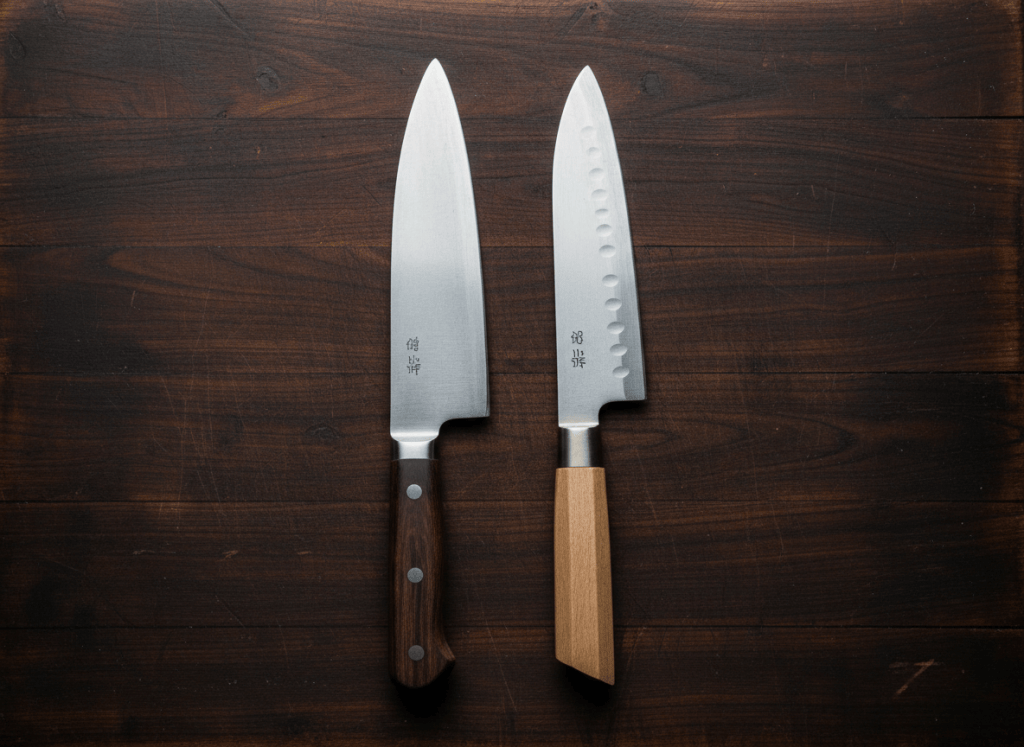
This is one of the most common questions I hear from home cooks putting together their first real knife collection: do you need a chef’s knife, a santoku, or both? The two look similar enough at a glance that it’s easy to assume they’re interchangeable. They’re not — the differences in shape lead to real differences in how each one handles a cutting board.
Side-by-Side Comparison
| Chef’s Knife | Santoku | |
|---|---|---|
| Blade shape | Curved belly, tapers to a point | Flatter edge, rounded tip (“sheep’s foot”) |
| Typical use | Rock-chopping, mixed prep, breaking down proteins | Push-cutting, thin slicing, vegetable-heavy prep |
| Learning curve | Moderate — rocking motion takes some practice | Low — straight up-and-down motion is intuitive |
| Typical price range | $50–$200 | $40–$180 |
Choose a Chef’s Knife If…
- You cook a mix of vegetables, meat, and fish, and want one knife that handles all of it reasonably well
- You’re comfortable with (or want to learn) a rocking chop motion
- You want the single most versatile knife in your kitchen, full stop
Choose a Santoku If…
- Most of your prep is vegetables — thin slicing, dicing, mincing herbs
- You prefer an up-and-down push cut over a rocking motion
- You want a lighter knife that feels less intimidating for everyday use
A Story From the Classroom
When I helped build the culinary sciences program at a university in Macau, this exact question showed up in a completely unexpected way. Most of our students arrived on day one owning exactly one blade — a cleaver. In Macau, as across much of China, the cleaver is the everyday kitchen knife; a Western-style chef’s knife or santoku simply isn’t part of most home kitchens.
What struck me was how the skill didn’t transfer the way you’d expect. These students were remarkably capable with a cleaver — fast, precise, completely at ease with a tool that intimidates most Western home cooks. Hand them a Western chef’s knife, though, and suddenly they were the beginners, relearning grip, balance, and motion from scratch. It was a good reminder that “easy” and “hard” in the kitchen are almost entirely about what you grew up using, not about the tool itself.
My honest take, for readers starting from zero the way those students effectively were with Western blades: if you can only own one, get the chef’s knife — see our full guide to the best chef’s knives for home cooks. But if your cooking leans heavily toward vegetables and you already own a chef’s knife, a santoku is one of the best second-knife additions you can make.
Product Recommendations
Chef’s Knife: Wusthof Classic 8″
Santoku: Global G-48 7″
Lightweight, well-balanced, and a genuinely excellent introduction to Japanese-style knives if you haven’t used one before.
Want to keep both edges performing their best? See our guide on knife care and sharpening systems.
As an Amazon Associate, I earn from qualifying purchases.
 The Seasoned Bench
Leave a comment