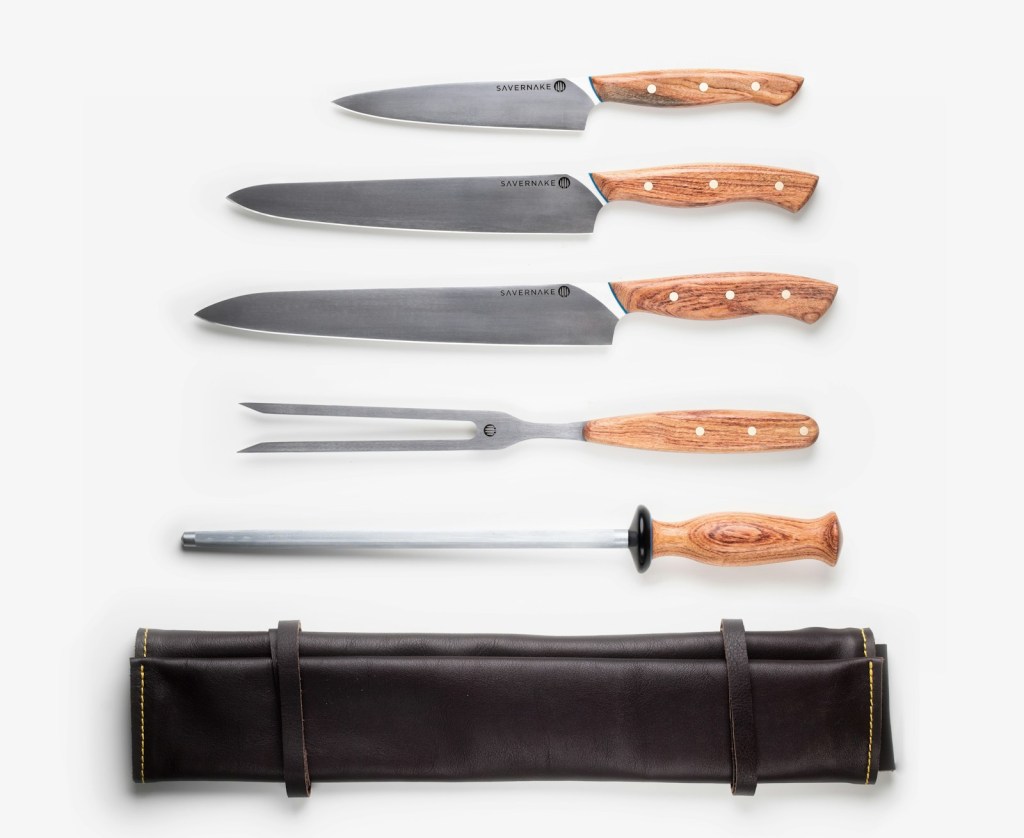
By Chef Jean Alberti — 40 years in professional kitchens
Every year around the holidays, and again in wedding season, someone asks me the same question. Usually it’s a young cook; sometimes it’s a mother shopping for her son’s first apartment: “Which knife block set should I get?”
I’ve been answering it the same way for decades, and I’ll give you the answer up front so you can stop reading if you want:
Most knife block sets are worth less than the knives inside them. You pay for a wooden block, two or three blades you’ll actually use, and a pile of others that will sit there until you move out. Take the same money, buy three good knives, and you’ll have a better kitchen, a sharper edge, and cash left over.
Now let me tell you why — and what to buy instead.
The Short Answer
If you want the two-sentence version for the back of an envelope:
- A $200 block set gives you 15 pieces at about $13 each. Two of them are worth keeping.
- Ask me which knives I reach for first in any kitchen I’ve run, and the answer is three knives, a steel, and a stone. That’s the whole list.
The rest is marketing.
Why Block Sets Exist (and Who They’re Really For)
Block sets aren’t designed by knife people. They’re designed by packaging people.
A block full of knives on a counter looks like a complete kitchen. It has heft, it has presence, it photographs well in a gift box. When you buy a block set, you’re mostly buying the feeling of a finished kitchen — and that’s exactly what makes it such a popular wedding gift. Nobody ever regretted giving one.
But think about what’s actually in the box:
| What’s in a typical 15-piece set | What a working bench holds |
|---|---|
| 8″ chef’s knife | 8″ chef’s knife |
| 3.5″ paring knife | Paring knife |
| 5″ santoku | Santoku or bread knife — pick one |
| 5″ utility knife | Honing steel |
| 8″ bread knife (serrated) | Whetstone or sharpener |
| 6 steak knives | Magnetic strip, blade guard, or knife roll |
| Kitchen shears and a honing steel | — |
| The block itself | — |
Look at the right-hand column: three knives, a steel, a way to sharpen, and somewhere to keep them. Everything on the left that isn’t on the right is something you can buy later, when a real job demands it — not something you need on day one.
The Three Real Problems with Block Sets
1. The filler blades
In professional kitchens from Alsace to Shanghai to San Francisco, I have never once reached for the carving knife from a block set. Neither has anyone on my line.
In a home kitchen, the steak knives get used twice a year and the carving knife waits for Thanksgiving. By then, after eleven months untouched in the block, they’re dull anyway — which brings me to problem two.
2. The block itself
A wooden block has two jobs: storing knives and slowly dulling them.
Every time a blade slides in or out of a slot, the edge drags along the wood. Do that every day and your brand-new set starts losing its edge in the first week. The slots also collect crumbs, dust, and moisture — pull an old block apart sometime and look inside. I have, during more than one sanitation inspection, and it’s one reason you won’t find blocks in a professional kitchen.
What do kitchens use instead? A magnetic strip on the wall, a blade guard in a drawer, or a knife roll. All three cost less than a block, and all three keep the edge from dragging. (If you keep a block anyway, slide each knife in spine-down so the edge doesn’t ride on the wood.)
3. The false economy
Here’s the math nobody does. A $200 set with 15 pieces works out to about $13 a piece — and the block probably cost the manufacturer more than several of the knives did.
You don’t need thirteen pieces you’ll never use. You need two or three knives that hold an edge and make you happy every time you pick them up. The same $200 gets you exactly that — I’ll show you how below.
(I wrote a whole guide on the one knife that matters most, if you want to go deep: the best chef’s knife for home cooks.)
The One Legitimate Case for a Set
I’ll be fair. There is one situation where I nod and say “fine, buy the set”:
You’re setting up a first kitchen from zero, your budget is one gift card, and the alternative is buying random cheap knives one at a time.
If that’s you, a small set — 2 to 4 pieces, no block full of steak knives — is not a sin. It’s a starting point you’ll upgrade one knife at a time, and there’s a decent version of that at the bottom of this post.
But if you already own one working chef’s knife, don’t buy a set. Buy the next good knife. A kitchen is assembled, not unboxed.
The 3 Knives (and 1 Sharpener) That Replace Any Block Set
This is the bench, in order of purchase:
1. The 8-inch chef’s knife — buy this first and spend the most here.
Ninety percent of your cutting happens with this knife: onions, garlic, herbs, chicken, squash. If you only buy one, this is it. My full guide, with five picks at every price, is here: best chef’s knife for home cooks. On a strict budget, there’s one under $100 I still recommend to apprentices: best budget chef’s knife under $100.
2. The paring knife.
Peeling, trimming, hulling strawberries, peeling ginger — the little jobs where a big knife is clumsy. Spend $10–60 and be done for years.
3. The santoku or the bread knife — know which cook you are.
If you cook vegetables and weeknight proteins, the santoku is a lovely second blade. If your kitchen smells like fresh baguettes, get the serrated bread knife. I laid out the full comparison here — including why I own both but reach for only one: chef’s knife vs santoku.
4. The sharpener.
The block set’s greatest trick is convincing you that sharpening is included. It isn’t. The steel rod in most blocks hones — it straightens the edge — but it doesn’t sharpen. A dull $180 knife loses to a sharp $40 knife every single time, so this purchase protects all the others: knife sharpening systems, tested.
Everything else — carving knife, boning knife, fillet knife — you buy later, when a specific job demands it. That’s how professionals build a kit, and the same logic works in a home kitchen. (If you want to see how I stocked an entire kitchen around this principle, the whole system is here: how I stock my kitchen.)
The Three I Reach For First
My full roll holds more than this post might suggest — I walk through every piece in what’s in a chef’s knife roll after 40 years. But a young line cook asked me last month which knives I’d keep if I could only keep three, and the answer came out before he finished the question.
A 10-inch chef’s knife I’ve had since the eighties. A paring knife. A flexible fillet knife my father would have called the most personal tool in the kit. Plus a small steel, and a pocket whetstone that’s older than the cook asking the question.
Three blades and two ways to keep them sharp. Three continents, kitchens that fed presidents — and those five pieces would fit in a canvas roll the size of a laptop sleeve.
Nobody would walk past that bench and think I was underequipped. They’d think: that man can cook.
If You Must Buy a Set (The Gift Guide)
Sometimes the set isn’t for you — it’s a wedding gift, a graduation present, and the person unwrapping it wants to see a box. Fine. Here are the sets I’d actually give, all small, all without the worst sins of the 15-piece industry:
(Amazon affiliate links — I earn a small commission at no cost to you, and I only recommend gear I’d let on my bench.)
The best small set for a first kitchen:
Victorinox Swiss Classic 3-Piece Chef’s Set — two chef’s knives, one full-size and one smaller, plus a paring knife. Same company that makes my budget knife pick. No block filler, just three useful blades.
The upgrade gift:
Wüsthof Gourmet 2-Piece Chef’s Knife Set — a German 8-inch chef’s knife and a 4-inch utility knife from a maker I trust. Two knives that will outlast the registry.
The culinary-school starter:
Mercer Culinary Millennia Culinary School Kit — the kind of kit culinary students actually buy: an 8-inch chef’s knife, a slim paring knife, a honing steel, a peeler, and a pocket thermometer, with blade guards, all in a knife roll. It’s the one exception to my five-piece rule below, because everything comes in a roll instead of a block, and the roll is the point.
Skip anything with more than five pieces, anything with “21-piece!” on the box (that count includes the block, the shears, and a drawer’s worth of steak knives), and any block with built-in sharpener slots. The ceramic rods in those slots grind a little steel off every time you pull the knife out, wearing the blade down and leaving a rough, uneven edge. That’s problem #2 with a bow on it.
FAQ
Do professional chefs use knife blocks?
No professional kitchen I’ve worked in has used a block for storage. Wall magnets, blade guards, and knife rolls keep the edge from dragging and are faster to clean and sanitize.
Are knife blocks sanitary?
They can be cleaned, but the slots are nearly impossible to sanitize properly, and they trap moisture and crumbs. A dirty knife block is a common finding in kitchen inspections.
What about blocks with built-in sharpeners?
Avoid them. The ceramic rods in the slots grind a little steel off every time you remove or replace the knife. It’s wear and tear disguised as a feature.
Is a knife set a good wedding gift?
A small quality set is. A 15-piece block is a gift that looks generous in the box and quietly disappoints for ten years. Two good knives and a sharpener, wrapped in a knife roll, is the gift a cook will still be using in 2046.
How many knives does a home cook actually need?
Three: a chef’s knife, a paring knife, and either a santoku or a serrated bread knife. Plus a sharpener. That’s the real count.
A note on care: whichever route you go, the knife you bought deserves to outlive the block you didn’t. Here’s how I keep mine sharp and rust-free after 40 years: how to care for your knives so they last. And if you’re rethinking your board too: wood vs plastic cutting boards.
— Chef Jean Alberti, The Seasoned Bench. I spent 40 years in professional kitchens, from Alsace to San Francisco. This blog is where I write about the tools that actually earn their place on a working bench.
FTC Disclosure: This post contains affiliate links. If you buy through them, I may earn a small commission at no extra cost to you. I only recommend equipment I would put on my own bench. As an Amazon Associate, I earn from qualifying purchases.

Leave a comment