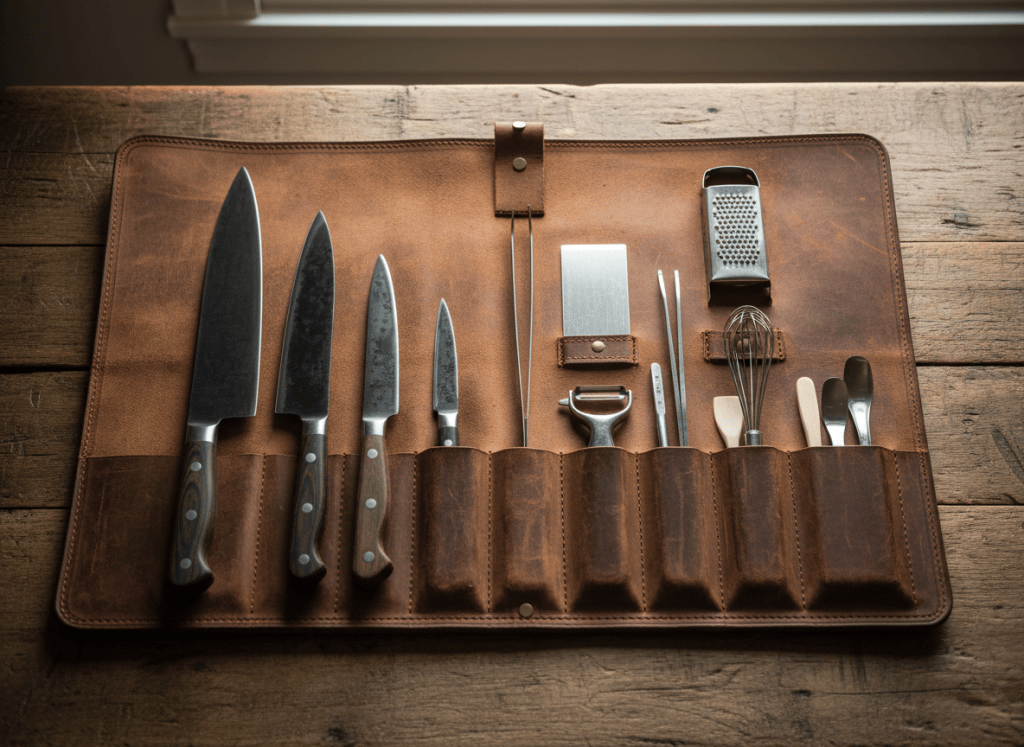
A knife roll tells you everything about the cook who packed it. Not what they own — what they actually use. Over 40 years, mine has been edited constantly: things added when a new station demanded them, things dropped when they turned out to be more trouble than they were worth. What’s left is not a wish list. It’s a working kit, refined by decades of actual service.
Here’s what’s actually in it, and why each piece earned its place.
Essential Knives
Chef’s Knife
The main workhorse, 8 to 10 inches. This is what handles the bulk of chopping, slicing, and dicing on any station, and it’s the one blade I’d genuinely never work without. I’ve written a full guide to picking the right one if you’re starting from scratch.
Paring Knife
A small, nimble 3-to-4-inch blade for intricate peeling, coring, and any in-hand work where a full-size knife is too much tool. Every roll needs one — it’s the second knife you reach for most, right after the chef’s knife.
Petty or Utility Knife
A 5-to-6-inch mid-sized knife for quick, minor cutting tasks that don’t justify pulling out the chef’s knife. It fills the gap between the paring knife and the chef’s knife almost perfectly, and it’s the tool I reach for more often than people expect.
Boning or Fillet Knife
Thin and flexible, for breaking down meat or fish. Optional for a lot of home cooks, but non-negotiable for any station that handles butchery or fish prep regularly. The flex in the blade is what lets it follow bone and joint without hacking through either.
Serrated Bread Knife
Optional, but essential the moment you’re working with pastries, artisan bread, or anything delicate like tomatoes that a straight edge would crush instead of slice. If you’ve made the no-knead Dutch oven loaf, you already know why a clean serrated edge matters.
Couteau Filet de Sole
A specialized fillet knife for flat fish — sole, turbot, that family of fish with a distinct anatomy that a standard fillet knife doesn’t handle as cleanly. Narrow and specific, but exactly right for the job it’s built for.
Cleaver
For heavy work — breaking down bone, splitting joints, the kind of force a chef’s knife was never designed to take. I have a real appreciation for the cleaver that goes beyond utility; some of the most skilled knife work I’ve ever watched came from students who’d only ever used one.
Batte à Côtelette
A meat pounder, for evening out cutlets and scaloppine to an even thickness before cooking. Not glamorous, but the difference between a cutlet that cooks evenly and one that’s overdone on one side and raw on the other.
Poultry Shears
For breaking down a bird cleanly — through joints and thin bone in a way no knife manages as efficiently. A dedicated pair earns its space the first time you try to spatchcock a chicken with a knife instead.
Precision & Prep Tools
Microplane Grater
Indispensable for zesting citrus, grating garlic, or finishing a dish with hard cheese. Small, cheap, and one of the tools I’d genuinely miss the most if it disappeared from the roll.
Bench Scraper
Perfect for moving chopped product off the board, cleaning counters, or portioning dough. A flat piece of metal that somehow ends up in my hand more than half the knives in this list.
Plating Tweezers
Long, precise tweezers for delicate garnish placement and accurate plating. The difference between a plate that looks composed and one that looks dropped into place.
Offset Spatula
A mini metal spatula, great for flipping small items, spreading, or lifting delicate garnishes without disturbing them. The offset angle keeps your hand out of the way in a manner a flat spatula can’t match.
Tasting and Plating Spoons
Solid and slotted spoons for basting, tasting sauces, or portioning. Simple tools, but I go through more of these in a service than almost anything else in the roll.
Kitchen Shears
Heavy-duty shears for cutting twine, opening packaging, and the dozen small jobs a knife shouldn’t be used for. Distinct from the poultry shears above — these are for everything else.
Speed Peeler
A reliable vegetable peeler for quick, uniform prep work. Unglamorous, but a bad peeler slows down a station more than almost any other tool on this list — a good one disappears into the work entirely.
What Four Decades Actually Teaches You
None of this is a shopping list. It’s the result of decades of carrying tools I didn’t need out of a roll, and keeping the ones that kept proving themselves, service after service. If you’re building your own kit — professional or home — that’s really the only test that matters: not what looks complete, but what you’d actually reach for again tomorrow.
If you’re starting with just one piece, start with the chef’s knife — see the full guide — and let the rest of the roll grow the way mine did: one genuine need at a time.
 The Seasoned Bench
Leave a comment