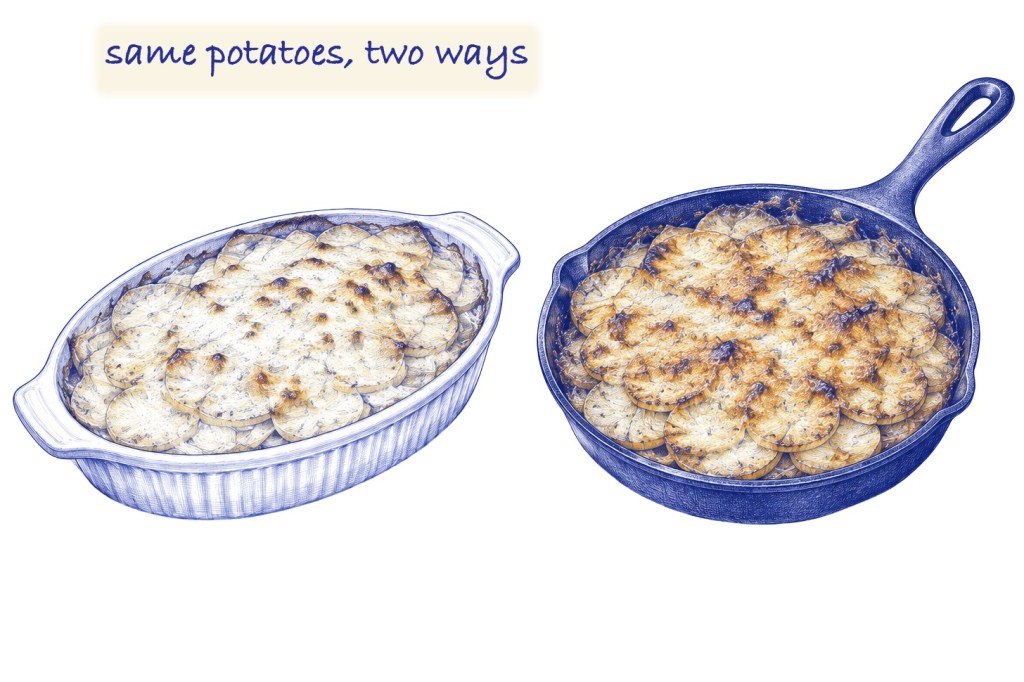
Gratin dauphinois is potatoes, cream and patience. There is no secret ingredient, and the traditional version has no cheese. What separates a great gratin from a watery or greasy one is a handful of small decisions: how you slice, whether you rinse, how you heat the cream, and how slowly you bake. This dish rewards care far more than it rewards extra ingredients. It is also an ideal Thanksgiving-season side, because it can be assembled ahead and finished in the oven.
Gratin dauphinois vs gratin savoyard
Both are gratins of thinly sliced potatoes from neighboring regions of southeastern France: the Dauphiné, around Grenoble, and the Savoie, in the Alps. They look alike on the plate and are often confused, but they are different dishes.
- Gratin dauphinois: potatoes cooked in cream and milk, with garlic, butter, salt, pepper and sometimes nutmeg. By tradition, no cheese. The result is soft, rich and creamy.
- Gratin savoyard: potatoes cooked in stock, usually beef and sometimes chicken, with cheese from the Savoie, traditionally Beaufort. No cream. The result is lighter and more savory, with a golden cheese crust.
Many cooks and restaurants today add cheese to a dauphinois and still use the name. Purists in the Dauphiné would say that once you add cheese, you have made a savoyard. Below is the classic dauphinois, and a short section on how to turn the same potatoes into a savoyard.
Ingredients (serves 6 as a side)
- 1 kg (about 2.2 lb) potatoes, all-purpose or lightly waxy (Yukon Gold works well)
- 400 ml (1 2/3 cups) heavy cream
- 400 ml (1 2/3 cups) whole milk
- 1 garlic clove, halved
- 20 g (1 1/2 tablespoons) butter, soft, plus a little for the dish
- About 2 teaspoons fine salt, or to taste
- Freshly ground black pepper and a small grating of nutmeg
Choose and slice the potatoes
Pick a potato that holds its shape but still releases some starch. Very waxy potatoes stay separate and the sauce stays thin. Very floury potatoes can fall apart. Peel them and slice evenly at about 3 mm (1/8 inch). A mandoline gives the most even result, and even slices cook at the same rate, which matters more here than almost anything else. Mind your fingers and use the guard.
Do not rinse the slices. The surface starch is what thickens the cream into a silky sauce. If you slice ahead, keep the slices covered with a damp towel for a short time only, since they darken when exposed to air.
Method
- Heat the oven to 150 C (300 F). Rub a 2-liter (about 9 by 13 inch) gratin dish with the cut garlic, then butter it lightly.
- Put the cream, milk, salt, pepper and nutmeg in a wide pot and bring to a gentle simmer. Add the potato slices and simmer about 10 minutes, stirring carefully, until the liquid has thickened slightly and the slices have begun to soften at the edges. This step releases starch and gives a more reliable texture than raw layers.
- Taste the liquid. It should taste lightly seasoned, because the potatoes will absorb salt as they bake.
- Transfer everything to the dish and level the top. Dot with the soft butter.
- Bake 60 to 90 minutes, until the top is golden and a knife slides through the potatoes with no resistance. Oven times vary, so go by the knife, not the clock. If the top browns too early, cover loosely with foil.
- Rest 10 to 15 minutes before serving. The sauce sets as it cools slightly.
How to make a gratin savoyard instead
Use the same 1 kg of potatoes, sliced the same way and not rinsed. Replace the cream and milk with about 400 ml (1 2/3 cups) of hot, good beef or chicken stock, and add about 150 g (5 oz) of grated Beaufort, or Gruyère if you cannot find it. Rub the dish with butter, layer the potatoes with the cheese and a little salt and pepper, and pour in the hot stock. Bake at 200 C (400 F) for about 45 minutes, until the potatoes are tender, the stock has been absorbed and the top is golden. Quantities and oven temperatures vary between recipes, so go by the knife again. Use a well-flavored stock, since there is no cream to carry the taste.
Common problems and fixes
- Watery gratin: the potatoes were rinsed, the slices were too thick, or there was too much milk. Bake a little longer, uncovered.
- Greasy or split cream: the oven was too hot. Low heat keeps the cream smooth.
- Hard centers: uneven slicing. Bake longer and cover if the top is dark.
- Bland: under-salted liquid. Taste it before baking, as you would a soup.
Make it ahead for the holidays
Bake the gratin fully, cool it, and refrigerate it covered for up to two days. Reheat at 160 C (325 F), covered, for about 25 minutes, then uncover for a few minutes to crisp the top. This frees your oven timing on a crowded holiday day. Serve it beside roast chicken (see Roast Chicken the French Way) or a roast, with a sharp green salad dressed with a good vinaigrette to cut the richness.
The bottom line
Slice evenly, keep the starch, season the cream, and bake low and slow. That is the whole recipe. The patience is the ingredient. And if you want a lighter, cheesier version, the savoyard is a short step away.

Leave a Reply