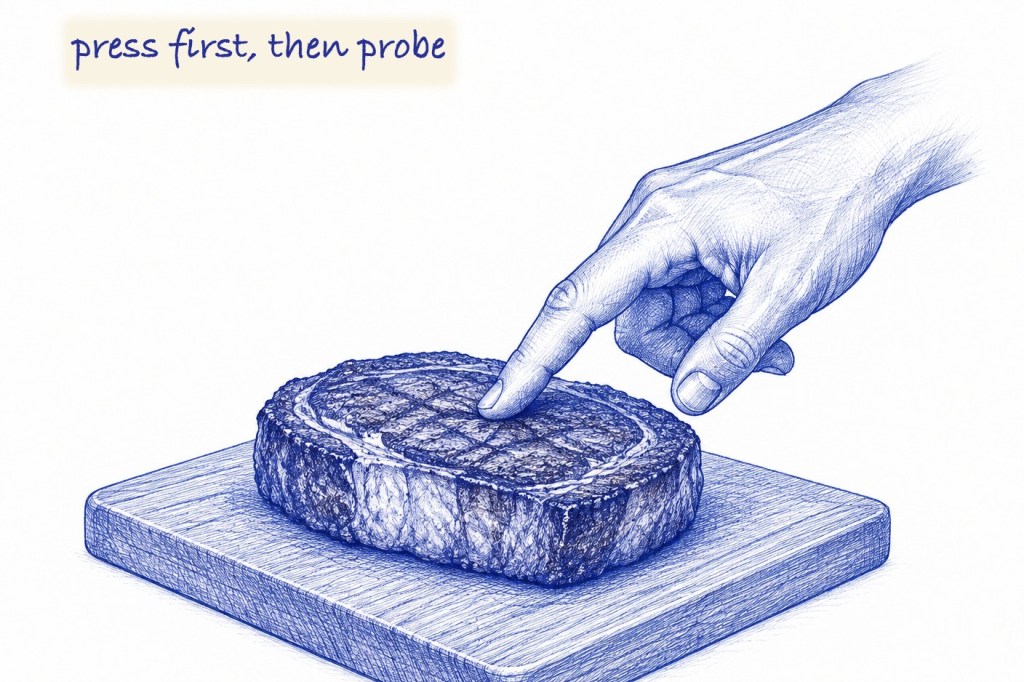
I do not use a meat thermometer. I never have. After a lifetime in professional kitchens, I check a steak, a chop or a roast with my fingers, and so do most of the older chefs I know. And yet, if you cook at home, I will tell you to buy a thermometer. Both things are true, and this post explains why.
Why older chefs do not use thermometers
It is not that thermometers are bad. It is a matter of how we were trained. Many older chefs learned in kitchens where cheap, fast digital thermometers did not exist. You learned by cooking the same cuts, over the same fire, every day, and by touching them every day. After thousands of steaks, the hand knows what rare feels like and what medium feels like, in the same way you recognize a friend’s voice without thinking about it.
There is also the pace of service. On a busy line there may be twenty steaks and chops on the grill at once. Nobody has time to probe each one. A cook presses the meat, looks at it, listens to it and decides in a second or two. The thermometer is replaced by experience.
How the finger test works
The idea is simple. Raw meat feels soft and loose. As it cooks, the proteins tighten and the meat becomes firmer. A cook presses the center of the meat with a fingertip and compares what they feel with the firmness of their own hand.
A well-known way to learn the comparison is the palm method. Relax your hand and press the fleshy pad at the base of your thumb with the other hand. That soft feel is raw. Then touch your thumb to each finger in turn and press the same pad again. As your thumb moves from the index finger to the middle finger, ring finger and little finger, the pad becomes firmer, and each step matches a stage of doneness.
- Thumb to index finger: soft with a lot of give, rare.
- Thumb to middle finger: still springy, but with more resistance, medium-rare.
- Thumb to ring finger: firmer, medium.
- Thumb to little finger: firm, well done.
In a professional kitchen, nobody thinks about the fingers anymore. The cook presses the meat with the tip of a finger, feels the spring, and knows. A thick steak that has just come off the heat feels different from one that still has a few minutes to go, and an experienced hand can tell the difference very precisely.
The honest part: it takes years
That precision is earned, and it applies to the cuts a cook handles every day. A thick strip steak, a thin one, a chicken breast and a rack of lamb all feel different at the same doneness. A beginner who tries the palm method for the first time will get it wrong more often than right. In one small study of 26 people, the finger test did better than chance but was often wrong, and the researchers concluded that a thermometer is more reliable. The touch comes with repetition, not with a chart.
There is a second reason, and it matters more. Touch tells you how firm the meat is. It does not tell you whether it is safe. The USDA says never to rely on color, firmness or time alone to know that food is cooked. For poultry and ground meat in particular, I would not guess.
Why you should still own one
At home you cook a roast chicken a few times a year, not a few hundred times a week. You do not have years of repetitions to train your hand, and a thermometer replaces them. It also protects you from the two most common mistakes: overcooking an expensive piece of meat, and undercooking poultry. The USDA’s safe minimum internal temperatures are:
- Poultry (chicken, turkey, duck): 165 F (74 C).
- Ground meats: 160 F (71 C).
- Steaks, chops and roasts of beef, pork, veal and lamb: 145 F (63 C), followed by a rest of at least three minutes.
Many cooks choose to take a steak off the heat before it reaches the number they want to serve, because meat keeps cooking for a few minutes as it rests. That is why a thermometer reading and the final result do not always agree, and why the touch test works best when you combine it with resting time.
Which kind should you buy?
I am not recommending a specific model, and I have not lab-tested any. Here is how to choose by type.
- Instant-read thermometer: the one to buy first. You insert it at the end of cooking, read the number, and take it out. Speed matters. Thermocouple models generally read in a few seconds, while cheaper thermistor models can take noticeably longer. A slow thermometer means holding the oven door open or leaving the pan off the heat while you wait.
- Leave-in probe thermometer: a probe stays in a roast or a turkey while it cooks, with a cable to a display or an alarm outside the oven. It is best for large roasts and long cooks, because you can watch the temperature climb without opening the door.
- Infrared thermometer: it reads only the surface. It is useful for checking a pan or a grill, and it is not a substitute for a probe, because it cannot tell you the temperature inside the meat.
How to use one properly
- Insert the tip into the center of the thickest part of the meat. Keep it away from bone, fat and the hot pan, because they read hotter or cooler than the meat itself.
- For a chicken, check the thickest part of the thigh and the breast.
- Check in a second spot if the first reading seems off.
- Test it from time to time by stirring it in a glass of ice and water. It should read about 0 C (32 F). If it is off by a few degrees, adjust it or replace it.
- Clean the probe between uses, especially when moving from raw to cooked food.
The best of both worlds
If you want to learn the touch test, use both tools together. Press the meat, guess where it is, then probe it and see how close you were. After a few dozen steaks, your fingers start to learn. Try it first on a cut you cook often, such as the roast chicken, where the thermometer will tell you the truth every time.
The bottom line
I trust my fingers because I have trained them for a lifetime. You can build that skill too, but a thermometer lets you cook well and safely from the first day. Buy a fast instant-read thermometer, use it for poultry and ground meat every time, and let your hands learn alongside it.

Leave a Reply