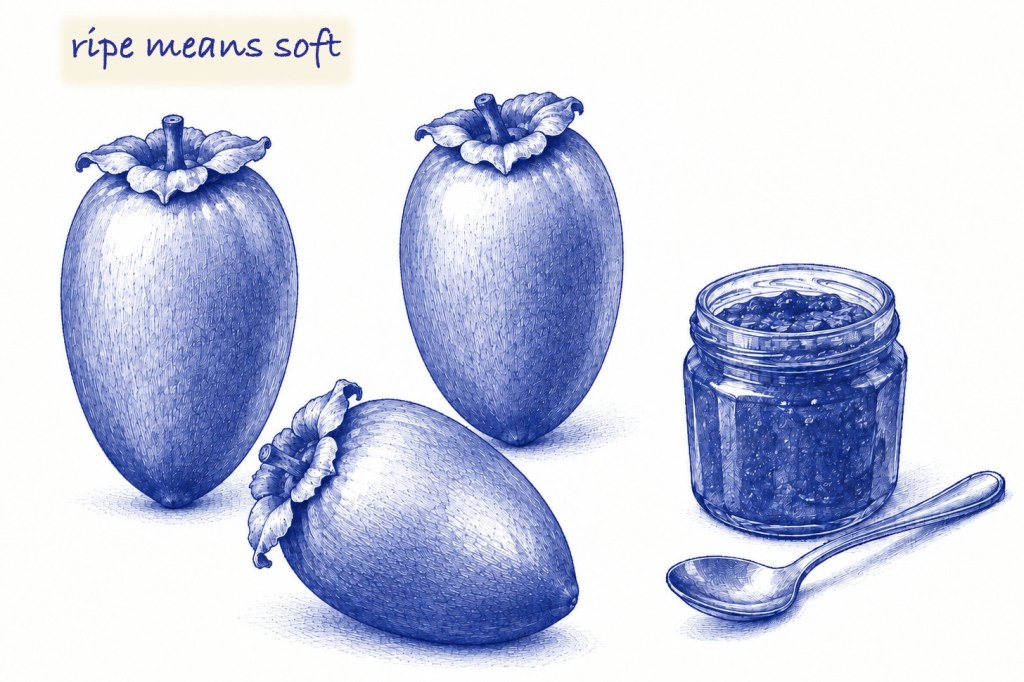
Persimmons arrive in the markets in late fall, and a ripe one is one of the best fruits of the season: honeyed, soft and faintly spiced, somewhere between apricot and pumpkin. They also ripen all at once, and they do not keep. Jam is the best way to use a box of them. This is a small-batch persimmon jam with no added pectin, just fruit, sugar and lemon, and it takes about an hour.
Jam or marmalade?
You will see both names online. In English, marmalade traditionally means a preserve made from citrus fruit with its peel, and jam is made from crushed or chopped fruit. This recipe is a jam, although many people call it persimmon marmalade. In France it would simply be a confiture. Whatever the name, the method is the same.
Which persimmons to use
Two varieties are common, and they behave very differently.
- Hachiya: heart or acorn shaped. It is very astringent until it is completely ripe, because of its tannins. It has to be jelly-soft, almost squishy, with thin, translucent skin. A firm Hachiya will make your mouth feel dry and furry, and it will ruin the jam. Its soft pulp is the best choice for jam.
- Fuyu: short and squat, like a tomato. It is not astringent and can be eaten while still firm, like an apple. It makes good jam too, but the fruit is chopped rather than scooped, and it is a little less silky.
If your Hachiyas are still firm, leave them at room temperature for several days to soften. A paper bag with an apple or a banana speeds it up. A mix of both varieties also works well.
Ingredients (makes about three 250 ml jars)
- 1 kg (about 2.2 lb) persimmon pulp, from very ripe Hachiya, or peeled and chopped Fuyu. That is about 5 or 6 large fruits.
- 400 to 500 g (2 to 2 1/4 cups) sugar
- 60 to 90 ml (4 to 6 tablespoons) lemon juice, plus the zest of 1 lemon
- A pinch of salt
- Optional: 1/2 teaspoon cinnamon, a little grated ginger, or half a vanilla bean
Method
- Put a small plate in the freezer. You will use it to test the set.
- Prepare the fruit. For soft Hachiya, cut off the calyx (the leafy top), scoop the pulp out of the skin and discard the skin. For Fuyu, peel the fruit, remove the calyx and any seeds, and chop it small.
- Put the pulp in a wide, heavy pot with the sugar, lemon juice, zest, salt and any spices. For Fuyu, add a few tablespoons of water. Stir over medium heat until the sugar dissolves.
- Bring to a steady simmer and cook for 30 to 45 minutes, stirring often, especially near the end, because persimmon pulp scorches easily. Mash it with the spoon as it cooks. The jam will darken and thicken.
- Test the set. Put a spoonful on the cold plate, wait a minute, then push it with your finger. If it wrinkles and holds a line, it is ready. If it is still runny, cook another 5 minutes and test again. If you use a thermometer, the setting point of jam is about 104 C (220 F).
- Take it off the heat, skim any foam, and spoon it into clean jars. Let it cool before closing and refrigerating.
Persimmons are low in pectin, so this jam sets softly rather than firmly. The lemon helps, and the sugar and the reduction do most of the work. It thickens more as it cools, so stop cooking while it still looks a little loose.
A word on storage and canning
I recommend keeping this jam in the refrigerator, where it keeps for about three weeks, or freezing it for longer. I do not recommend canning it for the shelf without a tested recipe. Persimmons sit close to the pH limit for safe water-bath canning, which is 4.6, and I could not find a tested home-canning recipe for persimmon jam from the National Center for Home Food Preservation. If you want to can it, add bottled lemon juice, which has a reliable acidity, and check with your local extension office first. When in doubt, refrigerate or freeze.
How to use it
- On toast or a warm croissant with good butter.
- Stirred into plain yogurt or spooned over ricotta.
- On a cheese board with an aged cheese such as Comté, or with a soft one like brie.
- As a glaze for roast pork or duck, thinned with a little warm stock or orange juice.
- As a sweet note beside a simple roast chicken.
Common problems and fixes
- Dry, furry taste: the Hachiya was not ripe enough. There is no fixing it, so wait until the fruit is completely soft.
- Too runny: cook it longer and test again on the cold plate. It also thickens in the refrigerator.
- Scorched at the bottom: the heat was too high or you stirred too little. Move the unscorched jam to a clean pot right away, and do not scrape the bottom.
- Too sweet or flat: add more lemon juice at the end, a teaspoon at a time.
The bottom line
Ripe fruit, sugar, lemon and patience at the stove. Use persimmons that are truly soft, stir near the end, and stop while the jam still looks a little loose. A small jar of it is a good thing to have in the refrigerator in November.

Leave a Reply