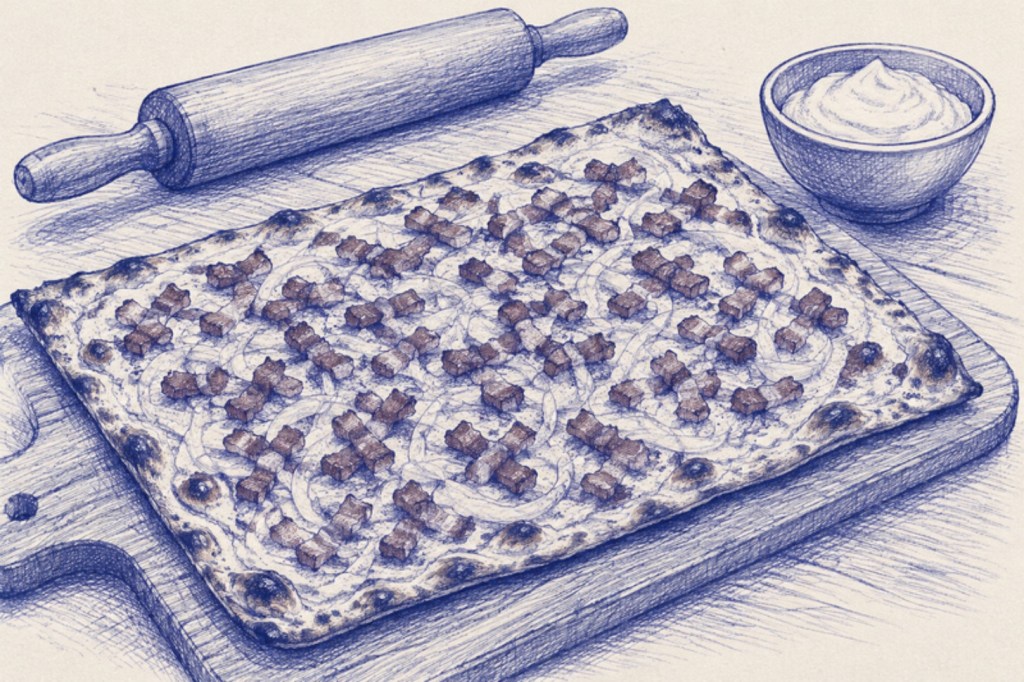
Tarte flambée is the dish I would put in front of anyone who asks what Alsace tastes like. It is a very thin sheet of dough, spread with a layer of fromage blanc and crème fraîche, scattered with raw onions and small pieces of smoked bacon, and baked in the hottest oven you have. It takes about ten minutes to cook, it is crisp at the edges and creamy in the middle, and it is meant to be eaten right away, in rectangles, with your hands. It is also very easy to make, and I have the proof: as a young apprentice, it was the only thing the chef trusted me to make. In Alsatian it is called Flammekueche, which simply means flame cake.
What it is, and what it is not
People call it Alsatian pizza, and I understand why, but the two are different. There is no tomato and no melted cheese in the classic version. The dough is rolled much thinner, usually without yeast, so it bakes up crisp and cracker-like instead of soft and chewy. The topping is white and mild: soft fresh cheese, cream, onion and bacon. That is the whole recipe, and it is worth making exactly that way at least once before you change anything.
Where it comes from
Tarte flambée began as a baker’s shortcut. In the villages of Alsace, families baked their bread in a wood-fired oven, and the baker needed a way to know whether the oven was hot enough. A small piece of dough, rolled very thin and topped with whatever was on hand, went in first. If it blistered and browned in a few minutes, the oven was ready for the loaves. The test was also lunch. That is why the dough is so thin, and why the tart cooks so fast: it was made for an oven that was far hotter than anything in a home kitchen today.
The dough
This makes two large tarts, enough for four people as a meal or six as a starter.
- 250 g (2 cups) all-purpose flour
- 125 ml (1/2 cup) lukewarm water
- 2 tablespoons neutral oil
- 1/2 teaspoon salt
Mix everything together and knead for about five minutes, until the dough is smooth and elastic. Cover it and let it rest for at least 30 minutes, and up to an hour. The rest relaxes the gluten, which is what lets you roll it paper thin without it shrinking back.
The topping
- Fromage blanc: 200 g (7 oz). It is a fresh, mild, slightly tangy cheese. If you cannot find it, use full-fat plain Greek yogurt or quark, drained for an hour in a sieve so it is not watery.
- Crème fraîche: 100 g (scant 1/2 cup). Sour cream works if you cannot find it.
- Seasoning: a pinch of salt, black pepper and a small pinch of nutmeg.
- Onions: 2 medium, sliced as thin as you can, and used raw.
- Lardons: 150 g (5 oz) of smoked bacon, cut into small sticks. Thick-cut smoked bacon is fine.
Stir the fromage blanc, crème fraîche, salt, pepper and nutmeg together until smooth. It should be spreadable, like thick cream.
How to bake it at home
The one thing you cannot fake is the heat. Put a baking stone, a baking steel or a heavy upside-down baking sheet on the middle rack, and heat the oven as high as it will go, at least 250°C (480°F), for 45 minutes. A hot surface is what crisps the underside of the dough in minutes.
- Divide the dough in two. Roll each piece on a floured surface into a rectangle about 2 to 3 mm (1/8 inch) thick. It should be thin enough to see the work surface through it in places.
- Slide the dough onto a sheet of parchment paper, so you can move it to the hot oven easily.
- Spread a thin layer of the cream mixture over the dough, leaving a border of about 1 cm (1/2 inch) around the edge.
- Scatter the onions evenly, then the lardons.
- Slide the tart, parchment and all, onto the hot stone or sheet. Bake for 6 to 10 minutes, until the edges are blistered and golden and the lardons are crisp.
- Cut and serve at once, while the edges are still crackling. Bake the second tart while the first is being eaten.
Keep the topping light. A thick layer of cream makes the thin dough soggy in the middle, and the tart should taste of the dough and the onion as much as the cheese.
Variations worth knowing
- Gratinée: add a handful of grated Gruyère or Emmental over the top before baking.
- Forestière: add sliced mushrooms, sautéed briefly first so they do not release water on the tart.
- Au Munster: add small pieces of Munster, the strong washed-rind cheese of the Vosges, for a more assertive tart.
- Sweet: skip the onions and bacon, and top the cream with thin apple slices, a little sugar and cinnamon for a dessert version.
What to serve with it
A tarte flambée is a meal on its own, and the best way to eat it is in the middle of the table, shared. A simple green salad with a sharp vinaigrette cuts the richness well, and I have written about the vinaigrette ratio every cook should know. For a drink, stay with Alsace: a dry Pinot Blanc, a Sylvaner or a Riesling, a glass of Crémant d’Alsace, or simply a cold beer.
Common mistakes
- An oven that is not hot enough. The tart steams instead of crisping. Preheat for a full 45 minutes, with the stone or sheet inside.
- Rolling the dough too thick. You end up with bread, not a tart. Keep rolling until it is almost see-through.
- Too much cream. A thin layer is enough. Too much makes the middle wet.
- Cooking the onions first. Raw, thinly sliced onions soften and sweeten in the oven and keep a little bite. Pre-cooked ones turn limp.
- Letting it wait. The tart is at its best in the first few minutes out of the oven. Serve it as it comes.
The short version
- Make a simple dough of flour, water, oil and salt, and rest it for 30 minutes.
- Heat the oven to its maximum, with a stone or heavy sheet inside, for 45 minutes.
- Roll the dough paper thin, spread a light layer of fromage blanc and crème fraîche, then add raw onions and smoked lardons.
- Bake 6 to 10 minutes and eat right away.
If you like the cooking of Alsace, you may also enjoy my posts on sauerkraut the Alsatian way and truite au bleu.

Leave a Reply