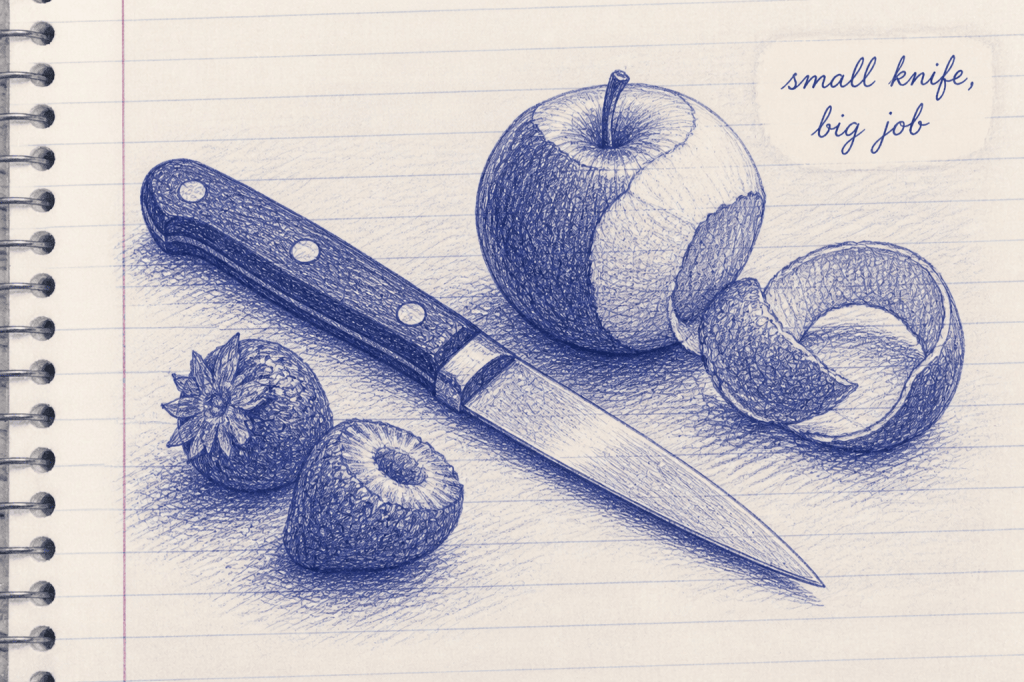
The chef’s knife gets all the credit. The paring knife does the fiddly work nobody notices: hulling strawberries, peeling an apple, taking the vein out of a shrimp, cutting the bitter white pith off an orange. They are small jobs, but you do them constantly, and a bad little knife makes every one of them more annoying than it needs to be.
Here is the good news. This is the one knife where you really do not have to spend much. If you are still deciding on the big one, start with my guide to the best chef’s knives for home cooks, then come back here for the small one.
One honest note before we start. I have not lab-tested these knives for this article. The picks come from how the knives are built, what the makers publish, and what several independent testing sites have found. Prices move around, so treat every number below as a ballpark and check the current price before you buy.
What to look for in a paring knife
Length. Three to four inches of blade is the sweet spot. Short enough to control with your fingertips, long enough to reach what you are cutting. Anything much longer starts to feel like a small chef’s knife, and anything shorter is a toy.
Shape. Most paring knives are spear point: a straight edge with the tip in the middle of the blade. That shape does nearly everything, and it is what I would buy. The other one you will see is the bird’s beak, with a curved blade. It is good for peeling round things in your hand and for the decorative turned cuts French kitchens love, but it is much less useful for everyday work on a board. Unless you know you want it, skip it.
Handle. You hold this knife close to the blade, often in the air, often with wet hands. A grip that stays put matters more than a handsome one. Forged knives with a bolster feel more substantial, while stamped knives like the Victorinox are almost weightless. Neither is wrong. It comes down to what feels good in your hand.
Edge. A paring knife that is not sharp is worse than no paring knife, because you end up forcing it. Whatever you buy, learn to keep it honed. I explain the difference in honing versus sharpening.
Four paring knives worth buying
Best budget: Victorinox Fibrox Pro 3.25-inch
Usually somewhere around $10 to $15. This is the knife most testers name as the best value, and it is built to be used hard: lightweight, non-slip handle, razor-sharp out of the box, and a lifetime guarantee against defects. It is a stamped knife, so it does not have the heft of a forged one, and the 3.25-inch blade will feel small if you have large hands. For the money, nothing beats it. If you only buy one paring knife, make it this one.
Best overall: Wüsthof Classic 3.5-inch
Roughly $50 to $95 depending on where you buy it. A forged German knife with a full tang and a lifetime warranty, and a favorite of several testing sites. It has more weight and a sturdier feel than the Victorinox, which some cooks love for heavy daily prep like peeling a pile of apples. The trade-offs are the price and the care: wash it by hand and dry it right away. It is the knife for someone who wants one paring knife to last for decades.
Best Japanese-style: MAC Professional paring knife
In the neighborhood of $50. Japanese steel tends to be harder, which means the edge stays sharp longer, but it can chip if you pry or twist, so keep it to cutting. If you like the idea but want to understand the trade-offs first, I wrote about them in Japanese versus German knives. A good choice if precision matters more to you than toughness.
Best premium: Shun Classic 3.5-inch
Usually in the $70 range. A handsome Japanese-style knife praised for its sharpness and craftsmanship. It is the one to buy as a gift or as a small luxury for yourself. Like any fine knife, it needs hand washing and a little respect: no dishwasher, no prying open a jar.
What a paring knife is for
- Peeling in your hand. Hold the fruit in one hand, rest the blade lightly against it, and use your thumb to steady the cut. The blade does not swing toward you, and you keep control.
- Hulling strawberries. Angle the tip in at the top and cut a small circle. Done.
- Deveining shrimp. A shallow cut along the back, then lift the vein out with the tip.
- Segmenting citrus. Cut off the peel and the white pith, then slide the blade between the membranes.
- Trimming and detail work. Garlic, shallots, small vegetables, the eyes of a potato, a lemon for garnish.
How to keep it working
A paring knife is delicate at the tip, and the tip is where all the work happens. Do not use it to pry, to open cans, or to scrape a board. Do not toss it loose in a drawer where it bangs against other tools. A blade guard or a knife block slot protects the edge, and the full routine is in how to care for your knives so they last. Work on a board that is kind to the edge: I compared the options in wood versus plastic cutting boards.
And when it does get dull, which it will, my guide to knife sharpening systems covers the options.
What I would buy
If you are not sure, buy the Victorinox. It costs less than a sandwich, it is sharp, and you will not mind using it hard. If you want one that feels like a real tool in your hand and plan to keep it for twenty years, the Wüsthof is the safe choice. The rest is preference. Pick one, keep it sharp, and the small jobs stop being annoying.
If you enjoy a knife story, I wrote about one I earned at 5 AM in Alsace: the couteau filet de sole.
As an Amazon Associate, I earn from qualifying purchases.

Leave a Reply