Affiliate disclosure: This post contains affiliate links. If you buy through them, I may earn a commission at no cost to you. I only recommend equipment I have actually used in professional kitchens.
Ask ten home cooks about cutting boards and you’ll get a religious debate. Ask a health inspector and you’ll get a different answer. Ask a chef who has bought hundreds of boards over forty years, and you’ll get this: it depends on the station — and almost nobody’s home setup matches what they actually need.
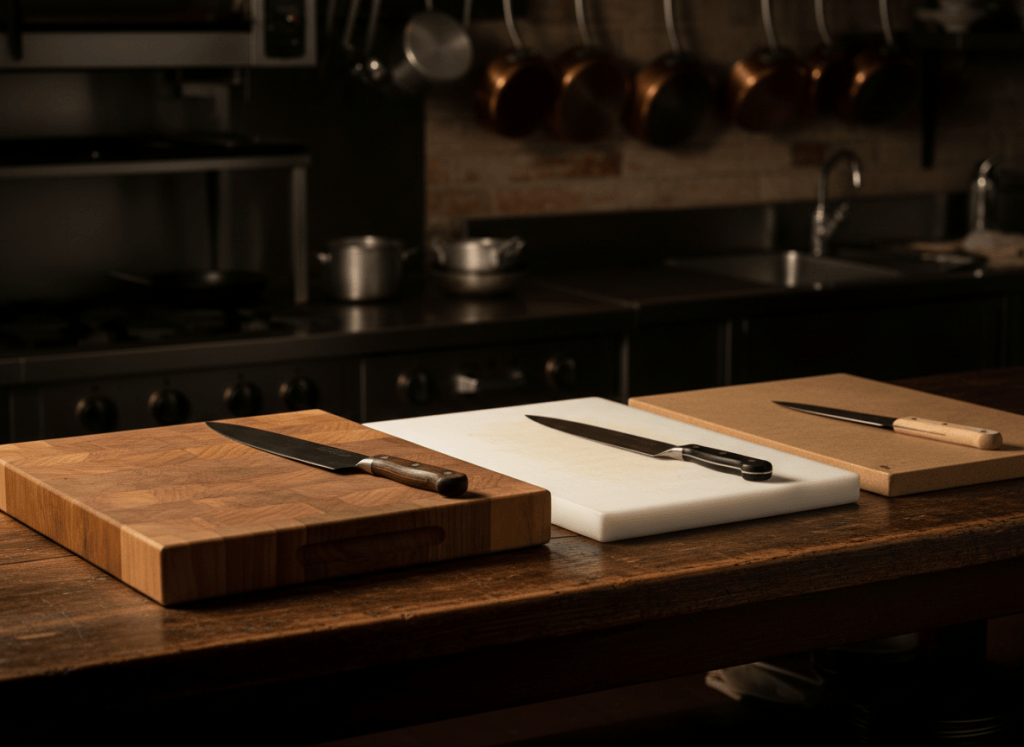
Here is the truth about wood, plastic, and composite boards — hygiene, knives, cost, and what we actually use in restaurant kitchens.
The Short Answer
- Wood (edge grain or end grain) — the best surface for your knives and for most home cooking. Get one big one.
- Plastic — the cheap, dishwasher-safe workhorse. What restaurants run for protein and high-volume prep. Have at least two small ones.
- Composite (like Epicurean) — the compromise: knife-friendly, dishwasher-safe, a little boring. Great second board.
- Glass, marble, granite — never. They destroy knives. If you own one, use it as a serving platter.
Now, the details.
Wood: What Your Knives Want
Wood is the surface every knife prefers. It gives slightly under the edge, so it dulls blades slowest of any material. End grain (the checkerboard pattern, fibers pointing up) is the gentlest — the knife parts the wood fibers rather than cutting across them. It’s also the most expensive and heaviest, which is why restaurants don’t use it and why it’s worth it at home if you cook daily.
The hygiene question — settled. People worry wood is unsanitary because you can’t put it in the dishwasher. The science says otherwise: studies going back to the 1990s (Cliver et al., UC Davis) found that wood boards actually trap and kill bacteria in their fibers — bacteria counts on contaminated wooden boards dropped below recovery within minutes to hours, while bacteria on plastic boards survived in knife scars and multiplied. The catch: wood must be cleaned and dried properly, because it’s porous.
Care is the price of admission:
- Scrape, wash with hot soapy water, rinse, and dry standing upright — never soak, never dishwasher
- Salt-and-lemon or a 3% hydrogen peroxide wipe for deep cleaning
- Food-safe mineral oil when the wood looks dry (every few weeks with daily use)
- One rule from the sanitation code that applies at home too: when it’s deeply scarred, it’s done — retire it to the bread-and-cheese board
Where wood wins: everything except raw protein, if you follow a one-board-for-everything life. I keep raw meat off wood at home for the simplest reason: peace of mind beats microbiology in a home kitchen.
Plastic: What Restaurants Actually Run
Walk into any professional kitchen and count the boards: it’s polyethylene plastic, color-coded, everywhere.
Why — and it’s not because plastic is better:
- The dishwasher. Commercial high-temp dish machines sanitize at 180°F+. Wood can’t survive that; plastic can. In a restaurant, sanitation has to be automatic, not artisanal.
- Color-coding. Red for raw meat, yellow for raw poultry, blue for fish, green for produce, white for ready-to-eat. Health inspectors love it; it removes human error.
- Cost. A restaurant plastic board costs $15–30 and gets replaced the moment it’s knife-scarred — because scarred plastic, unlike scarred wood, harbors bacteria in the grooves. We buy them knowing they’re consumables.
The part home cooks get wrong: they keep plastic boards for years. A scarred plastic board is the worst surface in your kitchen — worse than wood ever was. Look at yours under light: if you see a valley network of knife scars, replace it. Plastic boards are disposable and should be treated that way.
Where plastic wins at home: raw meat and fish (then straight to the dishwasher), picnics, and as the cheap second board you’ll actually use.
Composite: The Compromise Nobody Loves, Everybody Buys
Composite boards (wood fiber + resin, Epicurean being the best known) are fairly knife-friendly, dishwasher-safe, thin, light, and heat-resistant to a point. Restaurants use them as service and bar boards; at home they’re a genuinely good second board.
Honest downsides: they wear faster than they should for the price, the surface roughens over years, and they flex if you buy the thin ones. Buy the thickest version.
Glass, Marble, Granite: Just No
I have watched a cook destroy a $200 Japanese knife on a glass “cutting board” in one shift. Stone and glass are work surfaces and serving pieces, not cutting surfaces. If one is in your kitchen, it’s a trivet now.
What’s Actually in a Pro Kitchen vs. Your Home
Here’s the part no affiliate site will tell you, because none of them have bought boards by the case:
- Restaurants: plastic, color-coded, replaced quarterly-ish, sanitized in a machine. End-grain wood appears only at the carving station or the cheese station, where it’s show as much as function.
- Your home: you have a dishwasher, not a 180°F flight-type machine, and you cook everything on one board. That math favors one good wood board for most work plus two small plastic boards for raw protein. Total cost: about the price of one mid-range knife — the same knife you’ll stop destroying.
Comparison Table
| Wood | Plastic | Composite | Glass/Stone | |
|---|---|---|---|---|
| Knife-friendliness | Excellent (end grain: best) | Fair — dulls over time | Good | Terrible |
| Hygiene | Traps/kills bacteria when dry | Good when new; scars harbor bacteria | Good | Excellent (and knife-ruining) |
| Dishwasher-safe | Never | Yes | Yes | Yes |
| Durability | Decades with care | Months to years (replace when scarred) | Years | Forever (see knives) |
| Weight/stability | Heavy = stable | Light, can slide | Light | Heavy |
| Price | $40–200+ | $10–30 | $30–50 | — |
| Best for | Main board, vegetables, bread, cooked food | Raw protein, second board | Second board, serving | Never cutting |
My Actual Recommendation
- One large wood board, edge grain minimum (15×20″ or bigger — the biggest your sink can handle). Maple is the classic — this John Boos edge-grain maple board is what I’d point a home cook to. Walnut is beautiful and slightly softer; cherry in between. This is your main board for life. Oil it. If you want to go further, a true end-grain maple board like this one is the kindest surface your knives will ever touch.
- Two small plastic boards (or one plastic plus one composite) for raw meat and fish. A color-coded set takes the guesswork out of which board is for what. Run them through the dishwasher. Replace them when scarred — yearly, realistically. For the composite option, the Epicurean Kitchen Series board is the one I’d actually keep around.
- Keep your wood board fed with a food-safe mineral oil and board cream set — it’s the difference between a board that lasts a decade and one that cracks in a year.
- Skip glass, stone, and every “self-sharpening” or antimicrobial gimmick board.
If someone gives you an end-grain board, thank them twice — once for the gift, once in ten years when it’s still the best surface in your kitchen.
How to Clean a Cutting Board (the version health inspectors would approve)
Wood: scrape off debris → hot soapy water, scrub with the grain → rinse → sanitize (diluted bleach per label, or 3% hydrogen peroxide) → air dry upright, never flat, never damp in a stack. Oil when pale and dry.
Plastic: dishwasher, or same as above. Retire when scarred.
Every board, always: never cross from raw protein to ready-to-eat food on the same unwashed surface. That one rule prevents more foodborne illness than any board material choice — it’s the same logic behind the color-coded systems we run in restaurants.
FAQ
Are wooden cutting boards hygienic?
Yes — when cleaned and dried properly, wood boards actually trap and absorb bacteria, which then die in the wood fibers. Multiple studies have found bacteria survive longer on scarred plastic than on wood. The keys: wash hot, dry upright, never soak, oil regularly.
One board or several?
Two is the honest minimum: a main wood board and a small plastic one for raw protein. If you cook a lot of meat and fish, three.
Is an end-grain cutting board worth it?
If you cook daily and own good knives, yes — it’s the kindest surface for edges and lasts decades. If you cook weekly, a quality edge-grain board is plenty.
How often should I replace a plastic cutting board?
When you can see a network of knife scars that hold stains or debris after washing. For a home cook, roughly once a year with regular use. Plastic boards are consumables, not heirlooms.
Can I cut raw chicken on a wooden board?
You can — wood handles bacteria well — but the safest home habit is raw protein on a plastic board that goes straight to the dishwasher. I do it that way in my own kitchen.
What about bamboo?
Bamboo is technically a grass, harder on knives than wood (the silica content), and usually edge-glued in thin strips. It’s fine for the price, kinder than plastic, harder than maple. A budget pick, not the best pick.
Related Reading
- Best Chef’s Knife for Home Cooks — the knife this board protects
- Copper vs. Silicone vs. Black Steel Molds — more from the equipment-material-debate series
 The Seasoned Bench
Leave a comment