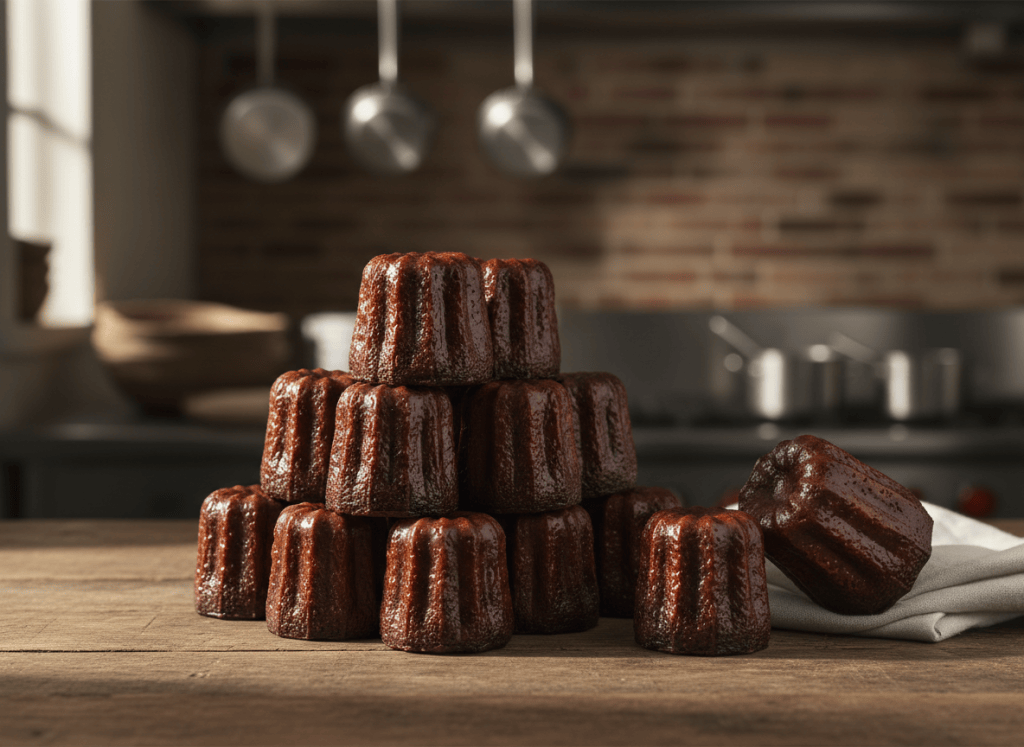
I have made thousands of these in my life, and I have ruined my share too — usually from impatience. A canelé does not reward impatience. It rewards a copper mold, a long rest, and a hot oven you trust.
The result, done right: a crust so dark it looks nearly burnt, cracking to a custard center that’s somewhere between flan and brioche. If your canelé comes out pale and soft all the way through, it isn’t a canelé. It’s a muffin that read about canelés once.
Makes about 18 canelés (standard 1¾” copper molds) | Active time: 20 minutes | Rest: 24–48 hours | Bake: 60–75 minutes
Ingredients
- 2 cups (480ml) whole milk
- 2 tbsp (28g) unsalted butter, plus more for the molds
- 1 vanilla bean, split and scraped (or 1 tbsp vanilla extract, added at the end)
- 1 cup (200g) granulated sugar
- 2 large eggs
- 2 large egg yolks
- 1 cup (125g) all-purpose flour
- ¼ cup (60ml) dark rum
- Pinch of salt
- Beeswax and clarified butter, for the molds (or clarified butter alone if you don’t have beeswax)
Method
- Infuse the milk. Combine the milk, butter, and scraped vanilla bean (pod included) in a saucepan. Bring just to a simmer, then remove from heat and let it steep for 15 minutes. Discard the pod.
- Mix the dry and the wet, separately, like they don’t trust each other. Whisk the sugar and flour together in a large bowl. In a separate bowl, whisk the whole eggs and egg yolks.
- Bring it together slowly. Pour the warm milk into the flour and sugar in a thin stream, whisking constantly — you’re avoiding lumps, not aerating. Once smooth, whisk in the eggs, then the rum and salt. The batter will be thin, almost like heavy cream. That’s correct. Do not panic and add more flour.
- Rest it. Actually rest it. Strain the batter through a fine sieve into a container, cover, and refrigerate for a minimum of 24 hours, ideally 48. This is not optional and it is not a suggestion for people with more discipline than you. The rest is what lets the crust and custard separate properly in the oven. Skip it and you get a uniform, gummy cake — the exact failure mode silicone gives you even with a full rest.
- Prepare the molds. If you’re using copper (you should be — see why), melt beeswax with a splash of clarified butter and brush a thin, even coat inside each mold. Chill the molds until the wax sets hard, about 10 minutes. This step is fussy and old-fashioned and it is the reason your crust will caramelize instead of stick. If you’re using black steel or a well-seasoned nonstick, butter alone is fine — you’ll lose some of the shine but keep most of the contrast.
- Fill and bake hot. Preheat your oven to 450°F (230°C). Whisk the rested batter briefly — it will have separated slightly, that’s fine — and fill each mold about ¾ full. Place the molds on a baking sheet and bake at 450°F for 15 minutes, then lower the heat to 375°F (190°C) and continue baking for 45–60 minutes more, until the tops are deeply mahogany, almost black at the ridges.
- Unmold immediately. Turn the canelés out onto a rack the moment they come out of the oven. If they stick, your wax coat was too thin — note it for next time and don’t force them, you’ll tear the crust.
- Let them cool before you eat one, which you won’t. They’re best within a few hours of baking, while the contrast between crust and custard is still sharp. By the next day, the crust softens. Still good. Not the same.
Notes from the Bench
- Why the rest matters: the batter needs time for the flour to hydrate fully and the gluten to relax. Bake it same-day and you get a cakier, less custardy interior — still a decent pastry, just not a canelé.
- Why copper matters: see the whole argument in Copper vs Silicone vs Black Steel Molds. Short version — nothing else gets the batter against the wall to caramelize before the center sets.
- Rum is not optional in Bordeaux, but it is in your kitchen. Leave it out if you want, add an extra half teaspoon of vanilla instead. I won’t tell anyone.
Related Guides
- Copper vs Silicone vs Black Steel Molds — the mold argument behind this recipe
Disclosure: This post contains affiliate links. If you purchase through these links, I may earn a small commission at no additional cost to you. I only recommend equipment I have used in professional kitchens.
 The Seasoned Bench
Leave a comment