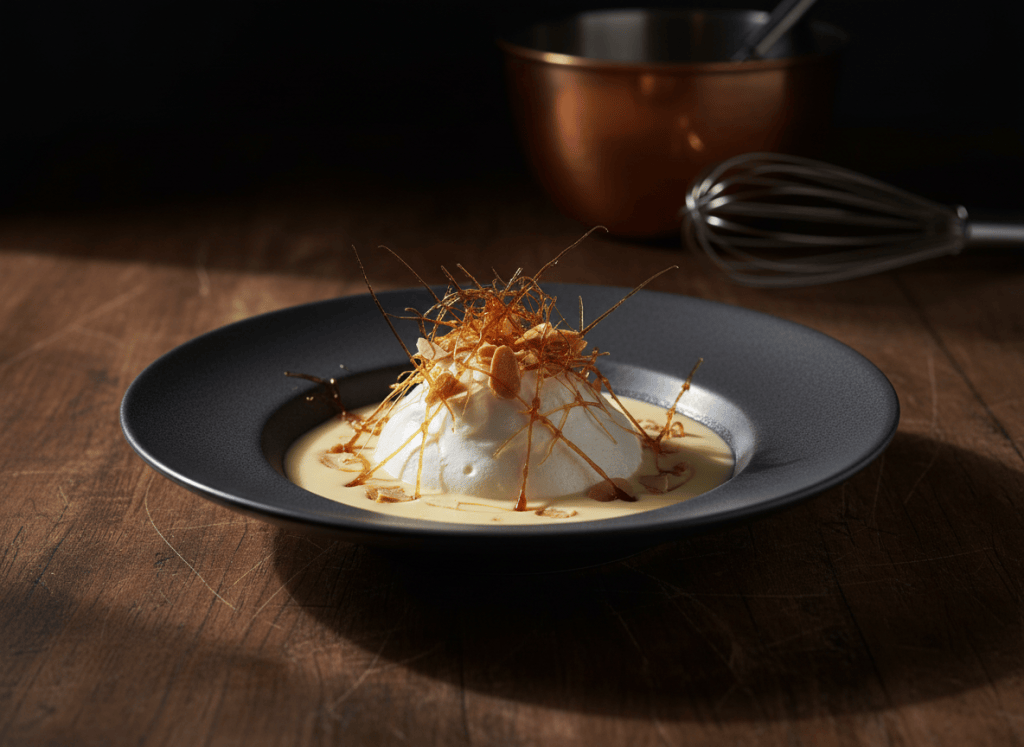
My mother did two things exceptionally well: French meringue, and strawberries in cream. But the dish I measure my childhood against is île flottante, the Sunday dessert. Every Sunday, a big bowl of crème anglaise sat in the middle of our table, and floating lazily on top, one big airy cloud of poached egg white: an island drifting in its own golden lake, caramel waiting on the side.
Every Sunday, unless my homework wasn’t finished, or my school results were not satisfying. In our house, île flottante was not served to boys who had not earned it, and so it became, without anyone ever saying so, the report card of the week. A boy who had worked got to watch that cloud float in. A boy who hadn’t, watched the bowl go back to the kitchen, and there is no hunger quite like the one a boy feels watching his dessert return to a kitchen he is not allowed to enter.
It took me years to understand that my mother was doing something genuinely difficult. Île flottante looks like the simplest dessert in France, three elements and no hiding place, but it is the quiet test of every pastry station I have ever run: the crème anglaise must be silky and exactly thick enough, the poached meringue must be cloud soft and hold its shape, and the two must meet at the right temperatures or the whole thing collapses into a puddle. Serve a bad one in a French bistro and the regulars know, instantly, that the kitchen has stopped caring.
My mother made hers in a copper bowl, with a balloon whisk, beaten by hand every week, never a machine. It is her meringue I still chase when I make this dessert today. So this recipe comes with its own story: the Sunday dessert that ruled my week, and the truth about that copper bowl and that whisk, which is more interesting than the myth.
What Is Ile Flottante, Exactly?
Floating island: a cloud of French meringue, drifting on a lake of vanilla crème anglaise, finished with caramel and praline crunch. That’s the whole dessert.
It is often confused with œufs à la neige (“eggs in snow”), and French families argue about this the way they argue about everything. The real distinction isn’t shape, it’s method: île flottante is traditionally a single meringue baked whole in a mold, set in a bain-marie; œufs à la neige is meringue shaped by spoon and poached directly in simmering milk, in small pieces. In everyday use, mine included, the two names get swapped constantly, and most home cooks and plenty of bistros call any poached-meringue-on-custard dessert île flottante, technique be damned.
What follows below is the poached method — which by the strict definition is œufs à la neige. I’m calling it île flottante because that’s what my mother called it, and I’m not about to correct her forty years late. It’s the same logic, really, behind why I still call a baked, steam-risen batter a popover and not a Yorkshire pudding: the name your family used wins, technique arguments aside.
It is not Italian meringue on custard, which is what many modern restaurants serve because the hot sugar syrup “cooks” the whites and holds longer. That version is more stable and less good. The classic is French meringue, gently poached: cloud soft, barely sweet, a texture no syrup-bound meringue can imitate.
The Copper Bowl and the Whisk: The Chemistry, Honestly
The bowl
You have heard the rule: beat egg whites in a copper bowl. Here is what is actually true — including the part most articles skip, because the science itself changed its mind.
Egg white foam is a fragile architecture of proteins wrapped around air. This was dismissed as an old wives’ tale until food scientist Harold McGee tested it and published his findings in the journal Nature in 1984. His original explanation: the protein conalbumin (also called ovotransferrin) bonds directly to copper ions, becoming harder to over-unfold and collapse. For a decade, that was the accepted answer, and I believed it as firmly as everyone else in a professional kitchen did.
Then, in the mid-1990s, McGee found a hole in his own theory: egg whites whipped in a silver bowl are just as stable as copper — and silver doesn’t bond to conalbumin at all. So he revised it. The current best explanation is broader: metal ions, copper or silver, bond to unstable sulfur groups on the surface of the egg proteins before those proteins can bond with each other and over-tighten. Fewer protein-to-protein bonds means a foam that resists collapse — not because of one specific chemical handshake, but because the metal quietly gets in the way of the wrong reactions. This also explains why a pinch of cream of tartar in a plain stainless bowl does nearly the same job: the acid interferes with those same bonds by a related route. A home cook with a spotless steel bowl and a pinch of tartar is at roughly 95% of the copper result.
So why do professionals, why do I, still use copper?
- Feel. The bowl is heavy; it stays put while you whisk. The bowl is cold; the whites stay cold, and cold whites make finer foam.
- Forgiveness. On a pastry station, the extra minute of grace between “perfect” and “over-beaten” is worth real money.
- Tradition, which is not nothing. My mother’s bowl beat the same meringue for years. When I whisk in copper, I am doing the same work the same way it has always been done. A craft keeps its tools — the same reasoning behind why I still reach for copper on madeleines and canelés, even though neither of those recipes involves egg white foam at all — there, it’s about heat, not chemistry. I go deep on that distinction in Copper vs Silicone vs Black Steel Molds.
Verdict: buy copper if you beat whites weekly and can afford one piece (see my picks below). If you bake twice a month, a stainless bowl plus cream of tartar is the smart purchase. What you must never do is beat whites in a plastic bowl. Plastic holds a film of grease no washing fully removes, and fat is the one true enemy of egg white foam.
The whisk, the part everyone forgets
The bowl gets the legend; the whisk does the work. Three things matter:
- Shape: the balloon whisk. A balloon whisk, with wires that spring out into a wide, rounded cage, is the right tool for whites. Its business is not stirring; it is folding air into liquid, and the wide cage drags the maximum amount of white over the maximum amount of air with every stroke. A tight, narrow whisk moves fast but moves little. For egg whites, big and balloon, always.
- Whisking by hand is not penance; it is control. My mother beat her meringue by hand every Sunday, and in forty years I will tell you what a machine cannot do: an electric mixer whips whites past their point in the seconds you look away. A hand and a balloon whisk arrive at the peak gradually, and your arm feels the foam change: soft, then ribboning, then the moment the wires start to push back. That resistance is the peak announcing itself. By hand, you almost never over-beat.
- The motion. Whisk in a wide circle, sweeping the bottom of the bowl and letting the whites climb the wires. You are not stirring in a small circle like soup. You are beating air in, and rhythm beats speed: steady wide strokes, forty to the minute, and you will feel the foam thicken under your hand.
The Recipe: Ile Flottante
Serves 6 · Active time: about 1 hour · Chill: 2 hours
Three elements, made in this order: anglaise first (it must chill), meringue next (it must rest), caramel last (it waits for nothing).
The Crème Anglaise (the lake)
- 2 cups (500 ml) whole milk
- 1 vanilla bean, split and scraped (or 2 tsp vanilla bean paste)
- 5 large egg yolks
- ⅔ cup (65 g) sugar
- Infuse: heat the milk with the vanilla bean and seeds until steaming, then off the heat to steep 10 minutes.
- Whisk the yolks with the sugar just until pale. Do not whip air into them; this is a sauce, not a foam.
- Temper: pour a slow stream of the hot milk into the yolks, whisking constantly, then return everything to the pot.
- Cook to 82 to 84°C (180 to 183°F), stirring constantly with a spatula that reaches the corners. If you have no thermometer, it is ready when the sauce coats the spatula and you can draw a clean line through it with your finger: la nappe.
- The cliff: above roughly 85°C (185°F) the yolks scramble. Err low, not high. Strain immediately through a fine sieve into a clean bowl, press plastic onto the surface, and chill at least 2 hours.
A grainy anglaise means you crossed the cliff. There is no repair, only starting over. Respect the temperature.
The Poached Meringue (the island)
- 4 large egg whites, room temperature, not one trace of yolk
- Pinch of fine salt
- ½ cup (100 g) sugar, added in three additions
- Pinch of cream of tartar if you are not using a copper bowl
- 1 wide pot of barely simmering water (or half milk, half water; the milk adds a skin of flavor, the French grandmother’s way)
- Beat the whites in your copper bowl (or spotless steel with the tartar) with the balloon whisk, by hand or machine fitted with the whisk, medium speed. Salt first; sugar in three additions once soft peaks form.
- Beat to firm but still glossy peaks: the whisk leaves a trail, and the peak stands with a tip that folds slightly. Stop before dry and dull. This is exactly the over-beating window the copper widens.
- Shape: for one grand island, mound the meringue on a buttered and sugared piece of cheesecloth or a slotted spatula; for individual portions, shape quenelles with two spoons, one oval sweep each.
- Poach gently: slide the meringue onto the barely simmering liquid, cover, 3 minutes, turn with a spatula, 3 minutes more. The water must never boil; a boil beats the cloud apart. Done when set to the touch but still springy.
- Drain on a wire rack 20 minutes. The island must come to room temperature while the anglaise stays cold. See assembly.
The leftover poaching liquid, lightly sweet and vanilla flecked, was my mother’s cook’s reward. Drink it warm; it is the smell of the whole dessert in a cup.
The Caramel and Pralines (the shipwreck)
- ¾ cup (150 g) sugar
- ⅓ cup (40 g) sliced almonds
- Caramel: sugar and a splash of water in a small, light-colored pan, light-colored so you can see the amber. No stirring once it boils; wash down the sides with a wet brush or a lid for the first minute. Cook to a deep amber and pull it at once; caramel keeps cooking from its own heat.
- Pour half over the almonds on parchment. When cool, snap into shards. That is your praline crunch.
- Thin the remaining caramel with a splash of hot water poured carefully down the side (it will spit; stand back) to a pourable amber syrup. Or pour it onto parchment and break it into glass shards for the classic crackle top.
If you want the deeper case for copper as a material — not just this bowl, but molds too, and exactly where caramelization comes in — see Copper vs Silicone vs Black Steel Molds.
Assembly
- Cold anglaise in the bowl, a wide, shallow bowl so the island has a lake, not a well.
- The meringue at room temperature, never chilled. A cold island on cold cream sweats condensation, and the whole dessert slides. Warmish island, cold cream, firm caramel: the three temperatures are the dessert.
- Caramel poured or shards planted last. The moment it goes on, the clock starts.
- Praline shards standing in the cloud, a spoon that reaches the bottom, and no ceremony beyond carrying it to the table fast.
Make ahead: anglaise 24 hours ahead (airtight, surface covered). Meringues poached that morning, held at room temperature on the rack. Caramel shards made days ahead in a dry tin. Assemble in ninety seconds at the table.
Five Ways Ile Flottante Fails
- Grainy anglaise. You scrambled the yolks. Lower, slower, thermometer.
- Weeping meringue. Over-beaten whites, or whites beaten in a greasy bowl. Copper or cream of tartar; spotless bowl either way.
- Dense, chewy island. Poached in a boil instead of a simmer, or shaped too thick. A wide island poaches better than a tall one.
- The slide. Cold-on-cold assembly. Room temperature island, always.
- Soggy caramel. Poured too early. Caramel goes on at the table or not at all.
Ile Flottante FAQ
Can I make this without a copper bowl?
Yes. A spotless stainless or glass bowl plus a pinch of cream of tartar gives you nearly the same stability. Never plastic; the grease film kills the foam.
Do I need a balloon whisk?
It is the right tool. The wide cage beats in far more air per stroke than a narrow whisk. If you own only one whisk, make it a balloon. What matters more is watching the peak: glossy and firm, never dry.
Can I bake the meringue instead of poaching?
You can — that’s technically the classic île flottante method, baked in a mold in a bain-marie. It gives a slightly firmer, more set texture than poaching. Poached (technically œufs à la neige) is cloud-soft, which is the version most people mean when they say the name today, mine included.
Why is my crème anglaise grainy?
The yolks passed roughly 85°C and scrambled. Use a thermometer until your wrist has learned it; strain always, as insurance.
How far ahead can I make it?
Anglaise a day ahead, meringues the morning of, caramel shards any dry day. Assembly only at the table.
Is île flottante the same as œufs à la neige?
Strictly, no — one is baked whole, the other poached in pieces. In practice, most people use the two names interchangeably, and the family argues about it the way the French argue about everything.
What to Buy (If You Want the Real Thing)
(Affiliate links below. I only recommend tools I’d keep on my own bench — the same short list behind How I Stock My Kitchen.)
- Mauviel M’Passion Copper Egg White Beating Bowl — the heirloom. Unlined, on purpose: the ion exchange wants direct contact with the whites, which is why a tin-lined copper bowl won’t do this job. Heavy, cold, and the bowl your grandchildren will argue over.
- A saner-priced alternative: any solid, uncoated stainless mixing bowl set plus cream of tartar — the honest 95% solution.
- A proper balloon whisk — the one tool this recipe asks you to upgrade. Look for springy wires, a wide cage, and a handle you can hold for six minutes straight.
- An instant-read thermometer — not for the whites, for the anglaise cliff at 82 to 84°C.
And if copper catches your heart, start the way professionals do: one piece at a time, beginning where copper does something nothing else can — caramelization, canelés, and madeleines all live in that same argument.
Every Sunday, my mother turned homework into dessert: a cloud in a golden lake, earned with a week’s work, beaten by hand in the same copper bowl. I have run pastry stations on three continents and I still consider her meringue the standard. Make it once, by hand, with a balloon whisk, and you will understand why a boy would finish his homework for it.
— Chef Jean, The Seasoned Bench
FTC disclosure: This post contains affiliate links. If you buy through them, I earn a small commission at no cost to you.

Leave a comment