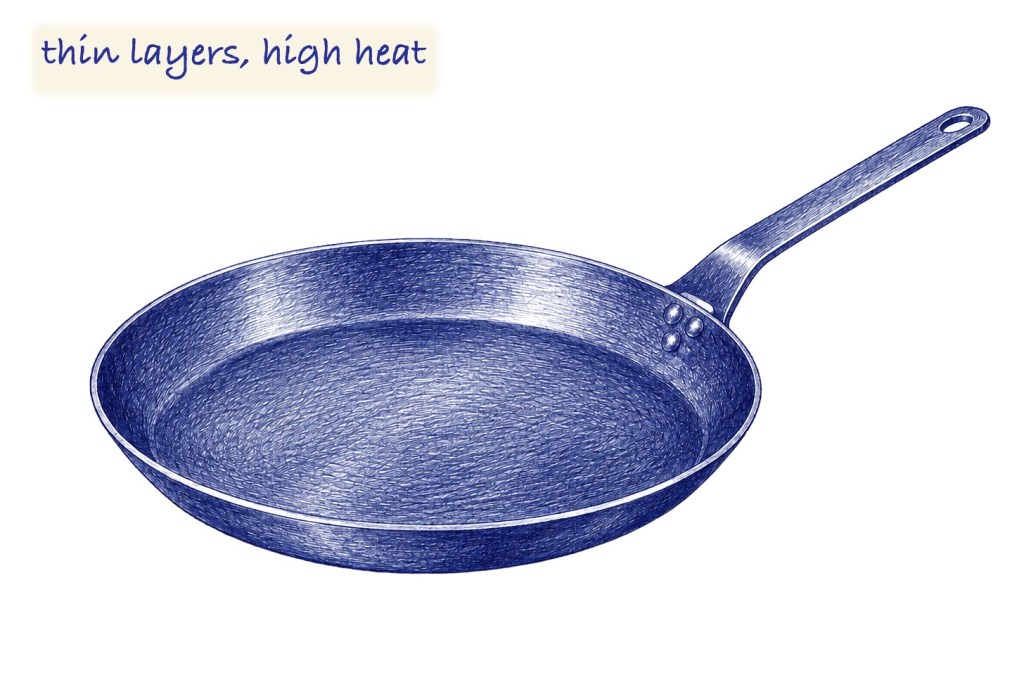
A new carbon steel pan arrives shiny, a little gray, and frankly unimpressive. Give it a few weeks of use and it turns the color of an old violin, and food that stuck on day one slides out on day thirty. That change is called seasoning, and it is the whole reason professional kitchens love these pans. Here is how to start one properly and how to keep it for decades.
What “seasoning” actually is
Seasoning is not a flavor. It is a thin, hard layer of oil that has been heated past its smoke point until it polymerizes, bonding to the metal. Done in many thin layers, it becomes a slick, dark, naturally nonstick surface. Done in one thick layer, it turns sticky and flakes. The rule for everything below is the same: thin layers, high heat, patience.
Step 1: Wash off the factory coating
Many new pans ship with a protective coating so they don’t rust on the shelf. Some makers use a wax, such as the beeswax on my favorite French pans, and others use a thin oil or lacquer. Check the maker’s instructions, because the removal method differs. For a wax or oil finish, scrub the pan with hot water, dish soap and a sponge, then dry it completely. This is the one time soap and a real scrub are expected. If your pan has a lacquer, follow the manufacturer’s directions to remove it before anything else.
Step 2: The first seasoning, on the stove
You can season in the oven, but the stovetop is faster and easier to control.
- Set the dry pan over medium-high heat until the metal darkens and begins to shift color. This is normal.
- Take it off the heat. Add about a teaspoon of a neutral high-heat oil (grapeseed, canola, sunflower or refined vegetable oil all work).
- With a folded paper towel and tongs, rub the oil over the entire inside surface, then wipe it off as if you meant to remove all of it. What remains is a film you can barely see. This is the step most people get wrong.
- Return the pan to medium-high heat until it stops smoking, a few minutes. The surface should look slightly darker and dry, not shiny and wet.
- Let it cool, and repeat three to five times.
Open a window and turn on the hood. Seasoning smokes. If the pan is sticky or blotchy afterward, you used too much oil: scrub lightly and start again.
Step 3: Build it by cooking
The best seasoning is built by use. For the first few weeks, cook things that are friendly to a young pan: fry potatoes in a generous amount of oil, sear sausages or bacon, shallow-fry, sauté vegetables in fat. Fatty foods add layers each time. Avoid long simmers with tomato, wine, lemon or vinegar early on, because acid can strip the young surface and leave the pan looking dull and patchy. Once the finish is dark and even, you can cook more freely.
Eggs are the test. If they stick, preheat longer, use a little more fat, and don’t move the food until it releases on its own. Carbon steel rewards a hot pan and a little patience.
Daily care
- Clean it while warm. Rinse with hot water and use a brush, sponge or a stiff non-metal scrubber. A little soap is fine on a well-seasoned pan, but don’t soak it.
- Stuck-on bits: add a splash of water to the hot pan and scrape, or rub with coarse salt and a paper towel.
- Dry it immediately. Put it back on the burner for a minute until every drop is gone. A damp pan rusts.
- Finish with a whisper of oil. Wipe a few drops over the cooking surface with a paper towel. It should look barely oiled, not greasy.
- Never put it in the dishwasher and never leave it wet in the sink.
Fixing problems
- Rust spots: scrub them off with steel wool or a scouring pad, wash, dry, and season again. Rust looks alarming but is cosmetic if caught in time.
- Sticky or tacky surface: too much oil was used. Scrub it back and re-season in thinner layers.
- Flaking: the layer was too thick or applied to a dirty surface. Scrub off the loose bits and build it up again with thin coats.
- Uneven color: don’t worry. Carbon steel is rarely uniform, and the patina is a record of what you have cooked.
Carbon steel or something else?
Carbon steel is lighter than cast iron and heats faster, which suits searing, eggs, fish and anything you want to flip or toss. The trade-off is upkeep: a few minutes of care after each use. If that sounds like a chore, a stainless pan is the easier life. I compare the two approaches, including a French carbon steel pan, in De Buyer vs All-Clad vs Hestan ProBond.
A well-known example of the type is the de Buyer Mineral B, made in France, shown here in the 11-inch size. It is thin steel with a long riveted handle, the kind of pan this guide describes. Check price on Amazon →
Another long-standing choice is the Matfer Bourgeat Black Carbon Steel Frying Pan, sold in several sizes. The 11-inch is shown here, to compare directly with the de Buyer. Check price on Amazon →
One more practical point: check the handle. Pans with riveted metal handles go in a hot oven freely, while some have coated or plastic-grip handles with lower oven limits. Read the maker’s specifications before broiling.
FAQ
Can I use olive oil or butter to season?
Butter and extra-virgin olive oil burn at low temperatures and leave a weak, sticky layer. Use a neutral oil with a higher smoke point for seasoning, and cook with butter or olive oil later.
Is it safe to use soap?
Yes, a little on a well-seasoned pan is fine. Modern dish soap won’t undo polymerized oil. Just don’t soak the pan and dry it right away.
How long until it is really nonstick?
It depends on how often you cook. Expect a noticeable improvement within a couple of weeks of regular use, and keep in mind it never becomes a Teflon-style coating. It becomes a better, more forgiving surface.
Can I season it in the oven instead?
Yes. Apply a very thin coat of oil, wipe it nearly all off, and bake upside down at a high temperature for about an hour, then let it cool in the oven. Many cooks do this for the first layers. Check your pan’s handle for oven limits first.
As an Amazon Associate, I earn from qualifying purchases.

Leave a Reply