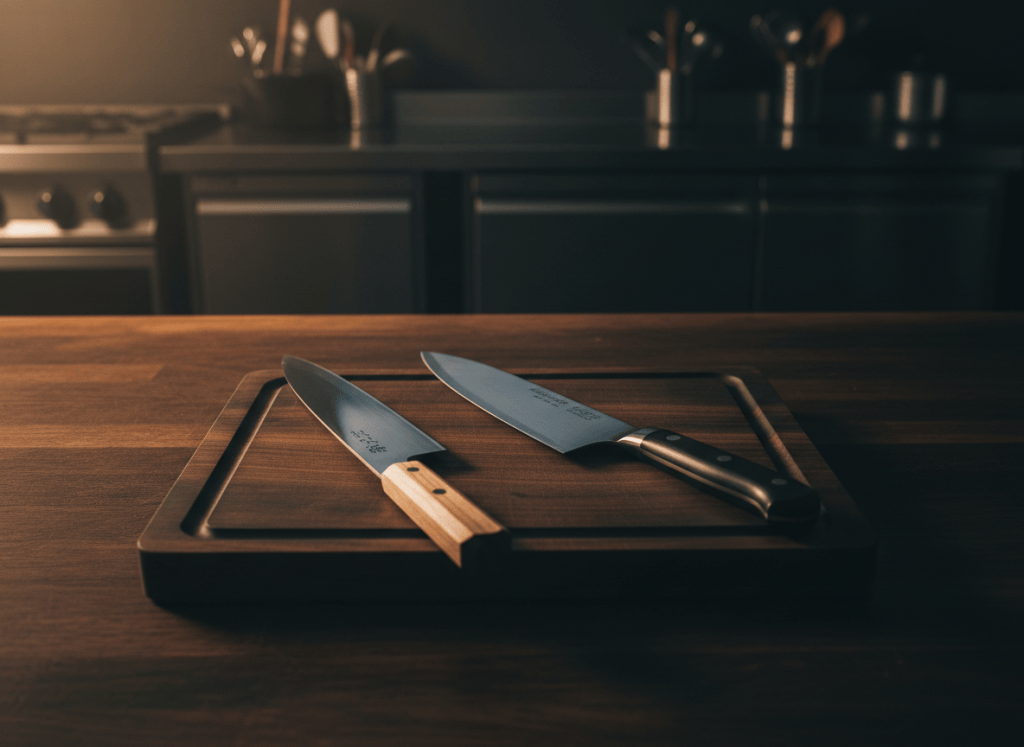
The Knife a Japanese Architect Carried Into My Shanghai Kitchen
My first restaurant in Shanghai was called Shikumen Bistro, in the heart of Xintiandi — a beautiful three-story restaurant with a rooftop, where the who’s-who of Shanghai came to dine. In my kitchen I employed young Chinese chefs, eager to learn from a chef from France — and eager, too, to see what this Frenchman actually knew.
One of my regulars was a well-known Japanese architect. He came in once or twice a month — a very nice gentleman, quiet, observant, the kind of guest you cook a little better for without being asked. One evening he arrived bearing a gift, wrapped with the care you’d expect of his profession: a Shirogami knife.
I knew enough to know what I was holding. Shirogami — “White Paper Steel” — is one of the legendary Japanese knife steels, and the name is literal: the steel that becomes these blades has been made since 1899 by the Yasugi Works in Japan (now part of Hitachi Metals), and the forge identifies each bundle of its high-purity carbon steel by wrapping it in white paper. The architect didn’t say much. He didn’t have to. The knife said: now learn what this can do.
I cherished that knife. It was like having a laser in your hand — it cut effortlessly through meat, through vegetables, through everything I put under it. A beautiful tool, the kind you protect and the kind you show off in the same breath.
Then one day, one of my young apprentices decided my knife was a screwdriver. He destroyed the tip of that magnificent companion in one act of kitchen laziness — and taught me, in one afternoon, the single most important thing about Japanese steel that no catalog will tell you: a harder blade is not a tougher blade.
I found an old Japanese bladesmith in Shanghai to repair it. He didn’t speak English and I didn’t speak Japanese. I handed him the knife with no way to explain what had happened, or that I wasn’t the one responsible for the damage — and it didn’t matter. The way he looked at me said everything. In his eyes, I was the barbarian who had been careless with a beautiful object, and no translator on earth was going to change his mind.
So that knife taught me two lessons from two masters: the architect showed me what Japanese steel can do, and the bladesmith showed me the reverence it demands. Between those two lessons — and forty years of scars on both sides of the argument — I can promise you this: by the end of this post, you’ll know which knife belongs in your kitchen, and you’ll know how to treat it once it’s there.
The One Difference That Explains Everything: The Steel
Everything in this comparison — the edge, the sharpening, the fragility, the price — flows from one engineering fact.
Japanese knives are made from harder steel. German knives are made from tougher steel.
Hardness is measured on the Rockwell scale (HRC). Most German knives (Wüsthof, Zwilling, my old Sabatier’s cousins) run around 54–58 HRC. Japanese knives commonly run 60–64 HRC, and Shirogami carbon steel can go higher.
What that means on the bench:
- Harder steel takes a sharper edge and keeps it longer. A Japanese blade at 15° per side will slice tomatoes like a razor and hold that edge through a week of home cooking.
- Softer steel bends instead of breaking. Hit a German blade’s tip on a bone or drop it wrong, and it may chip a corner or bend — a bladesmith fixes it in minutes. Do the same to a hard Japanese blade and you can lose a chunk of the edge for good, as my apprentice proved.
- Toughness is the ability to shrug off abuse. Hardness is the ability to resist dulling. You cannot maximize both in one piece of steel. Every knife maker picks a side, and that choice defines everything else about the knife.
This is not a quality difference — it’s a philosophy difference. The German maker assumes you will sometimes use the knife badly, and builds for survival. The Japanese maker assumes you will treat the knife like a professional, and builds for performance. Neither is wrong. But you, the buyer, are choosing which assumption you can live up to.
How They Differ on the Bench
Edge Angle: 15° vs 20°
German knives are typically sharpened to about 20° per side (40° total). Japanese knives run 12–15° per side. A narrower angle means less steel pushing through the food — that’s the “laser” feeling my Shirogami had. The trade: a 15° edge is more fragile than a 20° edge, and it chips where a German edge would just roll.
Blade Profile: The Rock vs The Pull
German chef’s knives have a curved belly — they’re built for the rocking chop, tip on the board, heel lifting. Japanese blades (especially the gyuto’s flatter profile, and even more the santoku) favor the push or pull cut — one clean stroke, straight down or toward you.
Neither is better. But your hands already have a habit, and the knife should match it. Rock-choppers feel awkward on a flat Japanese blade; pull-cutters feel like a curved German knife is fighting them. Watch how you cut an onion tonight before you buy anything.
Weight and Balance
German knives tend to be heavier, with a bolster, balanced to chop with authority — the knife does some of the work. Japanese knives are lighter, often thinner, balanced for control — your hand does the steering, and the knife gets out of the way. For hours of prep, the light knife saves your wrist. For splitting a squash, the heavy knife is your friend — though for hard squash, honestly, neither; that’s a cleaver’s job.
Maintenance
- German steel forgives. Sharpen it on anything, including the pull-through sharpener I’d never recommend but everyone owns, and it recovers. The edge dulls faster, but it takes abuse.
- Japanese steel demands. It wants whetstones, it wants to be dried immediately (carbon steel like Shirogami rusts if you look at it wrong), and it wants you to never, ever touch a bone, a frozen item, or — I cannot stress this enough — a screw.
- Neither should ever see the dishwasher. Not German, not Japanese, not French, not ever.
For the full care routine — stropping, storage, the works — see how to care for your knives so they last.
The Honest Failure Modes of Each
Japanese knives fail by breaking. Chips on bones, on frozen food, on pits and avocado seeds, on countertop contact. The damage is permanent and visible — and expensive to fix. My Shirogami’s tip was re-ground, but it was never the same knife.
German knives fail by dulling. They lose their edge quietly, over weeks, until one day you notice you’re sawing a tomato instead of slicing it. The damage is gradual and completely fixable with ten minutes on a stone.
Here is the uncomfortable truth for the buyer: the German knife’s failure is annoying. The Japanese knife’s failure is heartbreaking. Ask anyone who has chipped one — it feels like what the Shanghai bladesmith’s eyes told me it was: a small betrayal.
So Which One Should You Buy?
After forty years — trained on French and German-style knives, converted (mostly) by one gift — here is my verdict, and it is the same one I give any home cook who asks me at a dinner party:
A well-made Shirogami knife will out-cut any European knife, French or German. Full stop.
That is the truth about performance. But performance is only half the purchase. So here is the full answer, by cook:
The beginner, or the cook with kids and chaos: German. If the knife might be left wet, dropped, or used to pry something, buy the blade that forgives. A Wüsthof or Zwilling will survive the treatment, keep a decent edge, and take a generation of abuse. It is the right tool for a real life.
The cook who cares for their tools: Japanese. If you will wash and dry the knife immediately, keep it away from bones and frozen food, and learn to use a whetstone, nothing at any price cuts like well-made Japanese steel. The architect’s gift taught me this in one evening.
The one-kitchen-one-knife buyer: German, with my blessing — and a plan. One German chef’s knife does everything serviceably. Then, when you’re ready, add one Japanese knife as your second knife for the fine work — vegetable prep, fish, herbs. Every professional kitchen I have ever run lives exactly this way: a workhorse that absorbs the abuse, and a laser for when it matters. It’s the same logic behind keeping one enameled workhorse pot and one specialist — I make the same case for cookware in Le Creuset vs Staub.
For specific picks at every price, my full recommendations are in my guide to the best chef’s knife for home cooks.
What This Means for Your Wallet
You do not need to spend a fortune in either camp, and price stops mattering past a certain point.
- Under $50: German-style knives are the honest value here — a Victorinox Fibrox competes with knives at three times the price. Japanese knives under $50 exist, but the steel rarely delivers the promise.
- $100–200: This is where Japanese steel starts to show its character — Tojiro’s DP gyuto, for example, is the classic first “real” Japanese knife. German knives in this range are excellent but no longer transformative.
- Above $250: You are buying refinement, fit, and finish, not raw performance. A $300 knife does not cut twice as well as a $150 knife. It cuts a little better, a little longer, and feels better doing it — and that last part is worth something, or it isn’t. Your call.
Wherever you buy, budget for the whetstone. An expensive knife sharpened badly is a worse tool than a cheap knife sharpened well — and sharpening is the skill that separates the cooks from the buyers.
(Affiliate links below — I only recommend tools I’d keep on my own bench.)
- Victorinox Fibrox Pro 8″ — the best budget German-style knife, full stop.
- Wüsthof Classic 8″ — the German workhorse, the knife I’d hand a beginner without hesitation.
- Tojiro DP Gyuto 210mm — the classic first Japanese knife; VG-10 steel, sane price, real performance.
- King 1000/6000 combination whetstone — the stone I’d own if I could own only one.
Japanese vs German Knives: FAQ
Are Japanese knives harder to sharpen?
On a whetstone, no — the harder steel actually takes a keener edge more predictably. The real difficulty is that Japanese knives require a whetstone; pull-through sharpeners that a German blade tolerates will chew up a hard Japanese edge.
Can I use my rocking-chop technique on a Japanese knife?
You can, but you’re fighting the blade’s flatter profile. Give it two weeks of push-cutting and most cooks don’t go back. If you don’t want to change your technique at all, stay German.
Which lasts longer?
With good care, both last a lifetime. The difference is in how they age: the German knife’s edge comes and goes on a sharpening cycle; the Japanese knife holds its edge far longer but risks a permanent chip every time it’s misused.
Are Japanese knives worth the extra maintenance?
If you cook often and pay attention while you cook, yes — the performance gap is real and daily. If cooking is a chore you want to finish fast, no — the maintenance will feel like a tax.
What about santoku vs chef’s knife?
The santoku is the Japanese all-purpose profile and deserves its own conversation — I cover it in my chef’s knife vs. santoku guide.
Can a German knife do everything a Japanese knife does?
Almost — and at 90% of the performance with 10% of the fuss, which is exactly why I recommend German steel for most home kitchens, and Japanese steel for home cooks who have fallen in love with the craft.
Forty years ago a Japanese architect handed me a knife, an apprentice broke it, and a bladesmith judged me for it without a word. That’s the whole Japanese-vs-German debate in one story: unmatched performance, on the condition of respect. Choose the knife you can respect — and if you can respect both, buy the German first and earn the Japanese.
My full kitchen setup, knives included, is in how I stock my kitchen.
— Chef Jean, The Seasoned Bench
FTC disclosure: This post contains affiliate links. If you buy through them, I earn a small commission at no cost to you.

Leave a comment