I’ve watched a lot of good knives ruined by well-meaning home cooks — not through hard use, but through a handful of small daily habits. The knife itself is rarely the problem. How it’s treated between uses almost always is.
The three biggest mistakes I see: running knives through the dishwasher, cutting directly on stone or glass, and tossing them loose in a drawer where the edge knocks against everything else in there. Any one of these alone will shorten a knife’s life. Do all three, and even a great knife from our guide to the best chef’s knives for home cooks won’t perform the way it should within a year.
None of the fixes here are complicated. They’re just habits — and once they’re habits, they take no extra time at all.
Washing and Drying
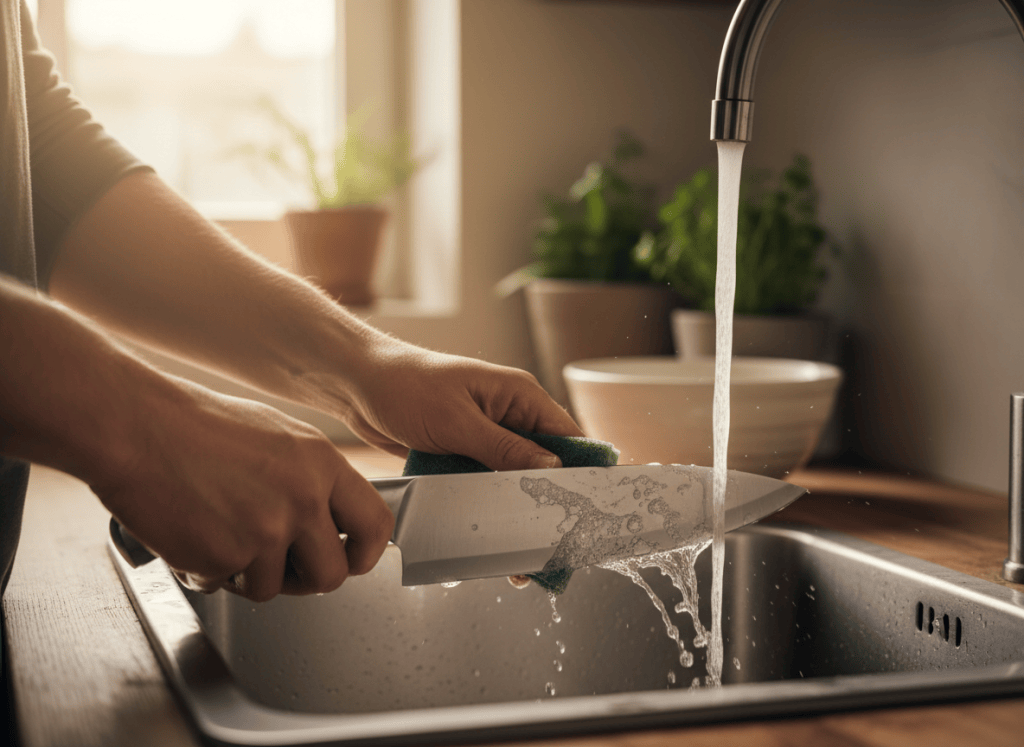
Hand-wash every knife immediately after use, with warm water and a bit of dish soap, and dry it right away with a towel. Never let it sit in a sink, soaking with other dishes — that’s how blades get nicked against pots and pans, and how handles (especially wood ones) start to swell and crack.
Skip the dishwasher entirely, even for knives marketed as “dishwasher safe.” The heat, the harsh detergent, and the knocking around against other items all degrade the edge and, over time, the handle too.
Storage: Blocks, Strips, and Sheaths
How you store a knife matters almost as much as how you clean it. A few good options:
- Knife blocks keep blades separated and protected, and they’re the easiest option if you already have countertop space for one.
- Magnetic strips mounted on a wall are my personal favorite for a working kitchen — knives stay visible, dry faster, and it’s easy to grab the right one without digging.
- Blade sheaths or edge guards are the right call if you’re storing knives in a drawer — they protect the edge from knocking against other tools, and protect your hand when reaching in.
Whatever you choose, the one rule that matters most: never let a blade’s edge touch another hard object unprotected. That’s where most everyday dulling actually comes from — not cutting food, but bumping around in storage.
Honing vs. Sharpening — and How Often to Do Each
These two get confused constantly, and they do very different jobs.
Honing realigns the edge — it doesn’t remove metal, just straightens the microscopic bends that build up with normal use. Do this every few uses, or before any serious prep session, with a honing rod.
Sharpening actually removes a thin layer of metal to create a new edge. This is what you need every few months for a home cook, more often for daily heavy use. If you want a full breakdown of the different systems available — whetstones, pull-through sharpeners, electric sharpeners — that’s covered in our guide to knife sharpening systems.
Pair the Right Cutting Board
Your cutting board matters just as much as anything above. Wood and quality plastic/composite boards are both fine — they have enough give to protect the edge. Glass, stone, marble, and bamboo (which is harder than it looks) will dull a good knife fast, sometimes within a single session.
If your current board is glass or stone, that’s genuinely the single fastest fix you can make — swapping it out will do more for your knife’s edge than almost anything else on this list.
A Simple Maintenance Checklist
- Every use: hand-wash and dry immediately, store properly (block, strip, or sheath).
- Every few uses: hone the edge before a prep session.
- Every 2–4 months: sharpen (more often with daily heavy use).
- Always: cut on wood or quality composite — never glass, stone, or marble.
Follow this and a good knife — like the ones in our chef’s knife guide — will easily outlast most of the other tools in your kitchen.
 The Seasoned Bench
Leave a comment